
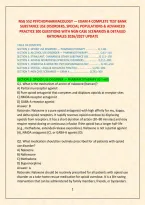
NSG 552 PSYCHOPHARMACOLOGY — EXAM 4 COMPLETE TEST BANK
SUBSTANCE USE DISORDERS, SPECIAL POPULATIONS & ADVANCED
PRACTICE 300 QUESTIONS WITH NGN CASE SCENARIOS & DETAILED
RATIONALES 2026/2027 UPDATE
TABLE OF CONTENTS
SECTION 1: OPIOID USE DISORDER — PHARMACOTHERAPY ................ Q 1–60
SECTION 2: ALCOHOL USE DISORDER — PHARMACOTHERAPY ................ Q 61–110
SECTION 3: STIMULANT, CANNABIS & OTHER SUBSTANCE USE ............. Q 111–150
SECTION 4: ADHD & NEURODEVELOPMENTAL DISORDERS ................... Q 151–200
SECTION 5: DEMENTIA & GERIATRIC PSYCHOPHARMACOLOGY ............... Q 201–250
SECTION 6: ETHICAL, LEGAL & ADVANCED PRACTICE .................... Q 251–280
SECTION 7: NGN CASE SCENARIOS — EXAM 4 ........................... Q 281–300
SECTION 1: OPIOID USE DISORDER — PHARMACOTHERAPY (Q 1–60)
Q1. What is the mechanism of action of naloxone (Narcan)?
A) Partial mu receptor agonist
B) Pure opioid antagonist that competes and displaces opioids at receptor sites
C) NMDA receptor antagonist
D) GABA-A receptor agonist
Answer: B
Rationale: Naloxone is a pure opioid antagonist with high affinity for mu, kappa,
and delta opioid receptors. It rapidly reverses opioid overdose by displacing
opioids from receptors. It has a short duration of action (30–90 minutes) and may
require repeat dosing or continuous infusion if the opioid has a longer half-life
(e.g., methadone, extended-release oxycodone). Naloxone is not a partial agonist
(A), NMDA antagonist (C), or GABA-A agonist (D).
Q2. What medication should be routinely prescribed for all patients with opioid
use disorder?
A) Naloxone
B) Naltrexone
C) Methadone
D) Buprenorphine
Answer: A
Rationale: Naloxone should be routinely prescribed for all patients with opioid use
disorder as a take-home rescue medication for opioid overdose. It is a life-saving
intervention that can be administered by family members, friends, or bystanders.
1
,Buprenorphine (D) and methadone (C) are first-line for OUD treatment;
naltrexone (B) is an alternative. Naloxone does not treat OUD itself but prevents
overdose death.
Q3. What medication for opioid use disorder is used with comorbid pain?
A) Naloxone
B) Buprenorphine
C) Naltrexone
D) Disulfiram
Answer: B
Rationale: Buprenorphine is a partial mu agonist that is effective for both opioid
use disorder and pain management. It is the preferred medication for OUD in
patients with comorbid pain because it provides analgesia and does not require
complete opioid abstinence before initiation. Methadone is also an option.
Naltrexone (C) blocks opioid effects and may worsen pain. Naloxone (A) is for
overdose reversal, not maintenance. Disulfiram (D) is for alcohol use disorder.
Q4. A patient on methadone for OUD reports QTc prolongation on ECG. The
PMHNP should:
A) Continue methadone at the same dose
B) Increase the methadone dose
C) Obtain a cardiology consult and consider dose reduction or alternative
medication
D) Add haloperidol for QT monitoring
Answer: C
Rationale: Methadone can cause QTc prolongation and torsades de pointes,
especially at higher doses (>100 mg/day). If QTc is >500 ms or increases by >60 ms
from baseline, the PMHNP should obtain a cardiology consult, consider dose
reduction, or switch to buprenorphine (which has less QT effect). Continuing (A)
or increasing (B) methadone would worsen QT prolongation. Adding haloperidol
(D) would further prolong QT.
Q5. Which medication for OUD is a full mu agonist?
A) Buprenorphine
B) Naltrexone
C) Methadone
D) Naloxone
2
,Answer: C
Rationale: Methadone is a full mu opioid agonist used for OUD treatment. It is
dispensed through federally regulated opioid treatment programs (OTPs). It
requires daily dosing and has a long half-life, allowing once-daily administration.
Buprenorphine (A) is a partial agonist; naltrexone (B) and naloxone (D) are
antagonists.
Q6. A patient on buprenorphine/naloxone reports that the medication "doesn't
work" for cravings. The PMHNP should:
A) Discontinue buprenorphine and start methadone
B) Increase the buprenorphine dose
C) Add naltrexone
D) Switch to naloxone nasal spray
Answer: B
Rationale: Buprenorphine has a ceiling effect, but many patients require higher
doses (16–24 mg/day) for optimal craving suppression. If cravings persist, the
dose should be increased before switching medications. Buprenorphine/naloxone
is first-line for OUD; methadone is an alternative. Naltrexone (C) is not added to
buprenorphine. Naloxone nasal spray (D) is for overdose reversal, not
maintenance.
Q7. What is the mechanism of action of buprenorphine?
A) Partial mu agonist and kappa antagonist
B) Full mu agonist
C) Pure mu antagonist
D) NMDA receptor antagonist
Answer: A
Rationale: Buprenorphine is a partial mu agonist and kappa antagonist. Its partial
agonist activity at the mu receptor produces analgesic and opioid effects but with
a ceiling effect on respiratory depression, making it safer than full agonists. Its
kappa antagonist activity may contribute to its antidepressant effects. It is not a
full agonist (B), pure antagonist (C), or NMDA antagonist (D).
Q8. What is the advantage of buprenorphine/naloxone combination over
buprenorphine alone?
A) It reduces the risk of abuse by injection
B) It is more effective
3
, C) It has a longer half-life
D) It is less expensive
Answer: A
Rationale: The buprenorphine/naloxone combination (Suboxone) reduces the risk
of abuse by injection because naloxone, when injected, precipitates withdrawal in
opioid-dependent individuals. When taken sublingually, naloxone is poorly
absorbed and does not interfere with buprenorphine's effects. The combination is
not more effective (B), does not have a longer half-life (C), and is not necessarily
less expensive (D).
Q9. What is the recommended induction protocol for buprenorphine/naloxone?
A) Patient must be in mild to moderate withdrawal before the first dose
B) Patient can be started while still using full agonists
C) Patient must be completely opioid-free for 7 days
D) Patient must be on methadone first
Answer: A
Rationale: Buprenorphine/naloxone induction requires the patient to be in mild
to moderate withdrawal (COWS score ≥8–12) to avoid precipitated withdrawal.
Because buprenorphine is a partial agonist with high affinity for mu receptors, it
can displace full agonists and precipitate withdrawal if given too early. The patient
should not be started while still using full agonists (B) or after 7 days of
abstinence (C). Methadone is not a prerequisite (D).
Q10. A patient on buprenorphine/naloxone experiences precipitated withdrawal
after taking the first dose. What should the PMHNP do?
A) Continue buprenorphine and provide supportive care
B) Discontinue buprenorphine and switch to methadone
C) Increase the buprenorphine dose
D) Add naloxone
Answer: A
Rationale: Precipitated withdrawal occurs when buprenorphine is given too soon
after a full agonist. The PMHNP should continue buprenorphine and provide
supportive care (clonidine, ondansetron, NSAIDs) until symptoms resolve.
Discontinuing (B) is not necessary. Increasing the dose (C) may worsen symptoms
initially. Adding naloxone (D) would worsen withdrawal.
4
SUBSTANCE USE DISORDERS, SPECIAL POPULATIONS & ADVANCED
PRACTICE 300 QUESTIONS WITH NGN CASE SCENARIOS & DETAILED
RATIONALES 2026/2027 UPDATE
TABLE OF CONTENTS
SECTION 1: OPIOID USE DISORDER — PHARMACOTHERAPY ................ Q 1–60
SECTION 2: ALCOHOL USE DISORDER — PHARMACOTHERAPY ................ Q 61–110
SECTION 3: STIMULANT, CANNABIS & OTHER SUBSTANCE USE ............. Q 111–150
SECTION 4: ADHD & NEURODEVELOPMENTAL DISORDERS ................... Q 151–200
SECTION 5: DEMENTIA & GERIATRIC PSYCHOPHARMACOLOGY ............... Q 201–250
SECTION 6: ETHICAL, LEGAL & ADVANCED PRACTICE .................... Q 251–280
SECTION 7: NGN CASE SCENARIOS — EXAM 4 ........................... Q 281–300
SECTION 1: OPIOID USE DISORDER — PHARMACOTHERAPY (Q 1–60)
Q1. What is the mechanism of action of naloxone (Narcan)?
A) Partial mu receptor agonist
B) Pure opioid antagonist that competes and displaces opioids at receptor sites
C) NMDA receptor antagonist
D) GABA-A receptor agonist
Answer: B
Rationale: Naloxone is a pure opioid antagonist with high affinity for mu, kappa,
and delta opioid receptors. It rapidly reverses opioid overdose by displacing
opioids from receptors. It has a short duration of action (30–90 minutes) and may
require repeat dosing or continuous infusion if the opioid has a longer half-life
(e.g., methadone, extended-release oxycodone). Naloxone is not a partial agonist
(A), NMDA antagonist (C), or GABA-A agonist (D).
Q2. What medication should be routinely prescribed for all patients with opioid
use disorder?
A) Naloxone
B) Naltrexone
C) Methadone
D) Buprenorphine
Answer: A
Rationale: Naloxone should be routinely prescribed for all patients with opioid use
disorder as a take-home rescue medication for opioid overdose. It is a life-saving
intervention that can be administered by family members, friends, or bystanders.
1
,Buprenorphine (D) and methadone (C) are first-line for OUD treatment;
naltrexone (B) is an alternative. Naloxone does not treat OUD itself but prevents
overdose death.
Q3. What medication for opioid use disorder is used with comorbid pain?
A) Naloxone
B) Buprenorphine
C) Naltrexone
D) Disulfiram
Answer: B
Rationale: Buprenorphine is a partial mu agonist that is effective for both opioid
use disorder and pain management. It is the preferred medication for OUD in
patients with comorbid pain because it provides analgesia and does not require
complete opioid abstinence before initiation. Methadone is also an option.
Naltrexone (C) blocks opioid effects and may worsen pain. Naloxone (A) is for
overdose reversal, not maintenance. Disulfiram (D) is for alcohol use disorder.
Q4. A patient on methadone for OUD reports QTc prolongation on ECG. The
PMHNP should:
A) Continue methadone at the same dose
B) Increase the methadone dose
C) Obtain a cardiology consult and consider dose reduction or alternative
medication
D) Add haloperidol for QT monitoring
Answer: C
Rationale: Methadone can cause QTc prolongation and torsades de pointes,
especially at higher doses (>100 mg/day). If QTc is >500 ms or increases by >60 ms
from baseline, the PMHNP should obtain a cardiology consult, consider dose
reduction, or switch to buprenorphine (which has less QT effect). Continuing (A)
or increasing (B) methadone would worsen QT prolongation. Adding haloperidol
(D) would further prolong QT.
Q5. Which medication for OUD is a full mu agonist?
A) Buprenorphine
B) Naltrexone
C) Methadone
D) Naloxone
2
,Answer: C
Rationale: Methadone is a full mu opioid agonist used for OUD treatment. It is
dispensed through federally regulated opioid treatment programs (OTPs). It
requires daily dosing and has a long half-life, allowing once-daily administration.
Buprenorphine (A) is a partial agonist; naltrexone (B) and naloxone (D) are
antagonists.
Q6. A patient on buprenorphine/naloxone reports that the medication "doesn't
work" for cravings. The PMHNP should:
A) Discontinue buprenorphine and start methadone
B) Increase the buprenorphine dose
C) Add naltrexone
D) Switch to naloxone nasal spray
Answer: B
Rationale: Buprenorphine has a ceiling effect, but many patients require higher
doses (16–24 mg/day) for optimal craving suppression. If cravings persist, the
dose should be increased before switching medications. Buprenorphine/naloxone
is first-line for OUD; methadone is an alternative. Naltrexone (C) is not added to
buprenorphine. Naloxone nasal spray (D) is for overdose reversal, not
maintenance.
Q7. What is the mechanism of action of buprenorphine?
A) Partial mu agonist and kappa antagonist
B) Full mu agonist
C) Pure mu antagonist
D) NMDA receptor antagonist
Answer: A
Rationale: Buprenorphine is a partial mu agonist and kappa antagonist. Its partial
agonist activity at the mu receptor produces analgesic and opioid effects but with
a ceiling effect on respiratory depression, making it safer than full agonists. Its
kappa antagonist activity may contribute to its antidepressant effects. It is not a
full agonist (B), pure antagonist (C), or NMDA antagonist (D).
Q8. What is the advantage of buprenorphine/naloxone combination over
buprenorphine alone?
A) It reduces the risk of abuse by injection
B) It is more effective
3
, C) It has a longer half-life
D) It is less expensive
Answer: A
Rationale: The buprenorphine/naloxone combination (Suboxone) reduces the risk
of abuse by injection because naloxone, when injected, precipitates withdrawal in
opioid-dependent individuals. When taken sublingually, naloxone is poorly
absorbed and does not interfere with buprenorphine's effects. The combination is
not more effective (B), does not have a longer half-life (C), and is not necessarily
less expensive (D).
Q9. What is the recommended induction protocol for buprenorphine/naloxone?
A) Patient must be in mild to moderate withdrawal before the first dose
B) Patient can be started while still using full agonists
C) Patient must be completely opioid-free for 7 days
D) Patient must be on methadone first
Answer: A
Rationale: Buprenorphine/naloxone induction requires the patient to be in mild
to moderate withdrawal (COWS score ≥8–12) to avoid precipitated withdrawal.
Because buprenorphine is a partial agonist with high affinity for mu receptors, it
can displace full agonists and precipitate withdrawal if given too early. The patient
should not be started while still using full agonists (B) or after 7 days of
abstinence (C). Methadone is not a prerequisite (D).
Q10. A patient on buprenorphine/naloxone experiences precipitated withdrawal
after taking the first dose. What should the PMHNP do?
A) Continue buprenorphine and provide supportive care
B) Discontinue buprenorphine and switch to methadone
C) Increase the buprenorphine dose
D) Add naloxone
Answer: A
Rationale: Precipitated withdrawal occurs when buprenorphine is given too soon
after a full agonist. The PMHNP should continue buprenorphine and provide
supportive care (clonidine, ondansetron, NSAIDs) until symptoms resolve.
Discontinuing (B) is not necessary. Increasing the dose (C) may worsen symptoms
initially. Adding naloxone (D) would worsen withdrawal.
4


