
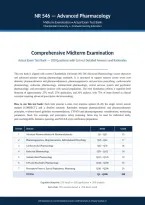
NR 546 — Advanced Pharmacology
Midterm Examination • Actual Exam Test Bank
Chamberlain University • Graduate Nursing Education
Comprehensive Midterm Examination
Actual Exam Test Bank — 200 Questions with Correct Detailed Answers and Rationales
This test bank is aligned with current Chamberlain University NR 546 Advanced Pharmacology course objectives
and advanced practice nursing pharmacology standards. It is structured to support mastery across seven core
domains: pharmacokinetics and pharmacodynamics, pharmacogenomics and precision prescribing, cardiovascular
pharmacology, endocrine pharmacology, antimicrobial pharmacology, central nervous system and psychiatric
pharmacology, and prescriptive practice with special populations. The item distribution reflects a cognitive-level
blueprint of approximately 25% recall, 55% application, and 20% analysis, with 75% of items framed as clinical
scenarios requiring advanced prescriptive decision-making.
How to use this test bank: Each item presents a stem, four response options (A–D), the single correct answer
marked [CORRECT], and a detailed rationale. Rationales integrate pharmacokinetic and pharmacodynamic
principles, evidence-based guideline recommendations, CYP450 and pharmacogenomic considerations, monitoring
parameters, black box warnings, and prescriptive safety reasoning. Items may be used for individual study,
peer-teaching drills, formative quizzing, and NCLEX-style certification preparation.
Section Domain Items Count
1 Advanced Pharmacokinetics & Pharmacodynamics Q1 – Q25 25
2 Pharmacogenomics, Drug Interactions, Individualized Prescribing Q26 – Q42 17
3 Cardiovascular Pharmacology Q43 – Q78 36
4 Endocrine Pharmacology Q79 – Q112 34
5 Antimicrobial Pharmacology Q113 – Q145 33
6 CNS and Psychiatric Pharmacology Q146 – Q180 35
7 Prescriptive Practice, Special Populations, Monitoring Q181 – Q200 20
TOTAL Q1 – Q200 200
Cognitive blueprint: 25% recall • 55% application • 20% analysis
Item style: 75% scenario-based • 25% direct recall
200 Questions • Correct Detailed Answers with Rationales • Already Graded A+
,NR 546 — Advanced Pharmacology
Format: Multiple choice, four options (A–D), one best answer
Midterm Examination • Actual Exam Test Bank
Chamberlain University • Graduate Nursing Education
200 Questions • Correct Detailed Answers with Rationales • Already Graded A+
,NR 546 — Advanced Pharmacology | Midterm Exam Test Bank Chamberlain University • Graduate Nursing
Section 1: Advanced Pharmacokinetics and Pharmacodynamics
Absorption, Distribution, Metabolism, Excretion, Receptors, and Dose-Response — Questions 1 through 25
Q1: A 67-year-old woman is started on oral propranolol 20 mg twice daily for atrial fibrillation with rapid
ventricular response. Despite adequate dosing, her heart rate control is poor compared with IV
administration she previously received in the hospital. Which pharmacokinetic property most accurately
explains this clinical observation?
A. Propranolol undergoes extensive first-pass hepatic metabolism, reducing oral bioavailability to roughly
25–35%. [CORRECT]
B. Propranolol is a high-extraction-ratio drug that is exclusively renally cleared unchanged.
C. Propranolol is highly protein-bound and competes with endogenous albumin for tissue receptors.
D. Propranolol is a P-glycoprotein substrate that is actively secreted back into the gut lumen.
Correct Answer: A
Rationale: Propranolol is a non-selective beta-blocker with high hepatic extraction and extensive first-pass metabolism,
lowering its oral bioavailability to approximately 25–35% and producing a marked discrepancy between oral and
intravenous effective doses. The other options mischaracterize its clearance (propranolol is hepatically metabolized, not
renally excreted unchanged), conflate protein binding with bioavailability, and overstate P-glycoprotein involvement.
Recognizing first-pass effects is essential when converting between IV and oral beta-blocker regimens.
Q2: A patient with partial seizures is switched from phenytoin capsules to phenytoin suspension at the same
milligram dose. Two weeks later the patient presents with nystagmus and ataxia, and a total phenytoin level is
32 mcg/mL (therapeutic 10–20). Which pharmacokinetic explanation is most likely responsible for the
toxicity?
A. The suspension has higher bioavailability than the capsules, increasing effective dose. [CORRECT]
B. Phenytoin follows linear kinetics, so dose form changes do not affect serum concentrations.
C. The suspension contains ethanol, which induces CYP2C9 and lowers phenytoin levels.
D. Phenytoin is a CYP3A4 inducer, accelerating its own clearance with chronic dosing.
Correct Answer: A
Rationale: Phenytoin suspension and capsules have different bioavailabilities; the suspension is typically more
completely absorbed, so an equivalent milligram dose produces higher serum concentrations. Phenytoin also follows
Michaelis-Menten (saturable) kinetics, so small increases in absorption can cause disproportionate rises in level. The other
options incorrectly assert linear kinetics, misattribute the suspension's ethanol content as a CYP inducer, and confuse
phenytoin's CYP2C9/2C19 metabolism with CYP3A4 induction.
Q3: A clinical pharmacist is consulted because a patient's free phenytoin level is elevated despite a total level
within the therapeutic range. The patient's albumin is 2.1 g/dL. Which prescribing principle is most
appropriate when interpreting this patient's phenytoin levels?
A. Use the Sheiner-Tozer equation to correct the total level for hypoalbuminemia. [CORRECT]
B. Increase the phenytoin dose because free drug is the inactive fraction.
C. Switch to phenobarbital because phenytoin is contraindicated in hypoalbuminemia.
D. Discontinue phenytoin because elevated free fraction always indicates toxicity.
Correct Answer: A
Rationale: In hypoalbuminemia, the fraction of unbound (free) phenytoin rises, so total levels underestimate the
pharmacologically active concentration; the Sheiner-Tozer equation corrects the total level to a value comparable to the
standard 10–20 mcg/mL range. The free fraction is the active (not inactive) moiety, phenytoin is not contraindicated in
hypoalbuminemia but requires dose adjustment, and elevated free fraction warrants dose reduction rather than automatic
discontinuation. This principle also applies to other highly protein-bound drugs such as valproate and warfarin.
200 Questions • Correct Detailed Answers with Rationales • Graded A+ Page 3
, NR 546 — Advanced Pharmacology | Midterm Exam Test Bank Chamberlain University • Graduate Nursing
Q4: An advanced practice nurse is comparing two angiotensin receptor blockers. Losartan has a half-life of
approximately 2 hours, while telmisartan has a half-life of roughly 24 hours. Which clinical implication is
most accurate when choosing between these agents?
A. Telmisartan provides more sustained AT1 receptor blockade and is suitable for once-daily dosing.
[CORRECT]
B. Losartan should be dosed three times daily to maintain receptor blockade.
C. Half-life differences are irrelevant because both agents are prodrugs.
D. Losartan has a longer duration of action due to active hepatic metabolites.
Correct Answer: A
Rationale: Telmisartan's longer half-life (≈24 hours) translates into more sustained AT1 receptor blockade and consistent
24-hour blood pressure control with once-daily dosing. Losartan is dosed once or twice daily, not three times daily;
neither losartan nor telmisartan is a prodrug (unlike losartan's active metabolite E-3174, which is formed after dosing but
does not change the prodrug designation). Although losartan has an active metabolite, its overall duration is shorter than
telmisartan's.
Q5: A patient receives a 400 mg loading dose of IV amiodarone for ventricular tachycardia. The drug has a
volume of distribution of approximately 60 L/kg and a half-life of up to 60 days. Which pharmacokinetic
feature most directly explains the need for a loading dose?
A. Massive volume of distribution producing a very large apparent distribution space. [CORRECT]
B. Renal clearance so low that steady state would be reached within hours anyway.
C. High first-pass metabolism preventing effective oral dosing.
D. Linear pharmacokinetics allowing predictable dose proportionality.
Correct Answer: A
Rationale: Amiodarone has a very large volume of distribution (≈60 L/kg) and extremely long half-life (up to 60 days)
because it accumulates extensively in adipose tissue; without a loading dose, steady state would take months to achieve.
Renal clearance is not the issue (amiodarone is hepatically metabolized), oral bioavailability is reasonable (≈50%), and
amiodarone does not follow linear kinetics. The loading strategy is a direct consequence of distributional
pharmacokinetics.
Q6: A 54-year-old patient with type 2 diabetes has an estimated glomerular filtration rate (eGFR) of 22
mL/min/1.73 m². The provider plans to prescribe a medication for glycemic control. Which pharmacokinetic
principle most directly governs the need for dose adjustment in this patient?
A. Renal clearance of drugs or active metabolites falls as GFR declines, prolonging half-life. [CORRECT]
B. Hepatic metabolism accelerates to compensate for declining renal function.
C. Volume of distribution always increases in chronic kidney disease, requiring higher doses.
D. Oral bioavailability rises predictably with declining GFR, mandating dose reduction.
Correct Answer: A
Rationale: Renal impairment reduces the clearance of renally eliminated drugs and active metabolites, prolonging
half-life and increasing accumulation risk; this is the central principle guiding dose adjustment (e.g., metformin,
gabapentin, dabigatran, many glypeptide antibiotics). Hepatic metabolism does not predictably compensate, volume of
distribution does not universally increase (it varies with fluid status and protein binding), and oral bioavailability is not a
direct function of GFR.
200 Questions • Correct Detailed Answers with Rationales • Graded A+ Page 4
Midterm Examination • Actual Exam Test Bank
Chamberlain University • Graduate Nursing Education
Comprehensive Midterm Examination
Actual Exam Test Bank — 200 Questions with Correct Detailed Answers and Rationales
This test bank is aligned with current Chamberlain University NR 546 Advanced Pharmacology course objectives
and advanced practice nursing pharmacology standards. It is structured to support mastery across seven core
domains: pharmacokinetics and pharmacodynamics, pharmacogenomics and precision prescribing, cardiovascular
pharmacology, endocrine pharmacology, antimicrobial pharmacology, central nervous system and psychiatric
pharmacology, and prescriptive practice with special populations. The item distribution reflects a cognitive-level
blueprint of approximately 25% recall, 55% application, and 20% analysis, with 75% of items framed as clinical
scenarios requiring advanced prescriptive decision-making.
How to use this test bank: Each item presents a stem, four response options (A–D), the single correct answer
marked [CORRECT], and a detailed rationale. Rationales integrate pharmacokinetic and pharmacodynamic
principles, evidence-based guideline recommendations, CYP450 and pharmacogenomic considerations, monitoring
parameters, black box warnings, and prescriptive safety reasoning. Items may be used for individual study,
peer-teaching drills, formative quizzing, and NCLEX-style certification preparation.
Section Domain Items Count
1 Advanced Pharmacokinetics & Pharmacodynamics Q1 – Q25 25
2 Pharmacogenomics, Drug Interactions, Individualized Prescribing Q26 – Q42 17
3 Cardiovascular Pharmacology Q43 – Q78 36
4 Endocrine Pharmacology Q79 – Q112 34
5 Antimicrobial Pharmacology Q113 – Q145 33
6 CNS and Psychiatric Pharmacology Q146 – Q180 35
7 Prescriptive Practice, Special Populations, Monitoring Q181 – Q200 20
TOTAL Q1 – Q200 200
Cognitive blueprint: 25% recall • 55% application • 20% analysis
Item style: 75% scenario-based • 25% direct recall
200 Questions • Correct Detailed Answers with Rationales • Already Graded A+
,NR 546 — Advanced Pharmacology
Format: Multiple choice, four options (A–D), one best answer
Midterm Examination • Actual Exam Test Bank
Chamberlain University • Graduate Nursing Education
200 Questions • Correct Detailed Answers with Rationales • Already Graded A+
,NR 546 — Advanced Pharmacology | Midterm Exam Test Bank Chamberlain University • Graduate Nursing
Section 1: Advanced Pharmacokinetics and Pharmacodynamics
Absorption, Distribution, Metabolism, Excretion, Receptors, and Dose-Response — Questions 1 through 25
Q1: A 67-year-old woman is started on oral propranolol 20 mg twice daily for atrial fibrillation with rapid
ventricular response. Despite adequate dosing, her heart rate control is poor compared with IV
administration she previously received in the hospital. Which pharmacokinetic property most accurately
explains this clinical observation?
A. Propranolol undergoes extensive first-pass hepatic metabolism, reducing oral bioavailability to roughly
25–35%. [CORRECT]
B. Propranolol is a high-extraction-ratio drug that is exclusively renally cleared unchanged.
C. Propranolol is highly protein-bound and competes with endogenous albumin for tissue receptors.
D. Propranolol is a P-glycoprotein substrate that is actively secreted back into the gut lumen.
Correct Answer: A
Rationale: Propranolol is a non-selective beta-blocker with high hepatic extraction and extensive first-pass metabolism,
lowering its oral bioavailability to approximately 25–35% and producing a marked discrepancy between oral and
intravenous effective doses. The other options mischaracterize its clearance (propranolol is hepatically metabolized, not
renally excreted unchanged), conflate protein binding with bioavailability, and overstate P-glycoprotein involvement.
Recognizing first-pass effects is essential when converting between IV and oral beta-blocker regimens.
Q2: A patient with partial seizures is switched from phenytoin capsules to phenytoin suspension at the same
milligram dose. Two weeks later the patient presents with nystagmus and ataxia, and a total phenytoin level is
32 mcg/mL (therapeutic 10–20). Which pharmacokinetic explanation is most likely responsible for the
toxicity?
A. The suspension has higher bioavailability than the capsules, increasing effective dose. [CORRECT]
B. Phenytoin follows linear kinetics, so dose form changes do not affect serum concentrations.
C. The suspension contains ethanol, which induces CYP2C9 and lowers phenytoin levels.
D. Phenytoin is a CYP3A4 inducer, accelerating its own clearance with chronic dosing.
Correct Answer: A
Rationale: Phenytoin suspension and capsules have different bioavailabilities; the suspension is typically more
completely absorbed, so an equivalent milligram dose produces higher serum concentrations. Phenytoin also follows
Michaelis-Menten (saturable) kinetics, so small increases in absorption can cause disproportionate rises in level. The other
options incorrectly assert linear kinetics, misattribute the suspension's ethanol content as a CYP inducer, and confuse
phenytoin's CYP2C9/2C19 metabolism with CYP3A4 induction.
Q3: A clinical pharmacist is consulted because a patient's free phenytoin level is elevated despite a total level
within the therapeutic range. The patient's albumin is 2.1 g/dL. Which prescribing principle is most
appropriate when interpreting this patient's phenytoin levels?
A. Use the Sheiner-Tozer equation to correct the total level for hypoalbuminemia. [CORRECT]
B. Increase the phenytoin dose because free drug is the inactive fraction.
C. Switch to phenobarbital because phenytoin is contraindicated in hypoalbuminemia.
D. Discontinue phenytoin because elevated free fraction always indicates toxicity.
Correct Answer: A
Rationale: In hypoalbuminemia, the fraction of unbound (free) phenytoin rises, so total levels underestimate the
pharmacologically active concentration; the Sheiner-Tozer equation corrects the total level to a value comparable to the
standard 10–20 mcg/mL range. The free fraction is the active (not inactive) moiety, phenytoin is not contraindicated in
hypoalbuminemia but requires dose adjustment, and elevated free fraction warrants dose reduction rather than automatic
discontinuation. This principle also applies to other highly protein-bound drugs such as valproate and warfarin.
200 Questions • Correct Detailed Answers with Rationales • Graded A+ Page 3
, NR 546 — Advanced Pharmacology | Midterm Exam Test Bank Chamberlain University • Graduate Nursing
Q4: An advanced practice nurse is comparing two angiotensin receptor blockers. Losartan has a half-life of
approximately 2 hours, while telmisartan has a half-life of roughly 24 hours. Which clinical implication is
most accurate when choosing between these agents?
A. Telmisartan provides more sustained AT1 receptor blockade and is suitable for once-daily dosing.
[CORRECT]
B. Losartan should be dosed three times daily to maintain receptor blockade.
C. Half-life differences are irrelevant because both agents are prodrugs.
D. Losartan has a longer duration of action due to active hepatic metabolites.
Correct Answer: A
Rationale: Telmisartan's longer half-life (≈24 hours) translates into more sustained AT1 receptor blockade and consistent
24-hour blood pressure control with once-daily dosing. Losartan is dosed once or twice daily, not three times daily;
neither losartan nor telmisartan is a prodrug (unlike losartan's active metabolite E-3174, which is formed after dosing but
does not change the prodrug designation). Although losartan has an active metabolite, its overall duration is shorter than
telmisartan's.
Q5: A patient receives a 400 mg loading dose of IV amiodarone for ventricular tachycardia. The drug has a
volume of distribution of approximately 60 L/kg and a half-life of up to 60 days. Which pharmacokinetic
feature most directly explains the need for a loading dose?
A. Massive volume of distribution producing a very large apparent distribution space. [CORRECT]
B. Renal clearance so low that steady state would be reached within hours anyway.
C. High first-pass metabolism preventing effective oral dosing.
D. Linear pharmacokinetics allowing predictable dose proportionality.
Correct Answer: A
Rationale: Amiodarone has a very large volume of distribution (≈60 L/kg) and extremely long half-life (up to 60 days)
because it accumulates extensively in adipose tissue; without a loading dose, steady state would take months to achieve.
Renal clearance is not the issue (amiodarone is hepatically metabolized), oral bioavailability is reasonable (≈50%), and
amiodarone does not follow linear kinetics. The loading strategy is a direct consequence of distributional
pharmacokinetics.
Q6: A 54-year-old patient with type 2 diabetes has an estimated glomerular filtration rate (eGFR) of 22
mL/min/1.73 m². The provider plans to prescribe a medication for glycemic control. Which pharmacokinetic
principle most directly governs the need for dose adjustment in this patient?
A. Renal clearance of drugs or active metabolites falls as GFR declines, prolonging half-life. [CORRECT]
B. Hepatic metabolism accelerates to compensate for declining renal function.
C. Volume of distribution always increases in chronic kidney disease, requiring higher doses.
D. Oral bioavailability rises predictably with declining GFR, mandating dose reduction.
Correct Answer: A
Rationale: Renal impairment reduces the clearance of renally eliminated drugs and active metabolites, prolonging
half-life and increasing accumulation risk; this is the central principle guiding dose adjustment (e.g., metformin,
gabapentin, dabigatran, many glypeptide antibiotics). Hepatic metabolism does not predictably compensate, volume of
distribution does not universally increase (it varies with fluid status and protein binding), and oral bioavailability is not a
direct function of GFR.
200 Questions • Correct Detailed Answers with Rationales • Graded A+ Page 4


