
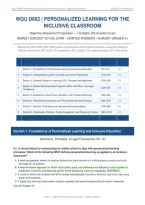
WGU D662 | Personalized Learning for the Inclusive Classroom | Objective Assessment 2026/2027 Verified Edition
WGU D662 | PERSONALIZED LEARNING FOR THE
INCLUSIVE CLASSROOM
Objective Assessment Preparation — Complete 100-Question Exam
NEWEST 2026/2027 ACTUAL EXAM • VERIFIED ANSWERS • ALREADY GRADED A+
Aligned with 2026–2027 WGU D662 course competencies and the official objective assessment blueprint.
Cognitive distribution: 30% recall, 50% application, 20% analysis. 75% scenario-based, 25% direct recall.
Question
# Section Items
Range
1 Section 1: Foundations of Personalized Learning and Inclusive Education Q1–Q12 12
2 Section 2: Understanding Learner Variability and Diverse Populations Q13–Q25 13
3 Section 3: Universal Design for Learning (UDL) Principles and Application Q26–Q38 13
Section 4: Individualized Education Programs (IEPs), 504 Plans, and Legal
4 Q39–Q52 14
Compliance
5 Section 5: Assessment, Data-Driven Instruction, and Progress Monitoring Q53–Q65 13
6 Section 6: Differentiated Instruction and Personalized Learning Pathways Q66–Q78 13
7 Section 7: Assistive Technology and Instructional Accommodations Q79–Q88 10
8 Section 8: Collaborative Practices, Family Engagement, and Classroom Culture Q89–Q100 12
TOTAL Q1–Q100 100
Section 1: Foundations of Personalized Learning and Inclusive Education
Definitions, Principles, & Legal Frameworks (Q1-12)
Q1: A school district is restructuring its middle school to align with personalized learning
principles. Which of the following BEST defines personalized learning as applied to an inclusive
classroom?
A. A teaching approach where the teacher delivers the same content at a uniform pace to ensure curricular
coverage for all students.
B. A learner-driven approach in which instruction, pace, and pathways are tailored to each student’s
readiness, interests, and learning profile while advancing common standards. [CORRECT]
C. A model in which only students with IEPs receive individualized instruction, while the rest of the class uses
grade-level materials.
D. A digital-only learning model where students complete self-paced modules without teacher interaction.
Correct Answer: B
Page 1 | D662 Personalized Learning Exam | Already Graded A+
,WGU D662 | Personalized Learning for the Inclusive Classroom | Objective Assessment 2026/2027 Verified Edition
Rationale: Personalized learning is a learner-centered framework that adapts pace, content, process, and product to
readiness, interests, and learning profile while maintaining common rigorous standards. Option A describes traditional
one-size-fits-all instruction. Option C incorrectly restricts personalization to students with IEPs (inclusion benefits ALL
learners). Option D confuses personalized learning with pure technology delivery, omitting teacher facilitation and
inclusive pedagogy.
Q2: A ninth-grade student with a specific learning disability in written expression wants to
demonstrate her understanding of the Civil War through a podcast instead of a traditional essay.
The teacher agrees, aligning the task to the same rubric standards. Which personalized learning
principle is MOST directly demonstrated?
A. Flexible pacing
B. Competency-based progression
C. Student agency [CORRECT]
D. Universal screening
Correct Answer: C
Rationale: Student agency is the principle that learners actively co-design their learning pathways, including how they
demonstrate mastery. The student exercised voice and choice in selecting her product. Competency-based
progression refers to advancement upon mastery rather than time, and flexible pacing concerns the speed of
instruction. Universal screening is an assessment practice, not a personalized learning principle.
Q3: A middle school implements competency-based progression in mathematics. Which scenario
best illustrates this approach?
A. All seventh-graders complete Chapter 5 by Friday regardless of mastery, then move to Chapter 6.
B. A student advances to the next math standard only after demonstrating proficiency on the current
standard, even if that takes longer than peers. [CORRECT]
C. Students receive a passing grade for completing all homework packets regardless of accuracy.
D. The teacher lowers the proficiency threshold so all students pass the unit test.
Correct Answer: B
Rationale: Competency-based progression means students advance upon demonstrated mastery of clearly defined
competencies, not by seat-time. Option B captures this. Option A reflects traditional time-based pacing. Option C
rewards completion rather than learning. Option D reduces rigor, which violates the integrity of competency-based
frameworks and FAPE expectations.
Q4: A teacher notices a student with ADHD struggles to maintain focus during a 45-minute lecture.
Which strategy best reflects flexible pacing within an inclusive classroom?
A. Requiring the student to sit through the lecture because all students must complete the same content at the
same time.
B. Allowing the student to break the lecture into shorter segments with movement breaks and
self-check stations. [CORRECT]
C. Sending the student to the resource room during the lecture.
D. Exempting the student from the lesson entirely and assigning independent reading.
Correct Answer: B
Rationale: Flexible pacing permits students to engage content in manageable chunks with breaks, supporting attention
variability without removing the student from inclusive instruction. Option A contradicts personalization. Option C
removes the student from LRE. Option D denies access to grade-level instruction, violating FAPE and inclusion
principles.
Q5: A fourth-grade student with autism spectrum disorder sits alone at lunch every day and is rarely
chosen for group activities. The teacher deliberately structures mixed-ability lunch groups and pairs
Page 2 | D662 Personalized Learning Exam | Already Graded A+
, WGU D662 | Personalized Learning for the Inclusive Classroom | Objective Assessment 2026/2027 Verified Edition
the student with consistent peer partners. Which principle of inclusive education is BEST
illustrated?
A. Belonging and meaningful participation [CORRECT]
B. Standardized accountability
C. Zero reject
D. Procedural safeguards
Correct Answer: A
Rationale: Belonging refers to the active, intentional creation of a community in which every learner is valued and
participates socially and academically. The teacher’s deliberate structuring of mixed-ability groups fosters belonging.
Zero reject and procedural safeguards are legal principles under IDEA, not classroom belonging strategies.
Standardized accountability is unrelated.
Q6: A teacher provides every student the same laptop, identical worksheet, and identical amount of
time to complete a task. When asked why a struggling reader still failed, the teacher replied, “I was
fair—I gave everyone the same thing.” Which concept is the teacher confusing?
A. Equality with equity [CORRECT]
B. Accommodation with modification
C. Formative with summative assessment
D. UDL with differentiated instruction
Correct Answer: A
Rationale: Equality means giving everyone the same thing; equity means giving each learner what they need to
access and demonstrate learning. The teacher confused equality with equity. Equity is foundational to inclusive
education. The other options reference distinct concepts (assessment, AT, instructional design) and do not match the
scenario.
Q7: Under the Individuals with Disabilities Education Act (IDEA), the “zero reject” principle
guarantees which of the following?
A. No school can refuse to evaluate or serve a child with a disability, regardless of severity. [CORRECT]
B. No student can be removed from general education for any reason.
C. No school can use restraint or seclusion on any student.
D. No parent can be excluded from IEP meetings.
Correct Answer: A
Rationale: Zero reject means no child with a disability, however severe, may be denied a free appropriate public
education (FAPE). Schools must identify, evaluate, and serve all eligible children. Option B confuses zero reject with
LRE (students may be moved along the continuum when needed). Options C and D are separate legal requirements
and procedural safeguards, not the zero reject principle.
Q8: A school district reframes its mission statement to read: “Disability arises when the
environment fails to accommodate learner variability, not from deficits within the student.” Which
model of disability does this statement reflect?
A. Medical model
B. Charity model
C. Social model [CORRECT]
D. Moral model
Correct Answer: C
Rationale: The social model of disability locates disability in environmental barriers (curricular, physical, attitudinal)
rather than in the individual. This aligns with UDL and inclusive education. The medical model views disability as a
deficit to be fixed. The charity and moral models are outdated framings that the social model explicitly rejects.
Page 3 | D662 Personalized Learning Exam | Already Graded A+
WGU D662 | PERSONALIZED LEARNING FOR THE
INCLUSIVE CLASSROOM
Objective Assessment Preparation — Complete 100-Question Exam
NEWEST 2026/2027 ACTUAL EXAM • VERIFIED ANSWERS • ALREADY GRADED A+
Aligned with 2026–2027 WGU D662 course competencies and the official objective assessment blueprint.
Cognitive distribution: 30% recall, 50% application, 20% analysis. 75% scenario-based, 25% direct recall.
Question
# Section Items
Range
1 Section 1: Foundations of Personalized Learning and Inclusive Education Q1–Q12 12
2 Section 2: Understanding Learner Variability and Diverse Populations Q13–Q25 13
3 Section 3: Universal Design for Learning (UDL) Principles and Application Q26–Q38 13
Section 4: Individualized Education Programs (IEPs), 504 Plans, and Legal
4 Q39–Q52 14
Compliance
5 Section 5: Assessment, Data-Driven Instruction, and Progress Monitoring Q53–Q65 13
6 Section 6: Differentiated Instruction and Personalized Learning Pathways Q66–Q78 13
7 Section 7: Assistive Technology and Instructional Accommodations Q79–Q88 10
8 Section 8: Collaborative Practices, Family Engagement, and Classroom Culture Q89–Q100 12
TOTAL Q1–Q100 100
Section 1: Foundations of Personalized Learning and Inclusive Education
Definitions, Principles, & Legal Frameworks (Q1-12)
Q1: A school district is restructuring its middle school to align with personalized learning
principles. Which of the following BEST defines personalized learning as applied to an inclusive
classroom?
A. A teaching approach where the teacher delivers the same content at a uniform pace to ensure curricular
coverage for all students.
B. A learner-driven approach in which instruction, pace, and pathways are tailored to each student’s
readiness, interests, and learning profile while advancing common standards. [CORRECT]
C. A model in which only students with IEPs receive individualized instruction, while the rest of the class uses
grade-level materials.
D. A digital-only learning model where students complete self-paced modules without teacher interaction.
Correct Answer: B
Page 1 | D662 Personalized Learning Exam | Already Graded A+
,WGU D662 | Personalized Learning for the Inclusive Classroom | Objective Assessment 2026/2027 Verified Edition
Rationale: Personalized learning is a learner-centered framework that adapts pace, content, process, and product to
readiness, interests, and learning profile while maintaining common rigorous standards. Option A describes traditional
one-size-fits-all instruction. Option C incorrectly restricts personalization to students with IEPs (inclusion benefits ALL
learners). Option D confuses personalized learning with pure technology delivery, omitting teacher facilitation and
inclusive pedagogy.
Q2: A ninth-grade student with a specific learning disability in written expression wants to
demonstrate her understanding of the Civil War through a podcast instead of a traditional essay.
The teacher agrees, aligning the task to the same rubric standards. Which personalized learning
principle is MOST directly demonstrated?
A. Flexible pacing
B. Competency-based progression
C. Student agency [CORRECT]
D. Universal screening
Correct Answer: C
Rationale: Student agency is the principle that learners actively co-design their learning pathways, including how they
demonstrate mastery. The student exercised voice and choice in selecting her product. Competency-based
progression refers to advancement upon mastery rather than time, and flexible pacing concerns the speed of
instruction. Universal screening is an assessment practice, not a personalized learning principle.
Q3: A middle school implements competency-based progression in mathematics. Which scenario
best illustrates this approach?
A. All seventh-graders complete Chapter 5 by Friday regardless of mastery, then move to Chapter 6.
B. A student advances to the next math standard only after demonstrating proficiency on the current
standard, even if that takes longer than peers. [CORRECT]
C. Students receive a passing grade for completing all homework packets regardless of accuracy.
D. The teacher lowers the proficiency threshold so all students pass the unit test.
Correct Answer: B
Rationale: Competency-based progression means students advance upon demonstrated mastery of clearly defined
competencies, not by seat-time. Option B captures this. Option A reflects traditional time-based pacing. Option C
rewards completion rather than learning. Option D reduces rigor, which violates the integrity of competency-based
frameworks and FAPE expectations.
Q4: A teacher notices a student with ADHD struggles to maintain focus during a 45-minute lecture.
Which strategy best reflects flexible pacing within an inclusive classroom?
A. Requiring the student to sit through the lecture because all students must complete the same content at the
same time.
B. Allowing the student to break the lecture into shorter segments with movement breaks and
self-check stations. [CORRECT]
C. Sending the student to the resource room during the lecture.
D. Exempting the student from the lesson entirely and assigning independent reading.
Correct Answer: B
Rationale: Flexible pacing permits students to engage content in manageable chunks with breaks, supporting attention
variability without removing the student from inclusive instruction. Option A contradicts personalization. Option C
removes the student from LRE. Option D denies access to grade-level instruction, violating FAPE and inclusion
principles.
Q5: A fourth-grade student with autism spectrum disorder sits alone at lunch every day and is rarely
chosen for group activities. The teacher deliberately structures mixed-ability lunch groups and pairs
Page 2 | D662 Personalized Learning Exam | Already Graded A+
, WGU D662 | Personalized Learning for the Inclusive Classroom | Objective Assessment 2026/2027 Verified Edition
the student with consistent peer partners. Which principle of inclusive education is BEST
illustrated?
A. Belonging and meaningful participation [CORRECT]
B. Standardized accountability
C. Zero reject
D. Procedural safeguards
Correct Answer: A
Rationale: Belonging refers to the active, intentional creation of a community in which every learner is valued and
participates socially and academically. The teacher’s deliberate structuring of mixed-ability groups fosters belonging.
Zero reject and procedural safeguards are legal principles under IDEA, not classroom belonging strategies.
Standardized accountability is unrelated.
Q6: A teacher provides every student the same laptop, identical worksheet, and identical amount of
time to complete a task. When asked why a struggling reader still failed, the teacher replied, “I was
fair—I gave everyone the same thing.” Which concept is the teacher confusing?
A. Equality with equity [CORRECT]
B. Accommodation with modification
C. Formative with summative assessment
D. UDL with differentiated instruction
Correct Answer: A
Rationale: Equality means giving everyone the same thing; equity means giving each learner what they need to
access and demonstrate learning. The teacher confused equality with equity. Equity is foundational to inclusive
education. The other options reference distinct concepts (assessment, AT, instructional design) and do not match the
scenario.
Q7: Under the Individuals with Disabilities Education Act (IDEA), the “zero reject” principle
guarantees which of the following?
A. No school can refuse to evaluate or serve a child with a disability, regardless of severity. [CORRECT]
B. No student can be removed from general education for any reason.
C. No school can use restraint or seclusion on any student.
D. No parent can be excluded from IEP meetings.
Correct Answer: A
Rationale: Zero reject means no child with a disability, however severe, may be denied a free appropriate public
education (FAPE). Schools must identify, evaluate, and serve all eligible children. Option B confuses zero reject with
LRE (students may be moved along the continuum when needed). Options C and D are separate legal requirements
and procedural safeguards, not the zero reject principle.
Q8: A school district reframes its mission statement to read: “Disability arises when the
environment fails to accommodate learner variability, not from deficits within the student.” Which
model of disability does this statement reflect?
A. Medical model
B. Charity model
C. Social model [CORRECT]
D. Moral model
Correct Answer: C
Rationale: The social model of disability locates disability in environmental barriers (curricular, physical, attitudinal)
rather than in the individual. This aligns with UDL and inclusive education. The medical model views disability as a
deficit to be fixed. The charity and moral models are outdated framings that the social model explicitly rejects.
Page 3 | D662 Personalized Learning Exam | Already Graded A+


