
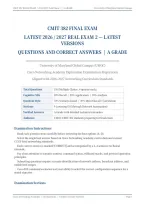
CMIT 382 FINAL EXAM | 2026/2027 Real Exam 2 | A GRADE University of Maryland Global Campus
CMIT 382 FINAL EXAM
LATEST REAL EXAM 2 — LATEST
VERSIONS
QUESTIONS AND CORRECT ANSWERS | A GRADE
University of Maryland Global Campus (UMGC)
Cisco Networking Academy Exploration Examination Preparation
Aligned with 2026–2027 Networking Curriculum Standards
Total Questions 150 (Multiple Choice, 4 options each)
Cognitive Mix 30% Recall | 50% Application | 20% Analysis
Question Style 70% Scenario-based | 30% Direct Recall / Calculation
Sections 9 (covering OSI through Network Automation)
Verified Answers A-Grade with detailed technical rationales
Audience UMGC CMIT 382 students preparing for final exam
Examination Instructions
• Read each question stem carefully before reviewing the four options (A–D).
• Select the single best answer based on Cisco Networking Academy curriculum and current
CCNA-level networking standards.
• Each correct answer is marked [CORRECT] and accompanied by a 2–4 sentence technical
rationale.
• Pay close attention to scenario context, command syntax, wildcard masks, and protocol operation
principles.
• Subnetting questions require accurate identification of network address, broadcast address, and
usable host ranges.
• Cisco IOS command scenarios test your ability to select the correct configuration sequence for a
stated objective.
Examination Sections
Cisco Networking Academy | 150 Questions | Verified A-Grade Answers Page 1
,CMIT 382 FINAL EXAM | 2026/2027 Real Exam 2 | A GRADE University of Maryland Global Campus
Section 1 (Q1 – Q15) — Network Fundamentals and Models (OSI, TCP/IP,
Encapsulation, Topologies)
Section 2 (Q16 – Q28) — Physical Layer and Cabling (Copper, Fiber, Wireless,
Connectors, Standards)
Section 3 (Q29 – Q45) — Data Link Layer and Ethernet (Framing, MAC, ARP,
Switching, VLANs, STP)
Section 4 (Q46 – Q68) — Network Layer and IP Addressing (IPv4, IPv6, Subnetting,
VLSM, CIDR)
Section 5 (Q69 – Q88) — Routing Fundamentals (Static, RIP, OSPF, EIGRP, Route
Selection)
Section 6 (Q89 – Q105) — Transport and Application Layer Protocols (TCP, UDP,
HTTP, DNS, DHCP, FTP, SMTP, Ports)
Section 7 (Q106 – Q122) — Network Security Fundamentals (AAA, ACLs, Firewalls,
VPNs, Threat Mitigation)
Section 8 (Q123 – Q135) — Wireless Networking (WLAN Standards, Security,
Configuration, Troubleshooting)
Section 9 (Q136 – Q150) — Network Management, Troubleshooting, and Automation
(CLI, SDN, APIs, Cloud)
Begin Examination
Cisco Networking Academy | 150 Questions | Verified A-Grade Answers Page 2
,CMIT 382 FINAL EXAM | 2026/2027 Real Exam 2 | A GRADE University of Maryland Global Campus
Section 1: Network Fundamentals and Models
OSI Model, TCP/IP Model, Encapsulation, and Network Topologies — Questions Q1 through Q15
Q1: Which OSI model layer is responsible for logical addressing and routing of packets
across multiple networks?
A. The Network layer, because it addresses and routes packets end-to-end across networks
[CORRECT]
B. The Transport layer, because it segments data into segments
C. The Data Link layer, because it uses MAC addresses for local delivery
D. The Session layer, because it manages communication sessions between hosts
Correct Answer: A
Rationale: The Network layer (Layer 3) is responsible for logical addressing (IP) and routing packets
between networks. The Transport layer (Layer 4) segments data, the Data Link layer (Layer 2) handles
local framing with MAC addresses, and the Session layer (Layer 5) manages sessions; none perform
inter-network routing. Cisco Networking Academy emphasizes that Layer 3 is the only layer that
understands the entire path.
Q2: In the TCP/IP model, which single layer encompasses the OSI Application, Presentation,
and Session layers?
A. The Internet layer
B. The Network Access layer
C. The Application layer [CORRECT]
D. The Transport layer
Correct Answer: C
Rationale: The TCP/IP Application layer combines the functionality of the OSI Application, Presentation,
and Session layers (Layers 5, 6, and 7). The Internet layer maps to OSI Layer 3, the Transport layer to OSI
Layer 4, and the Network Access layer to OSI Layers 1 and 2. This consolidation reflects TCP/IP's pragmatic
engineering approach over OSI's strict separation.
Q3: During encapsulation at the Transport layer on a sender, what is added to the data
received from the upper layers?
A. A header containing source and destination IP addresses
B. A trailer containing the Frame Check Sequence
C. A header containing source and destination MAC addresses
D. A header containing source and destination port numbers [CORRECT]
Correct Answer: D
Rationale: The Transport layer encapsulates data into segments by adding a header with source and
destination port numbers, which identify the application. IP addresses are added at the Network layer,
MAC addresses at the Data Link layer, and the FCS trailer at the Data Link layer. Port numbers are
essential for multiplexing multiple application sessions on a single host.
Q4: A web developer is troubleshooting an HTTP 404 Not Found error returned when a user
clicks a link. At which OSI layer does this error originate?
A. Layer 1 - the cable may be faulty
B. Layer 3 - routing failed to the web server
C. Layer 4 - the TCP session was reset
D. Layer 7 - the application reported a resource error [CORRECT]
Cisco Networking Academy | 150 Questions | Verified A-Grade Answers Page 3
, CMIT 382 FINAL EXAM | 2026/2027 Real Exam 2 | A GRADE University of Maryland Global Campus
Correct Answer: D
Rationale: An HTTP 404 is an application-layer (Layer 7) status code returned by the web server indicating
the requested resource does not exist. Layers 1-4 are responsible for delivering the request successfully,
which they did since the server received the request and responded. This is an application-level error, not
a network connectivity issue.
Q5: A network engineer issues the ping command to test reachability to a remote host.
Which OSI layer does ping primarily validate?
A. Layer 2 - MAC address reachability
B. Layer 4 - TCP session establishment
C. Layer 3 - IP reachability between hosts [CORRECT]
D. Layer 7 - application service availability
Correct Answer: C
Rationale: Ping uses ICMP, which operates at the Network layer (Layer 3), to test IP reachability between
hosts. It does not establish TCP sessions (Layer 4) or test application services (Layer 7), nor does it directly
test MAC-level (Layer 2) connectivity. If ping succeeds but application access fails, the issue is likely at
Layer 4 or 7.
Q6: A network designer must select a topology that maximizes redundancy so that the
failure of any single link does not disrupt communication. Which topology provides the
highest level of fault tolerance?
A. Star topology, because each device connects to a central hub
B. Bus topology, because all devices share a common medium
C. Full mesh topology, because every device has a direct link to every other device
[CORRECT]
D. Ring topology, because each device has two neighbors for redundancy
Correct Answer: C
Rationale: A full mesh topology provides maximum redundancy because every node has a direct link to
every other node, meaning (n(n-1))/2 links for n nodes. While this offers the highest fault tolerance, it is
also the most expensive and complex to cable and manage. Star, bus, and ring topologies all have single
points of failure or limited redundancy.
Q7: In a hub-and-spoke WAN topology connecting 10 branch offices to a central
headquarters router, what is the primary single point of failure?
A. The hub router at headquarters [CORRECT]
B. Any of the spoke branch routers
C. The customer edge switch at any branch
D. The ISP modem at the branch sites
Correct Answer: A
Rationale: In a hub-and-spoke topology, all spokes depend on the hub for connectivity to other sites. If
the hub router fails, all branch-to-branch and branch-to-headquarters communication is lost, even
though individual branches may still function internally. Spoke failures only affect that one site. Network
architects often deploy redundant hubs to mitigate this risk.
Cisco Networking Academy | 150 Questions | Verified A-Grade Answers Page 4
CMIT 382 FINAL EXAM
LATEST REAL EXAM 2 — LATEST
VERSIONS
QUESTIONS AND CORRECT ANSWERS | A GRADE
University of Maryland Global Campus (UMGC)
Cisco Networking Academy Exploration Examination Preparation
Aligned with 2026–2027 Networking Curriculum Standards
Total Questions 150 (Multiple Choice, 4 options each)
Cognitive Mix 30% Recall | 50% Application | 20% Analysis
Question Style 70% Scenario-based | 30% Direct Recall / Calculation
Sections 9 (covering OSI through Network Automation)
Verified Answers A-Grade with detailed technical rationales
Audience UMGC CMIT 382 students preparing for final exam
Examination Instructions
• Read each question stem carefully before reviewing the four options (A–D).
• Select the single best answer based on Cisco Networking Academy curriculum and current
CCNA-level networking standards.
• Each correct answer is marked [CORRECT] and accompanied by a 2–4 sentence technical
rationale.
• Pay close attention to scenario context, command syntax, wildcard masks, and protocol operation
principles.
• Subnetting questions require accurate identification of network address, broadcast address, and
usable host ranges.
• Cisco IOS command scenarios test your ability to select the correct configuration sequence for a
stated objective.
Examination Sections
Cisco Networking Academy | 150 Questions | Verified A-Grade Answers Page 1
,CMIT 382 FINAL EXAM | 2026/2027 Real Exam 2 | A GRADE University of Maryland Global Campus
Section 1 (Q1 – Q15) — Network Fundamentals and Models (OSI, TCP/IP,
Encapsulation, Topologies)
Section 2 (Q16 – Q28) — Physical Layer and Cabling (Copper, Fiber, Wireless,
Connectors, Standards)
Section 3 (Q29 – Q45) — Data Link Layer and Ethernet (Framing, MAC, ARP,
Switching, VLANs, STP)
Section 4 (Q46 – Q68) — Network Layer and IP Addressing (IPv4, IPv6, Subnetting,
VLSM, CIDR)
Section 5 (Q69 – Q88) — Routing Fundamentals (Static, RIP, OSPF, EIGRP, Route
Selection)
Section 6 (Q89 – Q105) — Transport and Application Layer Protocols (TCP, UDP,
HTTP, DNS, DHCP, FTP, SMTP, Ports)
Section 7 (Q106 – Q122) — Network Security Fundamentals (AAA, ACLs, Firewalls,
VPNs, Threat Mitigation)
Section 8 (Q123 – Q135) — Wireless Networking (WLAN Standards, Security,
Configuration, Troubleshooting)
Section 9 (Q136 – Q150) — Network Management, Troubleshooting, and Automation
(CLI, SDN, APIs, Cloud)
Begin Examination
Cisco Networking Academy | 150 Questions | Verified A-Grade Answers Page 2
,CMIT 382 FINAL EXAM | 2026/2027 Real Exam 2 | A GRADE University of Maryland Global Campus
Section 1: Network Fundamentals and Models
OSI Model, TCP/IP Model, Encapsulation, and Network Topologies — Questions Q1 through Q15
Q1: Which OSI model layer is responsible for logical addressing and routing of packets
across multiple networks?
A. The Network layer, because it addresses and routes packets end-to-end across networks
[CORRECT]
B. The Transport layer, because it segments data into segments
C. The Data Link layer, because it uses MAC addresses for local delivery
D. The Session layer, because it manages communication sessions between hosts
Correct Answer: A
Rationale: The Network layer (Layer 3) is responsible for logical addressing (IP) and routing packets
between networks. The Transport layer (Layer 4) segments data, the Data Link layer (Layer 2) handles
local framing with MAC addresses, and the Session layer (Layer 5) manages sessions; none perform
inter-network routing. Cisco Networking Academy emphasizes that Layer 3 is the only layer that
understands the entire path.
Q2: In the TCP/IP model, which single layer encompasses the OSI Application, Presentation,
and Session layers?
A. The Internet layer
B. The Network Access layer
C. The Application layer [CORRECT]
D. The Transport layer
Correct Answer: C
Rationale: The TCP/IP Application layer combines the functionality of the OSI Application, Presentation,
and Session layers (Layers 5, 6, and 7). The Internet layer maps to OSI Layer 3, the Transport layer to OSI
Layer 4, and the Network Access layer to OSI Layers 1 and 2. This consolidation reflects TCP/IP's pragmatic
engineering approach over OSI's strict separation.
Q3: During encapsulation at the Transport layer on a sender, what is added to the data
received from the upper layers?
A. A header containing source and destination IP addresses
B. A trailer containing the Frame Check Sequence
C. A header containing source and destination MAC addresses
D. A header containing source and destination port numbers [CORRECT]
Correct Answer: D
Rationale: The Transport layer encapsulates data into segments by adding a header with source and
destination port numbers, which identify the application. IP addresses are added at the Network layer,
MAC addresses at the Data Link layer, and the FCS trailer at the Data Link layer. Port numbers are
essential for multiplexing multiple application sessions on a single host.
Q4: A web developer is troubleshooting an HTTP 404 Not Found error returned when a user
clicks a link. At which OSI layer does this error originate?
A. Layer 1 - the cable may be faulty
B. Layer 3 - routing failed to the web server
C. Layer 4 - the TCP session was reset
D. Layer 7 - the application reported a resource error [CORRECT]
Cisco Networking Academy | 150 Questions | Verified A-Grade Answers Page 3
, CMIT 382 FINAL EXAM | 2026/2027 Real Exam 2 | A GRADE University of Maryland Global Campus
Correct Answer: D
Rationale: An HTTP 404 is an application-layer (Layer 7) status code returned by the web server indicating
the requested resource does not exist. Layers 1-4 are responsible for delivering the request successfully,
which they did since the server received the request and responded. This is an application-level error, not
a network connectivity issue.
Q5: A network engineer issues the ping command to test reachability to a remote host.
Which OSI layer does ping primarily validate?
A. Layer 2 - MAC address reachability
B. Layer 4 - TCP session establishment
C. Layer 3 - IP reachability between hosts [CORRECT]
D. Layer 7 - application service availability
Correct Answer: C
Rationale: Ping uses ICMP, which operates at the Network layer (Layer 3), to test IP reachability between
hosts. It does not establish TCP sessions (Layer 4) or test application services (Layer 7), nor does it directly
test MAC-level (Layer 2) connectivity. If ping succeeds but application access fails, the issue is likely at
Layer 4 or 7.
Q6: A network designer must select a topology that maximizes redundancy so that the
failure of any single link does not disrupt communication. Which topology provides the
highest level of fault tolerance?
A. Star topology, because each device connects to a central hub
B. Bus topology, because all devices share a common medium
C. Full mesh topology, because every device has a direct link to every other device
[CORRECT]
D. Ring topology, because each device has two neighbors for redundancy
Correct Answer: C
Rationale: A full mesh topology provides maximum redundancy because every node has a direct link to
every other node, meaning (n(n-1))/2 links for n nodes. While this offers the highest fault tolerance, it is
also the most expensive and complex to cable and manage. Star, bus, and ring topologies all have single
points of failure or limited redundancy.
Q7: In a hub-and-spoke WAN topology connecting 10 branch offices to a central
headquarters router, what is the primary single point of failure?
A. The hub router at headquarters [CORRECT]
B. Any of the spoke branch routers
C. The customer edge switch at any branch
D. The ISP modem at the branch sites
Correct Answer: A
Rationale: In a hub-and-spoke topology, all spokes depend on the hub for connectivity to other sites. If
the hub router fails, all branch-to-branch and branch-to-headquarters communication is lost, even
though individual branches may still function internally. Spoke failures only affect that one site. Network
architects often deploy redundant hubs to mitigate this risk.
Cisco Networking Academy | 150 Questions | Verified A-Grade Answers Page 4


