
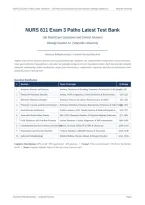
NURS 611 Exam 3 Patho Latest Test Bank — 156 Real Exam Questions & Correct Answers (Already Graded A+) Maryville University
NURS 611 Exam 3 Patho Latest Test Bank
156 Real Exam Questions and Correct Answers
Already Graded A+ | Maryville University
Advanced Pathophysiology | Graduate Nursing Education
Aligned with current advanced practice nursing pathophysiology standards, this comprehensive examination covers pulmonary,
renal, gastrointestinal, hepatobiliary, and endocrine pathophysiology across ten integrated sections. Each item provides detailed
rationales emphasizing cellular mechanisms, organ system interactions, compensatory responses, and clinical correlations at the
advanced practice nursing level.
Question Distribution
# Section Topic Coverage Q Range
1 Pulmonary Structure and Function Anatomy, Mechanics of Breathing, Ventilation, Perfusion, & Gas ExchangeQ1–Q15
2 Obstructive Pulmonary Disorders Asthma, COPD, Emphysema, Chronic Bronchitis, & Bronchiectasis Q16–Q32
3 Restrictive Pulmonary Disorders Pulmonary Fibrosis, Sarcoidosis, Pneumoconiosis, & ARDS Q33–Q45
4 Pulmonary Vascular and Infectious Disorders Pulmonary Embolism, Pulmonary Hypertension, Pneumonia, & Tuberculosis
Q46–Q58
5 Renal Structure and Function Nephron Anatomy, GFR, Tubular Function, & Hormonal Regulation Q59–Q70
6 Acute and Chronic Kidney Disease AKI, CKD, Glomerular Disorders, & Nephrotic/Nephritic Syndromes Q71–Q88
7 Fluid, Electrolyte, and Acid-Base Disorders Sodium, Potassium, Calcium, Magnesium, & ABG Interpretation Q89–Q108
8 Gastrointestinal Structure, Function, and Disorders
Motility, Secretion, GERD, PUD, IBD, & Obstruction Q109–Q125
9 Hepatobiliary and Pancreatic Disorders Cirrhosis, Hepatitis, Gallbladder Disease, & Pancreatitis Q126–Q140
10 Endocrine Pathophysiology Diabetes Mellitus, Thyroid, Adrenal, & Pituitary Disorders Q141–Q156
Cognitive Distribution: 30% recall · 50% application · 20% analysis | Format: 75% scenario-based · 25% direct mechanism
recall | Items: 4-option multiple choice (A–D), one correct answer each
Advanced Pathophysiology — Graduate Nursing Page 1
,NURS 611 Exam 3 Patho Latest Test Bank — 156 Real Exam Questions & Correct Answers (Already Graded A+) Maryville University
Section 1: Pulmonary Structure and Function
Anatomy, Mechanics of Breathing, Ventilation, Perfusion, & Gas Exchange
Q1: A 34-year-old healthy adult is undergoing pulmonary function testing. Which anatomical structure
constitutes the region of the lung where gas exchange actually occurs, distinguishing it from conducting
airways?
A. Terminal bronchioles
B. Respiratory bronchioles and alveolar sacs [CORRECT]
C. Trachea and mainstem bronchi
D. Segmental bronchi
Correct Answer: B
Rationale:
Gas exchange occurs across the respiratory bronchioles, alveolar ducts, and alveolar sacs—collectively the acinus. Terminal
bronchioles are the last purely conducting airways (generation 16) and have no alveoli, so no gas exchange occurs there.
Trachea, mainstem, and segmental bronchi are conducting airways only. The transition from conducting to
transitional/respiratory zone occurs at generation 17, where alveoli first appear.
Q2: A patient asks why their small airways do not collapse during expiration despite negative intrathoracic
pressure changes. Which structural feature is primarily responsible for maintaining patency of small airways
(<2 mm)?
A. Cartilage rings
B. Smooth muscle tone
C. Radial traction from surrounding alveolar elastic recoil [CORRECT]
D. Mucociliary clearance
Correct Answer: C
Rationale:
Small airways lack cartilage support and depend on radial traction from surrounding alveolar elastic recoil to remain open.
During expiration, increased pleural pressure reduces airway caliber, but elastic recoil of lung parenchyma pulls airways open.
In emphysema, loss of elastic recoil destroys this radial traction, causing small airway collapse during expiration and air
trapping. Cartilage is only present in bronchi >1 mm, and smooth muscle contributes to tone but cannot prevent collapse alone.
Q3: A neonatologist is explaining surfactant physiology to new parents of a premature infant. Which
statement about type II pneumocytes is most accurate?
A. They produce surfactant beginning at 36 weeks gestation
B. They secrete dipalmitoylphosphatidylcholine, which reduces alveolar surface tension [CORRECT]
C. They are the primary gas-exchange cells of the alveolus
D. They are incapable of proliferation
Correct Answer: B
Rationale:
Type II pneumocytes produce surfactant (primarily dipalmitoylphosphatidylcholine, DPPC), which reduces alveolar surface
tension and prevents atelectasis. Surfactant production begins around 24-28 weeks but is insufficient until ~34-36 weeks. Type I
pneumocytes are the actual gas-exchange cells covering 95% of alveolar surface. Type II cells also serve as alveolar stem cells
and can proliferate and differentiate into Type I cells after injury.
Advanced Pathophysiology — Graduate Nursing Page 2
,NURS 611 Exam 3 Patho Latest Test Bank — 156 Real Exam Questions & Correct Answers (Already Graded A+) Maryville University
Q4: A 28-year-old male presents with sudden onset left-sided chest pain and dyspnea. Chest X-ray reveals left
pneumothorax. Which pressure relationship best explains the collapse of the left lung?
A. Intrapleural pressure becomes more negative than normal
B. Intrapleural pressure equilibrates with atmospheric pressure [CORRECT]
C. Intrapulmonary pressure exceeds intrapleural pressure
D. Atmospheric pressure drops below intrapleural pressure
Correct Answer: B
Rationale:
A pneumothorax introduces atmospheric air into the pleural space, abolishing the normal negative intrapleural pressure (-5 cm
H2O during expiration, -8 cm H2O during inspiration). When intrapleural pressure equilibrates with atmospheric pressure (0
cm H2O), the elastic recoil of the lung is unopposed and the lung collapses. The chest wall simultaneously springs outward. This
loss of the coupled chest wall-lung mechanics is the fundamental pathophysiology.
Q5: During quiet breathing in a healthy adult, which muscle performs the majority of inspiratory work?
A. External intercostals
B. Diaphragm [CORRECT]
C. Sternocleidomastoid
D. Internal intercostals
Correct Answer: B
Rationale:
The diaphragm is the primary muscle of inspiration, responsible for ~70-80% of tidal volume during quiet breathing. During
contraction, it descends and increases vertical thoracic dimension. External intercostals assist by elevating ribs (bucket-handle
and pump-handle motion). Sternocleidomastoid and scalenes are accessory muscles used only during exercise or respiratory
distress. Internal intercostals are expiratory muscles.
Q6: A patient with severe kyphoscoliosis has a restrictive pattern on PFTs. Which mechanism best explains
the reduction in lung volumes?
A. Loss of alveolar elastic recoil
B. Decreased chest wall compliance limiting lung expansion [CORRECT]
C. Increased airway resistance causing air trapping
D. Destruction of type II pneumocytes
Correct Answer: B
Rationale:
Kyphoscoliosis reduces chest wall compliance, restricting thoracic cage expansion and lowering total lung capacity, vital
capacity, and functional residual capacity—a restrictive pattern. The lungs themselves may be normal. Loss of elastic recoil
(emphysema) causes obstructive pattern with increased volumes. Airway resistance causes obstructive disease. Type II
pneumocyte destruction causes neonatal RDS, not restrictive disease from skeletal deformity.
Q7: A 55-year-old smoker has an FEV1/FVC ratio of 0.55 (predicted >0.75) with increased total lung capacity.
Which underlying mechanism best explains these findings?
A. Pulmonary fibrosis reducing lung compliance
B. Loss of elastic recoil with small airway collapse during expiration [CORRECT]
C. Respiratory muscle weakness
D. Pleural effusion compressing lung tissue
Advanced Pathophysiology — Graduate Nursing Page 3
, NURS 611 Exam 3 Patho Latest Test Bank — 156 Real Exam Questions & Correct Answers (Already Graded A+) Maryville University
Correct Answer: B
Rationale:
FEV1/FVC <0.70 with increased TLC indicates obstructive physiology. In COPD/emphysema, destruction of alveolar septa
reduces elastic recoil, allowing airways to collapse during expiration (loss of radial traction), trapping air and increasing RV
and TLC. Pulmonary fibrosis causes restrictive disease (low TLC). Respiratory muscle weakness also causes restrictive pattern.
Pleural effusion causes restrictive pattern with reduced volumes.
Q8: A patient is undergoing evaluation for dyspnea. Pulmonary artery catheter shows normal pulmonary
capillary wedge pressure, but dead-space ventilation (Vd/Vt) is markedly elevated. Which condition best
explains this finding?
A. Pulmonary edema from left heart failure
B. Pulmonary embolism [CORRECT]
C. Asthma exacerbation
D. Pneumonia with consolidation
Correct Answer: B
Rationale:
Pulmonary embolism obstructs pulmonary blood flow to ventilated alveoli, creating alveolar dead space (ventilated but not
perfused) and increasing Vd/Vt. Pulmonary edema causes shunt-like physiology (perfused but not ventilated). Asthma causes
hypoventilation with V/Q mismatch but not primarily dead space. Pneumonia consolidation causes shunt, not dead space. The
hallmark of PE is increased dead space with hypoxemia refractory to supplemental O2.
Q9: A 60-year-old with COPD has a V/Q scan showing areas of low V/Q ratio. Which pathophysiologic
consequence is most directly responsible for hypoxemia in these regions?
A. Decreased inspired oxygen tension
B. Shunting of deoxygenated blood past underventilated alveoli [CORRECT]
C. Increased diffusing capacity
D. Right-to-left intracardiac shunt
Correct Answer: B
Rationale:
Low V/Q means ventilation is inadequate relative to perfusion; blood leaving these alveoli is incompletely oxygenated,
functioning as a physiologic shunt. This venous admixture lowers systemic arterial PaO2. Inspired oxygen tension is normal at
sea level. Diffusing capacity is typically reduced in COPD but contributes less than V/Q mismatch. True right-to-left shunt (e.g.,
ARDS, PFO) is not the primary mechanism in COPD, although hypoxic vasoconstriction may be impaired.
Q10: At high altitude, a healthy adult hyperventilates. After 4 days, which renal compensatory response is
expected to maintain acid-base balance?
A. Hydrogen ion secretion increases
B. Bicarbonate reabsorption decreases, causing urinary bicarbonate loss [CORRECT]
C. Ammonium excretion decreases
D. Renal bicarbonate generation increases
Correct Answer: B
Rationale:
High-altitude hyperventilation causes respiratory alkalosis. The kidneys compensate within 24-72 hours by decreasing proximal
tubular bicarbonate reabsorption (downregulating Na+/H+ exchanger and carbonic anhydrase), increasing urinary bicarbonate
excretion. This lowers serum bicarbonate and partially corrects pH. Increased H+ secretion and ammonium excretion occur in
Advanced Pathophysiology — Graduate Nursing Page 4
NURS 611 Exam 3 Patho Latest Test Bank
156 Real Exam Questions and Correct Answers
Already Graded A+ | Maryville University
Advanced Pathophysiology | Graduate Nursing Education
Aligned with current advanced practice nursing pathophysiology standards, this comprehensive examination covers pulmonary,
renal, gastrointestinal, hepatobiliary, and endocrine pathophysiology across ten integrated sections. Each item provides detailed
rationales emphasizing cellular mechanisms, organ system interactions, compensatory responses, and clinical correlations at the
advanced practice nursing level.
Question Distribution
# Section Topic Coverage Q Range
1 Pulmonary Structure and Function Anatomy, Mechanics of Breathing, Ventilation, Perfusion, & Gas ExchangeQ1–Q15
2 Obstructive Pulmonary Disorders Asthma, COPD, Emphysema, Chronic Bronchitis, & Bronchiectasis Q16–Q32
3 Restrictive Pulmonary Disorders Pulmonary Fibrosis, Sarcoidosis, Pneumoconiosis, & ARDS Q33–Q45
4 Pulmonary Vascular and Infectious Disorders Pulmonary Embolism, Pulmonary Hypertension, Pneumonia, & Tuberculosis
Q46–Q58
5 Renal Structure and Function Nephron Anatomy, GFR, Tubular Function, & Hormonal Regulation Q59–Q70
6 Acute and Chronic Kidney Disease AKI, CKD, Glomerular Disorders, & Nephrotic/Nephritic Syndromes Q71–Q88
7 Fluid, Electrolyte, and Acid-Base Disorders Sodium, Potassium, Calcium, Magnesium, & ABG Interpretation Q89–Q108
8 Gastrointestinal Structure, Function, and Disorders
Motility, Secretion, GERD, PUD, IBD, & Obstruction Q109–Q125
9 Hepatobiliary and Pancreatic Disorders Cirrhosis, Hepatitis, Gallbladder Disease, & Pancreatitis Q126–Q140
10 Endocrine Pathophysiology Diabetes Mellitus, Thyroid, Adrenal, & Pituitary Disorders Q141–Q156
Cognitive Distribution: 30% recall · 50% application · 20% analysis | Format: 75% scenario-based · 25% direct mechanism
recall | Items: 4-option multiple choice (A–D), one correct answer each
Advanced Pathophysiology — Graduate Nursing Page 1
,NURS 611 Exam 3 Patho Latest Test Bank — 156 Real Exam Questions & Correct Answers (Already Graded A+) Maryville University
Section 1: Pulmonary Structure and Function
Anatomy, Mechanics of Breathing, Ventilation, Perfusion, & Gas Exchange
Q1: A 34-year-old healthy adult is undergoing pulmonary function testing. Which anatomical structure
constitutes the region of the lung where gas exchange actually occurs, distinguishing it from conducting
airways?
A. Terminal bronchioles
B. Respiratory bronchioles and alveolar sacs [CORRECT]
C. Trachea and mainstem bronchi
D. Segmental bronchi
Correct Answer: B
Rationale:
Gas exchange occurs across the respiratory bronchioles, alveolar ducts, and alveolar sacs—collectively the acinus. Terminal
bronchioles are the last purely conducting airways (generation 16) and have no alveoli, so no gas exchange occurs there.
Trachea, mainstem, and segmental bronchi are conducting airways only. The transition from conducting to
transitional/respiratory zone occurs at generation 17, where alveoli first appear.
Q2: A patient asks why their small airways do not collapse during expiration despite negative intrathoracic
pressure changes. Which structural feature is primarily responsible for maintaining patency of small airways
(<2 mm)?
A. Cartilage rings
B. Smooth muscle tone
C. Radial traction from surrounding alveolar elastic recoil [CORRECT]
D. Mucociliary clearance
Correct Answer: C
Rationale:
Small airways lack cartilage support and depend on radial traction from surrounding alveolar elastic recoil to remain open.
During expiration, increased pleural pressure reduces airway caliber, but elastic recoil of lung parenchyma pulls airways open.
In emphysema, loss of elastic recoil destroys this radial traction, causing small airway collapse during expiration and air
trapping. Cartilage is only present in bronchi >1 mm, and smooth muscle contributes to tone but cannot prevent collapse alone.
Q3: A neonatologist is explaining surfactant physiology to new parents of a premature infant. Which
statement about type II pneumocytes is most accurate?
A. They produce surfactant beginning at 36 weeks gestation
B. They secrete dipalmitoylphosphatidylcholine, which reduces alveolar surface tension [CORRECT]
C. They are the primary gas-exchange cells of the alveolus
D. They are incapable of proliferation
Correct Answer: B
Rationale:
Type II pneumocytes produce surfactant (primarily dipalmitoylphosphatidylcholine, DPPC), which reduces alveolar surface
tension and prevents atelectasis. Surfactant production begins around 24-28 weeks but is insufficient until ~34-36 weeks. Type I
pneumocytes are the actual gas-exchange cells covering 95% of alveolar surface. Type II cells also serve as alveolar stem cells
and can proliferate and differentiate into Type I cells after injury.
Advanced Pathophysiology — Graduate Nursing Page 2
,NURS 611 Exam 3 Patho Latest Test Bank — 156 Real Exam Questions & Correct Answers (Already Graded A+) Maryville University
Q4: A 28-year-old male presents with sudden onset left-sided chest pain and dyspnea. Chest X-ray reveals left
pneumothorax. Which pressure relationship best explains the collapse of the left lung?
A. Intrapleural pressure becomes more negative than normal
B. Intrapleural pressure equilibrates with atmospheric pressure [CORRECT]
C. Intrapulmonary pressure exceeds intrapleural pressure
D. Atmospheric pressure drops below intrapleural pressure
Correct Answer: B
Rationale:
A pneumothorax introduces atmospheric air into the pleural space, abolishing the normal negative intrapleural pressure (-5 cm
H2O during expiration, -8 cm H2O during inspiration). When intrapleural pressure equilibrates with atmospheric pressure (0
cm H2O), the elastic recoil of the lung is unopposed and the lung collapses. The chest wall simultaneously springs outward. This
loss of the coupled chest wall-lung mechanics is the fundamental pathophysiology.
Q5: During quiet breathing in a healthy adult, which muscle performs the majority of inspiratory work?
A. External intercostals
B. Diaphragm [CORRECT]
C. Sternocleidomastoid
D. Internal intercostals
Correct Answer: B
Rationale:
The diaphragm is the primary muscle of inspiration, responsible for ~70-80% of tidal volume during quiet breathing. During
contraction, it descends and increases vertical thoracic dimension. External intercostals assist by elevating ribs (bucket-handle
and pump-handle motion). Sternocleidomastoid and scalenes are accessory muscles used only during exercise or respiratory
distress. Internal intercostals are expiratory muscles.
Q6: A patient with severe kyphoscoliosis has a restrictive pattern on PFTs. Which mechanism best explains
the reduction in lung volumes?
A. Loss of alveolar elastic recoil
B. Decreased chest wall compliance limiting lung expansion [CORRECT]
C. Increased airway resistance causing air trapping
D. Destruction of type II pneumocytes
Correct Answer: B
Rationale:
Kyphoscoliosis reduces chest wall compliance, restricting thoracic cage expansion and lowering total lung capacity, vital
capacity, and functional residual capacity—a restrictive pattern. The lungs themselves may be normal. Loss of elastic recoil
(emphysema) causes obstructive pattern with increased volumes. Airway resistance causes obstructive disease. Type II
pneumocyte destruction causes neonatal RDS, not restrictive disease from skeletal deformity.
Q7: A 55-year-old smoker has an FEV1/FVC ratio of 0.55 (predicted >0.75) with increased total lung capacity.
Which underlying mechanism best explains these findings?
A. Pulmonary fibrosis reducing lung compliance
B. Loss of elastic recoil with small airway collapse during expiration [CORRECT]
C. Respiratory muscle weakness
D. Pleural effusion compressing lung tissue
Advanced Pathophysiology — Graduate Nursing Page 3
, NURS 611 Exam 3 Patho Latest Test Bank — 156 Real Exam Questions & Correct Answers (Already Graded A+) Maryville University
Correct Answer: B
Rationale:
FEV1/FVC <0.70 with increased TLC indicates obstructive physiology. In COPD/emphysema, destruction of alveolar septa
reduces elastic recoil, allowing airways to collapse during expiration (loss of radial traction), trapping air and increasing RV
and TLC. Pulmonary fibrosis causes restrictive disease (low TLC). Respiratory muscle weakness also causes restrictive pattern.
Pleural effusion causes restrictive pattern with reduced volumes.
Q8: A patient is undergoing evaluation for dyspnea. Pulmonary artery catheter shows normal pulmonary
capillary wedge pressure, but dead-space ventilation (Vd/Vt) is markedly elevated. Which condition best
explains this finding?
A. Pulmonary edema from left heart failure
B. Pulmonary embolism [CORRECT]
C. Asthma exacerbation
D. Pneumonia with consolidation
Correct Answer: B
Rationale:
Pulmonary embolism obstructs pulmonary blood flow to ventilated alveoli, creating alveolar dead space (ventilated but not
perfused) and increasing Vd/Vt. Pulmonary edema causes shunt-like physiology (perfused but not ventilated). Asthma causes
hypoventilation with V/Q mismatch but not primarily dead space. Pneumonia consolidation causes shunt, not dead space. The
hallmark of PE is increased dead space with hypoxemia refractory to supplemental O2.
Q9: A 60-year-old with COPD has a V/Q scan showing areas of low V/Q ratio. Which pathophysiologic
consequence is most directly responsible for hypoxemia in these regions?
A. Decreased inspired oxygen tension
B. Shunting of deoxygenated blood past underventilated alveoli [CORRECT]
C. Increased diffusing capacity
D. Right-to-left intracardiac shunt
Correct Answer: B
Rationale:
Low V/Q means ventilation is inadequate relative to perfusion; blood leaving these alveoli is incompletely oxygenated,
functioning as a physiologic shunt. This venous admixture lowers systemic arterial PaO2. Inspired oxygen tension is normal at
sea level. Diffusing capacity is typically reduced in COPD but contributes less than V/Q mismatch. True right-to-left shunt (e.g.,
ARDS, PFO) is not the primary mechanism in COPD, although hypoxic vasoconstriction may be impaired.
Q10: At high altitude, a healthy adult hyperventilates. After 4 days, which renal compensatory response is
expected to maintain acid-base balance?
A. Hydrogen ion secretion increases
B. Bicarbonate reabsorption decreases, causing urinary bicarbonate loss [CORRECT]
C. Ammonium excretion decreases
D. Renal bicarbonate generation increases
Correct Answer: B
Rationale:
High-altitude hyperventilation causes respiratory alkalosis. The kidneys compensate within 24-72 hours by decreasing proximal
tubular bicarbonate reabsorption (downregulating Na+/H+ exchanger and carbonic anhydrase), increasing urinary bicarbonate
excretion. This lowers serum bicarbonate and partially corrects pH. Increased H+ secretion and ammonium excretion occur in
Advanced Pathophysiology — Graduate Nursing Page 4


