
NURS 611 Advanced Pathophysiology – Exam 4 – 200-Question Test Bank Already Graded A+
NURS 611 – Advanced Pathophysiology
Exam 4 – Complete 200-Question Test Bank
With Detailed Correct Answers and Rationales
Already Graded A+ | Maryville University Graduate Nursing Education
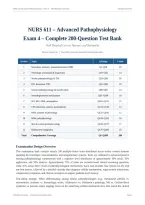
Section Topic Q Range Count
1 Neurologic anatomy, neurotransmission, BBB Q1–Q18 18
2 Neurologic assessment & diagnostics Q19–Q32 14
3 Stroke pathophysiology & TIA Q33–Q50 18
4 ICP, herniation, TBI Q51–Q68 18
5 Seizure pathophysiology & classification Q69–Q82 14
6 Neurodegenerative mechanisms Q83–Q100 18
7 SCI, MG, GBS, neuropathies Q101–Q115 15
8 CNS infections, tumors, autoimmunity Q116–Q130 15
9 MSK anatomy & physiology Q131–Q142 12
10 MSK pathophysiology Q143–Q158 16
11 Skin & wound pathophysiology Q159–Q175 17
12 Multisystem integration Q176–Q200 25
Total Comprehensive Coverage Q1–Q200 200
Examination Design Overview
This examination bank contains exactly 200 multiple-choice items distributed across twelve content domains
spanning the neurologic, musculoskeletal, and integumentary systems. Items are calibrated to advanced practice
nursing pathophysiology competencies with a cognitive level distribution of approximately 30% recall, 50%
application, and 20% analysis. Approximately 75% of items are scenario-based clinical reasoning questions,
while 25% assess direct recall of pathophysiological mechanisms. Each item includes four options (A–D) with
one best answer, followed by a detailed rationale that integrates cellular mechanisms, organ-system interactions,
compensatory responses, and clinical correlation to support graduate-level mastery.
Test-taking strategy: When differentiating among similar pathophysiologies (e.g., rheumatoid arthritis vs.
osteoarthritis, ischemic vs. hemorrhagic stroke, Alzheimer’s vs. Parkinson’s pathology, MS vs. Guillain-Barré
syndrome, or pressure injury staging), focus on the underlying cellular mechanism first, then match the clinical
Maryville University – Graduate Nursing Education Page 1
,NURS 611 Advanced Pathophysiology – Exam 4 – 200-Question Test Bank Already Graded A+
presentation. The correct answer consistently reflects the mechanism that best explains the majority of described
findings.
Section 1: Neurologic Structure and Function
CNS/PNS Anatomy, Neurons, Neurotransmitters, & BBB — Questions Q1–Q18
A 68-year-old patient suddenly develops halting, nonfluent speech with preserved comprehension. MRI
shows an infarct in the left inferior frontal gyrus (Brodmann areas 44/45). Which functional region is most
directly affected?
A. Wernicke’s area in the posterior superior temporal gyrus
B. Broca’s area in the inferior frontal gyrus [CORRECT]
C. Primary motor cortex in the precentral gyrus
D. The angular gyrus at the temporoparietal junction
Correct Answer: B
Rationale: Broca’s area, located in the left inferior frontal gyrus (Brodmann areas 44 and 45), is the motor planning center
for articulated speech. Its destruction produces Broca (expressive/motor) aphasia characterized by nonfluent, effortful,
telegraphic output with largely preserved comprehension. Wernicke’s area (posterior superior temporal gyrus) governs
language comprehension; its lesion produces fluent aphasia with nonsensical content. The primary motor cortex generates
voluntary motor commands, and the angular gyrus supports reading and written language. Only Broca’s area explains
nonfluent speech with intact comprehension.
A patient with a cerebellar tumor develops wide-based gait, past-pointing on finger-to-nose testing, and
intention tremor. These findings best reflect loss of which cerebellar function?
A. Initiation of voluntary movement via upper motor neurons
B. Comparison of intended movement with proprioceptive feedback to coordinate and fine-tune motor
output [CORRECT]
C. Transmission of nociceptive signals from the contralateral body to the thalamus
D. Integration of memory and emotional valence with motor planning
Correct Answer: B
Rationale: The cerebellum does not initiate movement; instead it modulates ongoing movement by comparing cortical
motor intent (conveyed via cortico-ponto-cerebellar pathways) with proprioceptive feedback (spinocerebellar tracts), then
correcting errors through outputs to the thalamus and motor cortex. Loss of this comparator function produces dyssynergia,
dysmetria (past-pointing), intention tremor, and ataxic gait. Initiation resides in the primary motor cortex; nociception
travels in the spinothalamic tract; memory/emotion integration is limbic. The classic triad localizes the lesion to cerebellar
circuitry.
Maryville University – Graduate Nursing Education Page 2
,NURS 611 Advanced Pathophysiology – Exam 4 – 200-Question Test Bank Already Graded A+
The blood-brain barrier (BBB) is structurally and functionally maintained primarily by which
mechanism?
A. Tight junctions between brain capillary endothelial cells reinforced by astrocytic end-feet [CORRECT]
B. Gap junctions between pericytes and microglia surrounding cerebral arterioles
C. A fenestrated endothelium with abundant pinocytotic vesicles that selectively filter plasma proteins
D. The arachnoid granulations that regulate cerebrospinal fluid return to venous blood
Correct Answer: A
Rationale: The BBB is formed by non-fenestrated brain capillary endothelial cells joined by complex tight junctions
(claudin-5, occludin) that severely restrict paracellular flux. Astrocytic end-feet ensheath >99% of the abluminal surface
and secrete factors (e.g., sonic hedgehog, retinoic acid) that induce and maintain the tight-junction phenotype. Pericytes
contribute to barrier maturation and vascular stability. Fenestrated endothelium (typical of endocrine organs) would permit
protein leakage; arachnoid granulations reabsorb CSF but do not constitute the BBB. The structural unit is therefore
endothelial tight junctions supported by astrocytes.
A neuron at rest maintains a membrane potential of approximately –70 mV. The ionic gradient most
directly responsible for establishing this resting potential is:
A. High intracellular Na+ and high intracellular Ca2+
B. High extracellular Na+ and high intracellular K+, with the membrane far more permeable to K+
[CORRECT]
C. Equal distribution of Cl– across the membrane with active Cl– pumping
D. High intracellular Na+ and high extracellular K+ maintained by voltage-gated channels
Correct Answer: B
Rationale: The resting membrane potential (≈ –70 mV in neurons) is set chiefly by the K+ equilibrium potential because
the resting membrane is far more permeable to K+ than to Na+ or Cl–. The Na+/K+-ATPase maintains high extracellular
Na+ and high intracellular K+ by exporting 3 Na+ and importing 2 K+ per ATP, establishing the gradients that both set rest
and store the energy for the action potential. Voltage-gated channels are mostly closed at rest; Cl– equilibrates passively.
Thus the resting potential reflects K+ efflux through leak channels down its concentration gradient.
During an action potential, the rapid depolarization phase (upstroke) in a typical myelinated CNS neuron
is generated by which event?
A. Opening of voltage-gated K+ channels causing K+ influx
B. Opening of voltage-gated Na+ channels causing Na+ influx [CORRECT]
C. Opening of ligand-gated Cl– channels causing Cl– efflux
D. Activation of the Na+/K+-ATPase pump
Correct Answer: B
Rationale: Threshold depolarization (~–55 mV) opens voltage-gated Na+ channels; Na+ rushes into the axon down its
electrochemical gradient, driving the membrane toward the Na+ equilibrium potential (~+60 mV) and producing the rapid
upstroke. Repolarization follows as Na+ channels inactivate and delayed-rectifier voltage-gated K+ channels open,
allowing K+ efflux. The Na+/K+-ATPase then restores ionic gradients over seconds but does not generate the upstroke.
Ligand-gated Cl– channels mediate postsynaptic inhibition, not the action potential spike.
Maryville University – Graduate Nursing Education Page 3
, NURS 611 Advanced Pathophysiology – Exam 4 – 200-Question Test Bank Already Graded A+
A graduate nurse is studying synaptic transmission. Which statement best describes the sequence of events
at a typical chemical synapse?
A. Action potential reaches the postsynaptic membrane, calcium enters postsynaptically, neurotransmitter flows
back to the presynaptic terminal
B. Action potential reaches the presynaptic terminal, voltage-gated Ca2+ channels open, vesicle fusion
releases neurotransmitter, ligand-gated channels open on the postsynaptic membrane [CORRECT]
C. Neurotransmitter is synthesized in the postsynaptic dendrite and travels by fast axonal transport to the
presynaptic terminal
D. Gap junction connexins directly conduct the action potential from presynaptic to postsynaptic neuron without
any chemical step
Correct Answer: B
Rationale: At a chemical synapse, the action potential arrives at the presynaptic terminal, depolarizing it and opening
voltage-gated Ca2+ channels. Ca2+ entry triggers synaptotagmin-mediated SNARE complex assembly, vesicle fusion, and
neurotransmitter release into the cleft. Transmitter binds ligand-gated (ionotropic) or G-protein-coupled (metabotropic)
receptors on the postsynaptic membrane, producing EPSPs or IPSPs. Synthesis actually occurs presynaptically (or in the
soma with anterograde transport), and electrical synapses via gap junctions are the exception, not the rule, in mammalian
CNS chemical transmission.
A 22-year-old patient is brought to the ED with severe agitation, tachycardia, mydriasis, and urinary
retention after ingesting an unknown plant. Which neurotransmitter system is most likely responsible for
this constellation of findings?
A. Excess parasympathetic (cholinergic) activity
B. Excess sympathetic (adrenergic) activity [CORRECT]
C. Deficient dopaminergic activity in the nigrostriatal pathway
D. Excess GABAergic activity in the thalamus
Correct Answer: B
Rationale: Mydriasis (radial pupillomotor dilation), tachycardia, urinary retention, decreased salivation, and agitation are
classic sympathomimetic/anticholinergic findings reflecting unopposed adrenergic tone. The sympathetic nervous system
uses norepinephrine at postganglionic synapses and epinephrine from the adrenal medulla; alpha-1 mediated
vasoconstriction and mydriasis plus beta-1 chronotropy explain the presentation. Parasympathetic excess would produce
miosis, bradycardia, diarrhea, and salivation (SLUDGE). Dopamine depletion causes parkinsonism; GABAergic excess
causes sedation.
A patient receives a cholinesterase inhibitor for myasthenia gravis. By which mechanism does the drug act
at the nicotinic neuromuscular junction?
A. It directly stimulates the postsynaptic acetylcholine receptor, mimicking ACh
B. It blocks the presynaptic voltage-gated Ca2+ channel
C. It inhibits acetylcholinesterase, increasing ACh concentration and dwell time at the postsynaptic
receptor [CORRECT]
D. It blocks the muscarinic receptor at the neuromuscular junction
Correct Answer: C
Rationale: Acetylcholinesterase inhibitors (pyridostigmine, neostigmine) hydrolyze ACh at a slower rate, increasing the
concentration and synaptic dwell time of ACh at the postsynaptic nicotinic receptor of the motor end plate. In myasthenia
gravis, autoantibodies have reduced the number of functional ACh receptors; prolonging ACh action partially
compensates. The drug does not directly activate the receptor, does not block presynaptic Ca2+ entry, and the NMJ uses
nicotinic (not muscarinic) receptors, making option D irrelevant to the junction.
Maryville University – Graduate Nursing Education Page 4
NURS 611 – Advanced Pathophysiology
Exam 4 – Complete 200-Question Test Bank
With Detailed Correct Answers and Rationales
Already Graded A+ | Maryville University Graduate Nursing Education
Section Topic Q Range Count
1 Neurologic anatomy, neurotransmission, BBB Q1–Q18 18
2 Neurologic assessment & diagnostics Q19–Q32 14
3 Stroke pathophysiology & TIA Q33–Q50 18
4 ICP, herniation, TBI Q51–Q68 18
5 Seizure pathophysiology & classification Q69–Q82 14
6 Neurodegenerative mechanisms Q83–Q100 18
7 SCI, MG, GBS, neuropathies Q101–Q115 15
8 CNS infections, tumors, autoimmunity Q116–Q130 15
9 MSK anatomy & physiology Q131–Q142 12
10 MSK pathophysiology Q143–Q158 16
11 Skin & wound pathophysiology Q159–Q175 17
12 Multisystem integration Q176–Q200 25
Total Comprehensive Coverage Q1–Q200 200
Examination Design Overview
This examination bank contains exactly 200 multiple-choice items distributed across twelve content domains
spanning the neurologic, musculoskeletal, and integumentary systems. Items are calibrated to advanced practice
nursing pathophysiology competencies with a cognitive level distribution of approximately 30% recall, 50%
application, and 20% analysis. Approximately 75% of items are scenario-based clinical reasoning questions,
while 25% assess direct recall of pathophysiological mechanisms. Each item includes four options (A–D) with
one best answer, followed by a detailed rationale that integrates cellular mechanisms, organ-system interactions,
compensatory responses, and clinical correlation to support graduate-level mastery.
Test-taking strategy: When differentiating among similar pathophysiologies (e.g., rheumatoid arthritis vs.
osteoarthritis, ischemic vs. hemorrhagic stroke, Alzheimer’s vs. Parkinson’s pathology, MS vs. Guillain-Barré
syndrome, or pressure injury staging), focus on the underlying cellular mechanism first, then match the clinical
Maryville University – Graduate Nursing Education Page 1
,NURS 611 Advanced Pathophysiology – Exam 4 – 200-Question Test Bank Already Graded A+
presentation. The correct answer consistently reflects the mechanism that best explains the majority of described
findings.
Section 1: Neurologic Structure and Function
CNS/PNS Anatomy, Neurons, Neurotransmitters, & BBB — Questions Q1–Q18
A 68-year-old patient suddenly develops halting, nonfluent speech with preserved comprehension. MRI
shows an infarct in the left inferior frontal gyrus (Brodmann areas 44/45). Which functional region is most
directly affected?
A. Wernicke’s area in the posterior superior temporal gyrus
B. Broca’s area in the inferior frontal gyrus [CORRECT]
C. Primary motor cortex in the precentral gyrus
D. The angular gyrus at the temporoparietal junction
Correct Answer: B
Rationale: Broca’s area, located in the left inferior frontal gyrus (Brodmann areas 44 and 45), is the motor planning center
for articulated speech. Its destruction produces Broca (expressive/motor) aphasia characterized by nonfluent, effortful,
telegraphic output with largely preserved comprehension. Wernicke’s area (posterior superior temporal gyrus) governs
language comprehension; its lesion produces fluent aphasia with nonsensical content. The primary motor cortex generates
voluntary motor commands, and the angular gyrus supports reading and written language. Only Broca’s area explains
nonfluent speech with intact comprehension.
A patient with a cerebellar tumor develops wide-based gait, past-pointing on finger-to-nose testing, and
intention tremor. These findings best reflect loss of which cerebellar function?
A. Initiation of voluntary movement via upper motor neurons
B. Comparison of intended movement with proprioceptive feedback to coordinate and fine-tune motor
output [CORRECT]
C. Transmission of nociceptive signals from the contralateral body to the thalamus
D. Integration of memory and emotional valence with motor planning
Correct Answer: B
Rationale: The cerebellum does not initiate movement; instead it modulates ongoing movement by comparing cortical
motor intent (conveyed via cortico-ponto-cerebellar pathways) with proprioceptive feedback (spinocerebellar tracts), then
correcting errors through outputs to the thalamus and motor cortex. Loss of this comparator function produces dyssynergia,
dysmetria (past-pointing), intention tremor, and ataxic gait. Initiation resides in the primary motor cortex; nociception
travels in the spinothalamic tract; memory/emotion integration is limbic. The classic triad localizes the lesion to cerebellar
circuitry.
Maryville University – Graduate Nursing Education Page 2
,NURS 611 Advanced Pathophysiology – Exam 4 – 200-Question Test Bank Already Graded A+
The blood-brain barrier (BBB) is structurally and functionally maintained primarily by which
mechanism?
A. Tight junctions between brain capillary endothelial cells reinforced by astrocytic end-feet [CORRECT]
B. Gap junctions between pericytes and microglia surrounding cerebral arterioles
C. A fenestrated endothelium with abundant pinocytotic vesicles that selectively filter plasma proteins
D. The arachnoid granulations that regulate cerebrospinal fluid return to venous blood
Correct Answer: A
Rationale: The BBB is formed by non-fenestrated brain capillary endothelial cells joined by complex tight junctions
(claudin-5, occludin) that severely restrict paracellular flux. Astrocytic end-feet ensheath >99% of the abluminal surface
and secrete factors (e.g., sonic hedgehog, retinoic acid) that induce and maintain the tight-junction phenotype. Pericytes
contribute to barrier maturation and vascular stability. Fenestrated endothelium (typical of endocrine organs) would permit
protein leakage; arachnoid granulations reabsorb CSF but do not constitute the BBB. The structural unit is therefore
endothelial tight junctions supported by astrocytes.
A neuron at rest maintains a membrane potential of approximately –70 mV. The ionic gradient most
directly responsible for establishing this resting potential is:
A. High intracellular Na+ and high intracellular Ca2+
B. High extracellular Na+ and high intracellular K+, with the membrane far more permeable to K+
[CORRECT]
C. Equal distribution of Cl– across the membrane with active Cl– pumping
D. High intracellular Na+ and high extracellular K+ maintained by voltage-gated channels
Correct Answer: B
Rationale: The resting membrane potential (≈ –70 mV in neurons) is set chiefly by the K+ equilibrium potential because
the resting membrane is far more permeable to K+ than to Na+ or Cl–. The Na+/K+-ATPase maintains high extracellular
Na+ and high intracellular K+ by exporting 3 Na+ and importing 2 K+ per ATP, establishing the gradients that both set rest
and store the energy for the action potential. Voltage-gated channels are mostly closed at rest; Cl– equilibrates passively.
Thus the resting potential reflects K+ efflux through leak channels down its concentration gradient.
During an action potential, the rapid depolarization phase (upstroke) in a typical myelinated CNS neuron
is generated by which event?
A. Opening of voltage-gated K+ channels causing K+ influx
B. Opening of voltage-gated Na+ channels causing Na+ influx [CORRECT]
C. Opening of ligand-gated Cl– channels causing Cl– efflux
D. Activation of the Na+/K+-ATPase pump
Correct Answer: B
Rationale: Threshold depolarization (~–55 mV) opens voltage-gated Na+ channels; Na+ rushes into the axon down its
electrochemical gradient, driving the membrane toward the Na+ equilibrium potential (~+60 mV) and producing the rapid
upstroke. Repolarization follows as Na+ channels inactivate and delayed-rectifier voltage-gated K+ channels open,
allowing K+ efflux. The Na+/K+-ATPase then restores ionic gradients over seconds but does not generate the upstroke.
Ligand-gated Cl– channels mediate postsynaptic inhibition, not the action potential spike.
Maryville University – Graduate Nursing Education Page 3
, NURS 611 Advanced Pathophysiology – Exam 4 – 200-Question Test Bank Already Graded A+
A graduate nurse is studying synaptic transmission. Which statement best describes the sequence of events
at a typical chemical synapse?
A. Action potential reaches the postsynaptic membrane, calcium enters postsynaptically, neurotransmitter flows
back to the presynaptic terminal
B. Action potential reaches the presynaptic terminal, voltage-gated Ca2+ channels open, vesicle fusion
releases neurotransmitter, ligand-gated channels open on the postsynaptic membrane [CORRECT]
C. Neurotransmitter is synthesized in the postsynaptic dendrite and travels by fast axonal transport to the
presynaptic terminal
D. Gap junction connexins directly conduct the action potential from presynaptic to postsynaptic neuron without
any chemical step
Correct Answer: B
Rationale: At a chemical synapse, the action potential arrives at the presynaptic terminal, depolarizing it and opening
voltage-gated Ca2+ channels. Ca2+ entry triggers synaptotagmin-mediated SNARE complex assembly, vesicle fusion, and
neurotransmitter release into the cleft. Transmitter binds ligand-gated (ionotropic) or G-protein-coupled (metabotropic)
receptors on the postsynaptic membrane, producing EPSPs or IPSPs. Synthesis actually occurs presynaptically (or in the
soma with anterograde transport), and electrical synapses via gap junctions are the exception, not the rule, in mammalian
CNS chemical transmission.
A 22-year-old patient is brought to the ED with severe agitation, tachycardia, mydriasis, and urinary
retention after ingesting an unknown plant. Which neurotransmitter system is most likely responsible for
this constellation of findings?
A. Excess parasympathetic (cholinergic) activity
B. Excess sympathetic (adrenergic) activity [CORRECT]
C. Deficient dopaminergic activity in the nigrostriatal pathway
D. Excess GABAergic activity in the thalamus
Correct Answer: B
Rationale: Mydriasis (radial pupillomotor dilation), tachycardia, urinary retention, decreased salivation, and agitation are
classic sympathomimetic/anticholinergic findings reflecting unopposed adrenergic tone. The sympathetic nervous system
uses norepinephrine at postganglionic synapses and epinephrine from the adrenal medulla; alpha-1 mediated
vasoconstriction and mydriasis plus beta-1 chronotropy explain the presentation. Parasympathetic excess would produce
miosis, bradycardia, diarrhea, and salivation (SLUDGE). Dopamine depletion causes parkinsonism; GABAergic excess
causes sedation.
A patient receives a cholinesterase inhibitor for myasthenia gravis. By which mechanism does the drug act
at the nicotinic neuromuscular junction?
A. It directly stimulates the postsynaptic acetylcholine receptor, mimicking ACh
B. It blocks the presynaptic voltage-gated Ca2+ channel
C. It inhibits acetylcholinesterase, increasing ACh concentration and dwell time at the postsynaptic
receptor [CORRECT]
D. It blocks the muscarinic receptor at the neuromuscular junction
Correct Answer: C
Rationale: Acetylcholinesterase inhibitors (pyridostigmine, neostigmine) hydrolyze ACh at a slower rate, increasing the
concentration and synaptic dwell time of ACh at the postsynaptic nicotinic receptor of the motor end plate. In myasthenia
gravis, autoantibodies have reduced the number of functional ACh receptors; prolonging ACh action partially
compensates. The drug does not directly activate the receptor, does not block presynaptic Ca2+ entry, and the NMJ uses
nicotinic (not muscarinic) receptors, making option D irrelevant to the junction.
Maryville University – Graduate Nursing Education Page 4


