
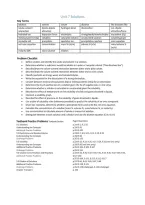
Unit 7 Solutions
Key Terms
solution solvent solute dissolve like dissolves like
solute–solvent dipole–dipole hydrogen bond dissociation ion–dipole
interaction attraction attraction/force
hydrated ion dispersion force electrolyte strong/weak/nonelectrolyte equivalent (Eq)
milliequivalent (mEq) solubility saturated solution unsaturated solution solubility graph
insoluble salt precipitate spectator ion precipitation reaction ionic equation
net ionic equation concentration mass % (m/m) volume % (v/v) mass/volume %
(m/v)
molarity (M) stock solution dilution
Problem Checklist
• Define solution and identify the solute and solvent in a solution.
• Determine whether a substance would be soluble in a polar or nonpolar solvent (“like dissolves like”).
• Describe/draw the solute–solvent interaction between water and a polar solute.
• Describe/draw the solute–solvent interaction between water and an ionic solute.
• Classify reactants as strong, weak, and nonelectrolytes.
• Write the equation for the dissociation of a strong electrolyte.
• Convert between moles and equivalents (Eq) or milliequivalents (mEq) for an electrolyte.
• Determine the Eq of positive ions in a solution given the Eq of negative ions or vice versa.
• Determine whether a solution is saturated or unsaturated given the solubility.
• Describe the effect of temperature on the solubility of solids and gases dissolved in liquids.
• Interpret a solubility graph.
• Describe the effect of pressure on the solubility of gases dissolved in liquids.
• Use a table of solubility rules (reference provided) to predict the solubility of an ionic compound.
• Given two reactants, determine whether a precipitate forms and write the net ionic equation.
• Calculate the concentration of a solution (mass %, volume %, mass/volume %, or molarity).
• Use concentration to calculate amount of solute or amount of solution.
• Distinguish between a stock solution and a dilution and use the dilution equation (C 2V2=C1V1)
Textbook Practice Problems Textbook Section Page # Questions
9.1 Solutions p.314 9.1, 9.3, 9.5
Understanding the Concepts p.350 9.91
Additional Practice Problems p.351 9.101
9.2 Electrolytes and Nonelectrolytes p.318 9.7, 9.9, 9.11, 9.13, 9.15, 9.19
Understanding the Concepts p.350 9.93
Challenge Problems p.353 9.135
9.3 Solubility p.324 9.21, 9.23, 9.25, 9.27, 9.29, 9.31 (net ionic only)
Understanding the Concepts p.350 9.95 (net ionic only)
Additional Practice Problems p.351 9.103, 9.105, 9.107
Challenge Problems p.352 9.131
9.4 Solution Concentrations and Reactions p.333 9.33, 9.35, 9.37, 9.39, 9.41, 9.43, 9.45, 9.47, 9.49, 9.55,
Additional Practice Problems 9.57, 9.59
p.351 9.109, 9.111, 9.113, 9.115, 9.117
9.5 Dilution of Solutions p.337 9.61, 9.63, 9.65, 9.67, 9.69
Additional Practice Problems p.352 9.119, 9.121
Challenge Problems p.352 9.129 (challenge), 9.133 (challenge)
Chapter 7 Answers p. 353
, Notes: Unit 7 – Solutions
Contents
9.1 Solutions.................................................................................................................................................. 3
Solutions.................................................................................................................................................... 3
Water as a Solvent .................................................................................................................................... 3
Formation of Solutions.............................................................................................................................. 3
9.2 Electrolytes and Nonelectrolytes ............................................................................................................ 5
Strong Electrolytes .................................................................................................................................... 6
Weak Electrolytes...................................................................................................................................... 6
Nonelectrolytes ......................................................................................................................................... 7
Equivalents of Electrolytes......................................................................................................................... 8
9.3 Solubility................................................................................................................................................ 10
Effect of Temperature on Solubility – Solids ........................................................................................... 11
Solubility and Pressure ............................................................................................................................ 11
Soluble and Insoluble Ionic Compounds ................................................................................................. 12
Using Solubility Rules .............................................................................................................................. 13
9.4 Solution Concentrations and Reactions ................................................................................................ 14
Percent Concentrations........................................................................................................................... 14
Molarity................................................................................................................................................... 15
Chemical Reactions in Solution ............................................................................................................... 16
9.5 Dilution of Solutions.............................................................................................................................. 17
Extra Practice Questions ............................................................................................................................. 19
, 9.1 Solutions
Solutions
• homogeneous mixtures of two or more substances.
• form when there is sufficient attraction between the solute
and solvent molecules.
• Solvent = larger amount
• Solute = smaller amount
• Solution = solvent + solute
Solutes:
• may be a liquid, gas, or solid.
• spread evenly throughout the solution.
• cannot be separated by filtration, but they can be separated by evaporation.
• are not visible, but they can give a color to the solution.
Water as a Solvent
Water:
• one of the most common solvents in nature.
• polar molecule due to polar O–H bonds.
• form hydrogen bonds important in many biological compounds.
Formation of Solutions
Favour forming solutions Resist forming solutions
• Solute-solvent attraction • solvent–solvent attraction
• solute-solute attraction
To dissolve, solute-solvent attraction must overcome solvent-solvent and solute-solute
attractions.
Key Terms
solution solvent solute dissolve like dissolves like
solute–solvent dipole–dipole hydrogen bond dissociation ion–dipole
interaction attraction attraction/force
hydrated ion dispersion force electrolyte strong/weak/nonelectrolyte equivalent (Eq)
milliequivalent (mEq) solubility saturated solution unsaturated solution solubility graph
insoluble salt precipitate spectator ion precipitation reaction ionic equation
net ionic equation concentration mass % (m/m) volume % (v/v) mass/volume %
(m/v)
molarity (M) stock solution dilution
Problem Checklist
• Define solution and identify the solute and solvent in a solution.
• Determine whether a substance would be soluble in a polar or nonpolar solvent (“like dissolves like”).
• Describe/draw the solute–solvent interaction between water and a polar solute.
• Describe/draw the solute–solvent interaction between water and an ionic solute.
• Classify reactants as strong, weak, and nonelectrolytes.
• Write the equation for the dissociation of a strong electrolyte.
• Convert between moles and equivalents (Eq) or milliequivalents (mEq) for an electrolyte.
• Determine the Eq of positive ions in a solution given the Eq of negative ions or vice versa.
• Determine whether a solution is saturated or unsaturated given the solubility.
• Describe the effect of temperature on the solubility of solids and gases dissolved in liquids.
• Interpret a solubility graph.
• Describe the effect of pressure on the solubility of gases dissolved in liquids.
• Use a table of solubility rules (reference provided) to predict the solubility of an ionic compound.
• Given two reactants, determine whether a precipitate forms and write the net ionic equation.
• Calculate the concentration of a solution (mass %, volume %, mass/volume %, or molarity).
• Use concentration to calculate amount of solute or amount of solution.
• Distinguish between a stock solution and a dilution and use the dilution equation (C 2V2=C1V1)
Textbook Practice Problems Textbook Section Page # Questions
9.1 Solutions p.314 9.1, 9.3, 9.5
Understanding the Concepts p.350 9.91
Additional Practice Problems p.351 9.101
9.2 Electrolytes and Nonelectrolytes p.318 9.7, 9.9, 9.11, 9.13, 9.15, 9.19
Understanding the Concepts p.350 9.93
Challenge Problems p.353 9.135
9.3 Solubility p.324 9.21, 9.23, 9.25, 9.27, 9.29, 9.31 (net ionic only)
Understanding the Concepts p.350 9.95 (net ionic only)
Additional Practice Problems p.351 9.103, 9.105, 9.107
Challenge Problems p.352 9.131
9.4 Solution Concentrations and Reactions p.333 9.33, 9.35, 9.37, 9.39, 9.41, 9.43, 9.45, 9.47, 9.49, 9.55,
Additional Practice Problems 9.57, 9.59
p.351 9.109, 9.111, 9.113, 9.115, 9.117
9.5 Dilution of Solutions p.337 9.61, 9.63, 9.65, 9.67, 9.69
Additional Practice Problems p.352 9.119, 9.121
Challenge Problems p.352 9.129 (challenge), 9.133 (challenge)
Chapter 7 Answers p. 353
, Notes: Unit 7 – Solutions
Contents
9.1 Solutions.................................................................................................................................................. 3
Solutions.................................................................................................................................................... 3
Water as a Solvent .................................................................................................................................... 3
Formation of Solutions.............................................................................................................................. 3
9.2 Electrolytes and Nonelectrolytes ............................................................................................................ 5
Strong Electrolytes .................................................................................................................................... 6
Weak Electrolytes...................................................................................................................................... 6
Nonelectrolytes ......................................................................................................................................... 7
Equivalents of Electrolytes......................................................................................................................... 8
9.3 Solubility................................................................................................................................................ 10
Effect of Temperature on Solubility – Solids ........................................................................................... 11
Solubility and Pressure ............................................................................................................................ 11
Soluble and Insoluble Ionic Compounds ................................................................................................. 12
Using Solubility Rules .............................................................................................................................. 13
9.4 Solution Concentrations and Reactions ................................................................................................ 14
Percent Concentrations........................................................................................................................... 14
Molarity................................................................................................................................................... 15
Chemical Reactions in Solution ............................................................................................................... 16
9.5 Dilution of Solutions.............................................................................................................................. 17
Extra Practice Questions ............................................................................................................................. 19
, 9.1 Solutions
Solutions
• homogeneous mixtures of two or more substances.
• form when there is sufficient attraction between the solute
and solvent molecules.
• Solvent = larger amount
• Solute = smaller amount
• Solution = solvent + solute
Solutes:
• may be a liquid, gas, or solid.
• spread evenly throughout the solution.
• cannot be separated by filtration, but they can be separated by evaporation.
• are not visible, but they can give a color to the solution.
Water as a Solvent
Water:
• one of the most common solvents in nature.
• polar molecule due to polar O–H bonds.
• form hydrogen bonds important in many biological compounds.
Formation of Solutions
Favour forming solutions Resist forming solutions
• Solute-solvent attraction • solvent–solvent attraction
• solute-solute attraction
To dissolve, solute-solvent attraction must overcome solvent-solvent and solute-solute
attractions.


