
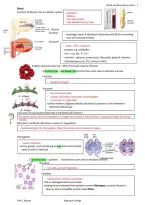
Blood and Respiratory system 1
Blood
Function of blood in the circulatory system - transport plasma
defense
form blood clots Cellular
help distribute body heat elements
4 components:
1. Plasma
Function: - exchanges water & dissolved substances with fluid surrounding
each cell (interstitial fluid)
Structure: -
— water - 90% of plasma
- proteins e.g. antibodies
- ions – e.g. Na+, K+, Ca+2
- nutrients – glucose, amino acids, fatty acids, glycerol, vitamins
- dissolved gases e.g. CO2 carried as HCO3-
Cellular elements make up ~ 45% of the total volume of blood
2. Erythrocytes – red blood cells formed from stem cells in red bone marrow
Function
- transport Oxygen
Structure
- tiny biconcave disk
- contain 250 million molecules of hemoglobin
- no nucleus or organelles
surface markers (oligosaccharides) attached to proteins in cell membrane
determine blood type
(A, B, AB or O)
How does the biconcave shape help a red blood cell function?
increases surface area for absorption of oxygen and makes it very exible to squeeze through tiny blood
vessels
Why don’t red blood cells have a nucleus or organelles?
maximizes space for hemoglobin, these structures would consume oxygen
Hemoglobin
- protein molecule
4 heme groups, each containing an iron atom which bonds
easily to one O2 molecule
3. Thrombocytes – platelets - formed from stem cells in red bone marrow
Structure
- not cells, just cell fragments
Function
- initiate blood clotting mechanism
stick to damaged blood vessel walls
clotting factors released from platelets convert fibrinogen, a protein found in
plasma, into a threadlike protein called fibrin.
Prof C. Baynes Algonquin College
fl
, Blood and Respiratory system 2
Structure and Function of Leukocytes (White Blood Cells) - formed from stem cells in red bone marrow
Name of White Blood Cell Structure Main Function
LEUKOCYTES: (white blood cells) - big nucleus Defend the body against disease
include granulocytes and
agranulocytes
A) GRANULOCYTES – 3 types: • Nucleus is lobed • Phagocytes which move
neutrophils, eospinophils and • Cytoplasm contains into tissue to surround
basophils visible granules and digest pathogens and
debris
(2nd line of defense)
i) Neutrophils Multilobed nucleus • Phagocytize bacteria and
(55-65% of WBCs) (dark purple); fungi
granules are
lavender purple
ii) Eosinophils Bilobed nucleus • Kill parasitic worms
(2-4% of WBCs) (dark purple); • Destroy antigen-antibody
granules are red complexes
• Inactivate some
inflammatory chemicals
during allergic response
iii) Basophils Lobed nucleus • Release histamine
(< 0.4% of WBCs) (dark purple); (vasodilator) during
granules are dark inflammation
blue • Release heparin
(anticoagulant)
B) AGRANULOCYTES – 2 types: • Nucleus round or kidney • Act in immune response
monocytes and lymphocytes shaped (3rd line of defense)
• No visible granules in • Monocytes become
cytoplasm phagocytes
(2nd line of defense)
i) Lymphocytes Smaller cells; light • T-Lymphocytes: act
(20-25% of WBCs) blue cytoplasm; directly against virus-
large dark purple infected cells and tumour
nucleus fills most cells
of the cell • B-Lymphocytes: make
antibodies
ii) Monocytes Largest cell; light • Move into tissues
(3-8% of WBCs) blue cytoplasm; developing into
kidney-shaped macrophages which are
nucleus highly active phagocytes
with voracious appetites
• Important in activating
lymphocytes
Prof C. Baynes Algonquin College
Blood
Function of blood in the circulatory system - transport plasma
defense
form blood clots Cellular
help distribute body heat elements
4 components:
1. Plasma
Function: - exchanges water & dissolved substances with fluid surrounding
each cell (interstitial fluid)
Structure: -
— water - 90% of plasma
- proteins e.g. antibodies
- ions – e.g. Na+, K+, Ca+2
- nutrients – glucose, amino acids, fatty acids, glycerol, vitamins
- dissolved gases e.g. CO2 carried as HCO3-
Cellular elements make up ~ 45% of the total volume of blood
2. Erythrocytes – red blood cells formed from stem cells in red bone marrow
Function
- transport Oxygen
Structure
- tiny biconcave disk
- contain 250 million molecules of hemoglobin
- no nucleus or organelles
surface markers (oligosaccharides) attached to proteins in cell membrane
determine blood type
(A, B, AB or O)
How does the biconcave shape help a red blood cell function?
increases surface area for absorption of oxygen and makes it very exible to squeeze through tiny blood
vessels
Why don’t red blood cells have a nucleus or organelles?
maximizes space for hemoglobin, these structures would consume oxygen
Hemoglobin
- protein molecule
4 heme groups, each containing an iron atom which bonds
easily to one O2 molecule
3. Thrombocytes – platelets - formed from stem cells in red bone marrow
Structure
- not cells, just cell fragments
Function
- initiate blood clotting mechanism
stick to damaged blood vessel walls
clotting factors released from platelets convert fibrinogen, a protein found in
plasma, into a threadlike protein called fibrin.
Prof C. Baynes Algonquin College
fl
, Blood and Respiratory system 2
Structure and Function of Leukocytes (White Blood Cells) - formed from stem cells in red bone marrow
Name of White Blood Cell Structure Main Function
LEUKOCYTES: (white blood cells) - big nucleus Defend the body against disease
include granulocytes and
agranulocytes
A) GRANULOCYTES – 3 types: • Nucleus is lobed • Phagocytes which move
neutrophils, eospinophils and • Cytoplasm contains into tissue to surround
basophils visible granules and digest pathogens and
debris
(2nd line of defense)
i) Neutrophils Multilobed nucleus • Phagocytize bacteria and
(55-65% of WBCs) (dark purple); fungi
granules are
lavender purple
ii) Eosinophils Bilobed nucleus • Kill parasitic worms
(2-4% of WBCs) (dark purple); • Destroy antigen-antibody
granules are red complexes
• Inactivate some
inflammatory chemicals
during allergic response
iii) Basophils Lobed nucleus • Release histamine
(< 0.4% of WBCs) (dark purple); (vasodilator) during
granules are dark inflammation
blue • Release heparin
(anticoagulant)
B) AGRANULOCYTES – 2 types: • Nucleus round or kidney • Act in immune response
monocytes and lymphocytes shaped (3rd line of defense)
• No visible granules in • Monocytes become
cytoplasm phagocytes
(2nd line of defense)
i) Lymphocytes Smaller cells; light • T-Lymphocytes: act
(20-25% of WBCs) blue cytoplasm; directly against virus-
large dark purple infected cells and tumour
nucleus fills most cells
of the cell • B-Lymphocytes: make
antibodies
ii) Monocytes Largest cell; light • Move into tissues
(3-8% of WBCs) blue cytoplasm; developing into
kidney-shaped macrophages which are
nucleus highly active phagocytes
with voracious appetites
• Important in activating
lymphocytes
Prof C. Baynes Algonquin College


