
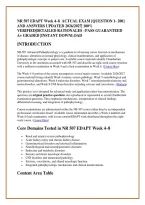
NR 507 EDAPT Week 4–8 ACTUAL EXAM [QUESTION 1- 200]
AND ANSWERS UPDATED 2026/2027| 100%
VERIFIED|DETAILED RATIONALES –PASS GUARANTEED
A+ GRADED |INSTANT DOWNLOAD
INTRODUCTION
NR-507 Advanced Pathophysiology is a graduate-level nursing course focused on mechanisms
of disease, alterations in normal physiology, clinical manifestations, and application of
pathophysiologic concepts to patient care. Available course materials identify Chamberlain
University as the institution associated with NR-507 and describe an eight-week course structure
with a midterm examination in Week 4 and a final examination in Week 8. (Course Hero)
The Week 4–8 portion of the course encompasses several major systems. Available 2026/2027
course-material listings identify Week 4 urinary-system pathology, Week 5 neurobiological and
gastrointestinal alterations, Week 6 endocrine disorders, Week 7 neurodegenerative/sensory and
motor disorders, and Week 8 CNS brain disorders including seizures and convulsions. (Studocu)
This practice set is designed for advanced study and application rather than memorization. The
questions are original practice questions, not reproduced or represented as actual Chamberlain
examination questions. They emphasize mechanisms, interpretation of clinical findings,
differential reasoning, and integration of pathophysiology.
Course examinations are administered within the NR-507 course rather than by an independent
professional certification board. Available course information describes a Week 4 midterm and
Week 8 final examination, with lesson-content/EDAPT work distributed throughout the eight-
week course. (Course Hero)
Core Domains Tested in NR 507 EDAPT Week 4–8
Renal and urinary-system pathophysiology
Acute kidney injury and chronic kidney disease
Gastrointestinal disorders and intestinal inflammation
Neurobiological and neurodegenerative disorders
Endocrine and metabolic disorders
Sensory and motor neurologic disorders
CNS disorders and intracranial pathology
Seizures, convulsions, and altered neurologic function
Integrated pathophysiologic mechanisms and clinical manifestations
Content Area Table
, % of Approx. # of
Content Domain Key Topics Covered
Exam Questions
Renal/Urinary UTI, BPH, calculi, incontinence, AKI,
20% 40
Pathology CKD
Gastrointestinal Inflammation, malabsorption, diverticular
15% 30
Pathology disease, intestinal disorders
Neurobiological Neurotransmission, mood-related
15% 30
Disorders mechanisms, neurodegeneration
Diabetes, thyroid, adrenal, pituitary,
Endocrine Pathology 20% 40
metabolic regulation
Sensory/Motor Motor pathways, sensory dysfunction,
10% 20
Disorders neurologic deficits
Intracranial pathology, altered
CNS/Brain Disorders 10% 20
consciousness, cerebral dysfunction
Seizure mechanisms, triggers, status
Seizures/Convulsions 10% 20
epilepticus, complications
Total 100% 200 Integrated Week 4–8 pathophysiology
QUESTIONS 1–200
Q1: A 72-year-old patient develops oliguria after three days of severe vomiting and
diarrhea. Laboratory testing shows rising BUN and creatinine with a BUN-to-creatinine
ratio greater than 20:1. Which mechanism best explains the kidney injury?
A) Direct tubular epithelial necrosis
B) Reduced renal perfusion causing prerenal acute kidney injury
C) Immune-mediated glomerular destruction
D) Postrenal obstruction from ureteral calculi
Correct Answer: B
Rationale: Volume depletion decreases renal blood flow and glomerular filtration, producing
prerenal AKI. Tubular necrosis is intrinsic renal injury, glomerular destruction is not suggested,
and obstruction would produce postrenal disease.
Q2: A patient with severe benign prostatic hyperplasia develops progressive urinary
retention. Which pathophysiologic consequence is most concerning if obstruction persists?
A) Increased erythropoietin production
B) Hydronephrosis with declining glomerular filtration
C) Increased renal potassium excretion
D) Enhanced bladder emptying
Correct Answer: B
Rationale: Persistent bladder outlet obstruction increases urinary tract pressure, potentially
causing hydroureter, hydronephrosis, and impaired renal function. The remaining choices
describe effects opposite to those expected.
,Q3: A patient has fever, flank pain, nausea, and costovertebral-angle tenderness. Which
condition is most consistent with these findings?
A) Cystitis
B) Acute pyelonephritis
C) Stress incontinence
D) Nephrotic syndrome
Correct Answer: B
Rationale: Fever and flank pain with costovertebral-angle tenderness strongly indicate upper
urinary tract involvement, particularly pyelonephritis. Cystitis generally produces lower-tract
symptoms without prominent flank pain or systemic illness.
Q4: A patient with recurrent calcium oxalate renal calculi asks why increased fluid intake
is recommended. What is the primary rationale?
A) It increases urinary protein excretion
B) It decreases urinary solute concentration and promotes stone passage
C) It directly dissolves all existing calcium stones
D) It prevents renal calcium filtration
Correct Answer: B
Rationale: Higher urine volume dilutes lithogenic substances and helps prevent crystal
aggregation while facilitating passage of small calculi. Hydration does not directly dissolve
established calcium oxalate stones.
Q5: A patient with chronic kidney disease develops fatigue, pallor, and reduced exercise
tolerance. Which mechanism is most likely responsible?
A) Excess renal erythropoietin production
B) Reduced erythropoietin production by diseased kidneys
C) Increased intestinal iron absorption
D) Increased red-cell survival
Correct Answer: B
Rationale: Diseased kidneys produce insufficient erythropoietin, reducing erythropoiesis and
contributing to normocytic anemia. CKD does not increase erythropoietin production.
Q6: A patient with advanced CKD has muscle weakness and peaked T waves on ECG.
Which electrolyte abnormality should be suspected?
A) Hypocalcemia
B) Hyperkalemia
C) Hypomagnesemia
D) Hypernatremia
Correct Answer: B
Rationale: Reduced renal potassium excretion can cause hyperkalemia. Peaked T waves are a
classic cardiac manifestation and severe hyperkalemia can cause life-threatening arrhythmias.
Q7: A patient with nephrotic syndrome develops generalized edema. Which mechanism
most directly contributes?
A) Increased plasma oncotic pressure
B) Urinary loss of albumin causing decreased plasma oncotic pressure
, C) Increased lymphatic drainage
D) Reduced sodium retention
Correct Answer: B
Rationale: Heavy proteinuria lowers serum albumin, reducing plasma oncotic pressure and
promoting movement of fluid into the interstitial space. Sodium and water retention can further
worsen edema.
Q8: A patient develops acute kidney injury after prolonged hypotension. Several days later,
urine output increases substantially while creatinine remains elevated. Which phase is most
consistent with this presentation?
A) Initiation phase
B) Maintenance phase
C) Recovery/polyuric phase
D) Postrenal phase
Correct Answer: C
Rationale: During the recovery phase of acute tubular injury, filtration begins improving before
tubular concentrating ability fully recovers, producing polyuria and electrolyte losses.
Q9: A patient with CKD has metabolic acidosis. Which renal function normally helps
prevent this abnormality?
A) Potassium secretion only
B) Hydrogen-ion excretion and bicarbonate regeneration
C) Albumin filtration
D) Glucose secretion
Correct Answer: B
Rationale: Healthy kidneys excrete hydrogen ions and generate/reabsorb bicarbonate. Loss of
these functions contributes to metabolic acidosis in advanced CKD.
Q10: A woman develops dysuria, urinary frequency, and urgency without fever or flank
pain. Which condition is most likely?
A) Acute glomerulonephritis
B) Lower urinary tract infection
C) Pyelonephritis
D) Nephrotic syndrome
Correct Answer: B
Rationale: Dysuria, frequency, and urgency are typical lower urinary tract symptoms.
Pyelonephritis usually produces systemic symptoms and flank pain.
Q11: A patient with CKD develops secondary hyperparathyroidism. Which mechanism
contributes most directly?
A) Increased calcitriol synthesis
B) Phosphate retention and reduced calcitriol production causing hypocalcemic stimulation
of PTH
C) Excess intestinal calcium absorption
D) Increased renal phosphate excretion
Correct Answer: B


