
A+ VERIFIED
P S YC H I AT R I C M E N TA L H E A LT H · O B J E C T I V E A S S E S S M E N T
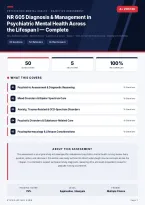
NR 605 Diagnosis & Management in
Psychiatric Mental Health Across
the Lifespan I — Complete
New 2026/2027 Update · Midterm Review · Questions & Answers · Grade A · 100% Correct (Verified Solutions) · Chamberlain 2026/2027
50 Questions Full Rationales Verified Answers
50
QUE STI ONS
5
SE CTI ONS
100%
R AT I O N A L E S
WHAT T HIS C OVE R S
01 Psychiatric Assessment & Diagnostic Reasoning 10 Questions
02 Mood Disorders & Bipolar Spectrum Care 10 Questions
03 Anxiety, Trauma-Related & OCD-Spectrum Disorders 10 Questions
04 Psychotic Disorders & Substance-Related Care 10 Questions
05 Psychopharmacology & Lifespan Considerations 10 Questions
AB OUT T H I S AS S E S S ME NT
This assessment is an original study aid developed for independent psychiatric-mental health nursing review. Every
question, option, and rationale in this edition was newly authored to reflect widely taught course concepts across the
lifespan. It is intended to support self-paced study, diagnostic-reasoning drills, and exam-preparation review for
graduate nursing coursework.
PA S S I N G S C O R E LE VE L F O R M AT
75% Application / Analysis Multiple Choice
S T UVI A ACT UAL E X AM Pa g e 1
, SECTION 01 — PSYCHIATRIC ASSESSMENT & DIAGNOSTIC REASONING
Q1. During a mental status examination, a 28-year-old client is asked about her reason for the visit. She
begins describing her job, drifts into a story about her landlord, then wanders to a distant memory of her
grandmother before the interviewer redirects her. Answers remain connected to questions only loosely, and
no pressured speech or flight of ideas is observed. How should the PMHNP document this finding?
A. Circumstantial thinking with excessive detail that eventually returns to the point
B. Tangential thinking with loose associations consistent with a thought-process disorder
C. Flight of ideas with rapid topic shifts driven by elevated mood
D. Perseveration with repetition of the same response across questions
Correct Answer: B
Rationale: The client's answers drift away from the question and only loosely connect to it, which defines tangentiality
with loose associations. Circumstantiality would eventually circle back to the point, and flight of ideas requires rapid
shifts triggered by internal stimuli, usually within an elevated or irritable mood.
Q2. A 45-year-old male client presents for an initial evaluation after his employer expressed concern about
missed deadlines and morning irritability. The PMHNP wants to screen for a possible alcohol use disorder
using a brief validated interview tool. Which action is most appropriate?
A. Administer the four-question CAGE screening questionnaire during the interview
B. Ask the client to complete the PHQ-9 before discussing substance use
C. Request both liver function tests and a urine drug screen as the primary screen
D. Begin with the GAD-7 to rule out anxiety before any alcohol questions
Correct Answer: A
Rationale: The CAGE questionnaire is a brief, validated four-item screen specifically designed to detect problem
drinking in clinical interviews. The PHQ-9 and GAD-7 screen mood and anxiety rather than alcohol use, and laboratory
values support but never replace a structured screening conversation.
Q3. A recently immigrated 52-year-old woman describes her distress as 'nervios,' reporting headaches,
trembling hands, and a 'restlessness in the chest' that began after her children moved away. She denies
feeling depressed in the way she has seen depicted on television. What is the PMHNP's best next step?
A. Document the symptoms as a somatic symptom disorder and begin symptom-focused care
B. Explain that these are symptoms of anxiety and provide psychoeducation in English
C. Use a cultural formulation interview to explore the meaning of 'nervios' in her own words
D. Refer her to a neurologist to rule out a tremor disorder before psychiatric assessment
Correct Answer: C
Rationale: The Cultural Formulation Interview elicits the client's own idiom of distress, which prevents mislabeling
culturally shaped somatic expressions and builds an accurate diagnostic picture. Interpreting 'nervios' as a standard
Western category or dismissing the physical complaints ignores the explanatory model that drives her presentation.
STUVIA ACTUAL EXAM · Page 2
, Q4. A 19-year-old college student reports episodes of high energy, decreased need for sleep, and impulsive
online shopping lasting several days, alternating with periods of low motivation. The PMHNP plans to start
an antidepressant but wants to screen for an underlying bipolar spectrum condition first. Which tool is most
appropriate?
A. Columbia Suicide Severity Rating Scale (C-SSRS)
B. Mood Disorder Questionnaire (MDQ)
C. Generalized Anxiety Disorder 7-item scale (GAD-7)
D. Abnormal Involuntary Movement Scale (AIMS)
Correct Answer: B
Rationale: The MDQ is a validated self-report screen for a lifetime history of manic or hypomanic episodes and is the
standard pre-antidepressant screen for bipolar spectrum illness. Missing hypomania before prescribing an
antidepressant risks triggering activation or a mixed state, so the bipolar-specific tool is required here.
Q5. A 31-year-old client with major depressive disorder tells the PMHNP that for the past two weeks he
has thought about being 'better off dead,' has a specific plan involving a firearm kept at home, and says he is
'halfway decided.' He denies an imminent intent to act today. Which intervention best reflects his current
risk level?
A. Schedule a routine outpatient follow-up appointment in four weeks and document the plan
B. Obtain a verbal no-suicide contract and continue weekly psychotherapy alone
C. Advise the client to have a friend 'keep an eye on him' without formal safety planning
D. Arrange an urgent psychiatric evaluation with collaborative safety planning and means restriction
Correct Answer: D
Rationale: Active ideation with a specific plan, access to a lethal means, and emerging intent places this client in a
high-risk tier requiring urgent evaluation, collaborative safety planning, and firearm removal or securing. No-suicide
contracts are not protective, and routine follow-up alone is unsafe at this level of risk.
Q6. An 82-year-old man admitted after a fall is examined by the PMHNP to determine whether he can
refuse a recommended transfer to assisted living. He is alert but mildly delirious, and his answers shift
between 'I want to stay home' and 'Do whatever my daughter wants.' Which finding is the core determinant
of decision-making capacity?
A. The ability to understand the risks and benefits of each option and communicate a stable choice
B. The agreement of the client's choice with what the treatment team considers safest
C. A formal Mini-Mental State Examination score above the published cutoff
D. The family's consensus that the client has historically made sound decisions
Correct Answer: A
Rationale: Capacity is decision-specific and rests on the four abilities: understanding, appreciation, reasoning, and
expressing a consistent choice. A cognitive score is a screening aid rather than a capacity verdict, and a choice is not
impaired simply because it conflicts with the team's preference or the family's wishes.
STUVIA ACTUAL EXAM · Page 3
P S YC H I AT R I C M E N TA L H E A LT H · O B J E C T I V E A S S E S S M E N T
NR 605 Diagnosis & Management in
Psychiatric Mental Health Across
the Lifespan I — Complete
New 2026/2027 Update · Midterm Review · Questions & Answers · Grade A · 100% Correct (Verified Solutions) · Chamberlain 2026/2027
50 Questions Full Rationales Verified Answers
50
QUE STI ONS
5
SE CTI ONS
100%
R AT I O N A L E S
WHAT T HIS C OVE R S
01 Psychiatric Assessment & Diagnostic Reasoning 10 Questions
02 Mood Disorders & Bipolar Spectrum Care 10 Questions
03 Anxiety, Trauma-Related & OCD-Spectrum Disorders 10 Questions
04 Psychotic Disorders & Substance-Related Care 10 Questions
05 Psychopharmacology & Lifespan Considerations 10 Questions
AB OUT T H I S AS S E S S ME NT
This assessment is an original study aid developed for independent psychiatric-mental health nursing review. Every
question, option, and rationale in this edition was newly authored to reflect widely taught course concepts across the
lifespan. It is intended to support self-paced study, diagnostic-reasoning drills, and exam-preparation review for
graduate nursing coursework.
PA S S I N G S C O R E LE VE L F O R M AT
75% Application / Analysis Multiple Choice
S T UVI A ACT UAL E X AM Pa g e 1
, SECTION 01 — PSYCHIATRIC ASSESSMENT & DIAGNOSTIC REASONING
Q1. During a mental status examination, a 28-year-old client is asked about her reason for the visit. She
begins describing her job, drifts into a story about her landlord, then wanders to a distant memory of her
grandmother before the interviewer redirects her. Answers remain connected to questions only loosely, and
no pressured speech or flight of ideas is observed. How should the PMHNP document this finding?
A. Circumstantial thinking with excessive detail that eventually returns to the point
B. Tangential thinking with loose associations consistent with a thought-process disorder
C. Flight of ideas with rapid topic shifts driven by elevated mood
D. Perseveration with repetition of the same response across questions
Correct Answer: B
Rationale: The client's answers drift away from the question and only loosely connect to it, which defines tangentiality
with loose associations. Circumstantiality would eventually circle back to the point, and flight of ideas requires rapid
shifts triggered by internal stimuli, usually within an elevated or irritable mood.
Q2. A 45-year-old male client presents for an initial evaluation after his employer expressed concern about
missed deadlines and morning irritability. The PMHNP wants to screen for a possible alcohol use disorder
using a brief validated interview tool. Which action is most appropriate?
A. Administer the four-question CAGE screening questionnaire during the interview
B. Ask the client to complete the PHQ-9 before discussing substance use
C. Request both liver function tests and a urine drug screen as the primary screen
D. Begin with the GAD-7 to rule out anxiety before any alcohol questions
Correct Answer: A
Rationale: The CAGE questionnaire is a brief, validated four-item screen specifically designed to detect problem
drinking in clinical interviews. The PHQ-9 and GAD-7 screen mood and anxiety rather than alcohol use, and laboratory
values support but never replace a structured screening conversation.
Q3. A recently immigrated 52-year-old woman describes her distress as 'nervios,' reporting headaches,
trembling hands, and a 'restlessness in the chest' that began after her children moved away. She denies
feeling depressed in the way she has seen depicted on television. What is the PMHNP's best next step?
A. Document the symptoms as a somatic symptom disorder and begin symptom-focused care
B. Explain that these are symptoms of anxiety and provide psychoeducation in English
C. Use a cultural formulation interview to explore the meaning of 'nervios' in her own words
D. Refer her to a neurologist to rule out a tremor disorder before psychiatric assessment
Correct Answer: C
Rationale: The Cultural Formulation Interview elicits the client's own idiom of distress, which prevents mislabeling
culturally shaped somatic expressions and builds an accurate diagnostic picture. Interpreting 'nervios' as a standard
Western category or dismissing the physical complaints ignores the explanatory model that drives her presentation.
STUVIA ACTUAL EXAM · Page 2
, Q4. A 19-year-old college student reports episodes of high energy, decreased need for sleep, and impulsive
online shopping lasting several days, alternating with periods of low motivation. The PMHNP plans to start
an antidepressant but wants to screen for an underlying bipolar spectrum condition first. Which tool is most
appropriate?
A. Columbia Suicide Severity Rating Scale (C-SSRS)
B. Mood Disorder Questionnaire (MDQ)
C. Generalized Anxiety Disorder 7-item scale (GAD-7)
D. Abnormal Involuntary Movement Scale (AIMS)
Correct Answer: B
Rationale: The MDQ is a validated self-report screen for a lifetime history of manic or hypomanic episodes and is the
standard pre-antidepressant screen for bipolar spectrum illness. Missing hypomania before prescribing an
antidepressant risks triggering activation or a mixed state, so the bipolar-specific tool is required here.
Q5. A 31-year-old client with major depressive disorder tells the PMHNP that for the past two weeks he
has thought about being 'better off dead,' has a specific plan involving a firearm kept at home, and says he is
'halfway decided.' He denies an imminent intent to act today. Which intervention best reflects his current
risk level?
A. Schedule a routine outpatient follow-up appointment in four weeks and document the plan
B. Obtain a verbal no-suicide contract and continue weekly psychotherapy alone
C. Advise the client to have a friend 'keep an eye on him' without formal safety planning
D. Arrange an urgent psychiatric evaluation with collaborative safety planning and means restriction
Correct Answer: D
Rationale: Active ideation with a specific plan, access to a lethal means, and emerging intent places this client in a
high-risk tier requiring urgent evaluation, collaborative safety planning, and firearm removal or securing. No-suicide
contracts are not protective, and routine follow-up alone is unsafe at this level of risk.
Q6. An 82-year-old man admitted after a fall is examined by the PMHNP to determine whether he can
refuse a recommended transfer to assisted living. He is alert but mildly delirious, and his answers shift
between 'I want to stay home' and 'Do whatever my daughter wants.' Which finding is the core determinant
of decision-making capacity?
A. The ability to understand the risks and benefits of each option and communicate a stable choice
B. The agreement of the client's choice with what the treatment team considers safest
C. A formal Mini-Mental State Examination score above the published cutoff
D. The family's consensus that the client has historically made sound decisions
Correct Answer: A
Rationale: Capacity is decision-specific and rests on the four abilities: understanding, appreciation, reasoning, and
expressing a consistent choice. A cognitive score is a screening aid rather than a capacity verdict, and a choice is not
impaired simply because it conflicts with the team's preference or the family's wishes.
STUVIA ACTUAL EXAM · Page 3


