
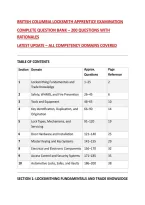
BRITISH COLUMBIA LOCKSMITH APPRENTICE EXAMINATION
COMPLETE QUESTION BANK – 200 QUESTIONS WITH
RATIONALES
LATEST UPDATE – ALL COMPETENCY DOMAINS COVERED
TABLE OF CONTENTS
Section Domain Approx. Page
Questions Reference
1 Locksmithing Fundamentals and 1–25 2
Trade Knowledge
2 Safety, WHMIS, and Fire Prevention 26–45 6
3 Tools and Equipment 46–65 10
4 Key Identification, Duplication, and 66–90 14
Origination
5 Lock Types, Mechanisms, and 91–120 19
Servicing
6 Door Hardware and Installation 121–140 25
7 Master Keying and Key Systems 141–155 29
8 Electrical and Electronic Components 156–170 32
9 Access Control and Security Systems 171–185 35
10 Automotive Locks, Safes, and Vaults 186–200 38
SECTION 1: LOCKSMITHING FUNDAMENTALS AND TRADE KNOWLEDGE
,Questions 1–25
1. What is the primary purpose of a lock mechanism in a security
system?
A. To increase the aesthetic value of a door
B. To prevent unauthorized access to a secured area
C. To reduce the weight of the door assembly
D. To provide structural support to the door frame
Answer: B
Rationale: The fundamental purpose of any lock is to restrict
unauthorized access while allowing authorized entry. While locks may
contribute to aesthetics or structural integrity, their primary function is
security.
2. In British Columbia, which regulatory body administers the Security
Services Regulation that governs locksmith licensing?
A. WorkSafeBC
B. BC Housing
C. Public Safety Canada
D. Provincial Security Regulatory Authority
Answer: D
Rationale: Locksmith licensing in British Columbia falls under the
Security Services Regulation, administered by the provincial security
regulatory authority. WorkSafeBC handles workplace safety, not
licensing.
,3. Which type of key has cuts on both the top and bottom edges of the
blade?
A. Paracentric key
B. Double-sided key
C. Tubular key
D. Skeleton key
Answer: B
Rationale: Double-sided keys have bitting cut on both edges of the
blade, allowing them to be inserted either way. Paracentric keys have
cuts on one edge only.
4. What does the term "cylinder" refer to in a pin tumbler lock?
A. The outer housing that contains the plug and pins
B. The rotating part that the key turns
C. The spring-loaded pins that prevent rotation
D. The keyway opening on the face of the lock
Answer: A
Rationale: The cylinder is the complete lock assembly housing that
contains the plug, pins, springs, and other internal components. The
plug is the rotating part, while the cylinder is the stationary housing.
5. Which historical figure is credited with developing the modern pin
tumbler lock?
, A. Alexander Graham Bell
B. Linus Yale Sr.
C. Henry Ford
D. Thomas Edison
Answer: B
Rationale: Linus Yale Sr. developed the pin tumbler lock in the mid-19th
century, and his son Linus Yale Jr. further refined it into the modern pin
tumbler mechanism widely used today.
6. What is the scope of practice for a licensed locksmith in British
Columbia?
A. Only cutting and duplicating keys
B. Installing, repairing, and servicing locks, safes, and security hardware
C. Only performing automotive lockout services
D. Only installing electronic access control systems
Answer: B
Rationale: The scope of locksmithing in BC encompasses a broad range
of services including key cutting, lock installation and repair, safe
servicing, automotive locks, and security hardware installation.
7. Which type of key is commonly used for high-security applications
and features cuts on the flat side of the blade?
A. Bit key
B. Tubular key
COMPLETE QUESTION BANK – 200 QUESTIONS WITH
RATIONALES
LATEST UPDATE – ALL COMPETENCY DOMAINS COVERED
TABLE OF CONTENTS
Section Domain Approx. Page
Questions Reference
1 Locksmithing Fundamentals and 1–25 2
Trade Knowledge
2 Safety, WHMIS, and Fire Prevention 26–45 6
3 Tools and Equipment 46–65 10
4 Key Identification, Duplication, and 66–90 14
Origination
5 Lock Types, Mechanisms, and 91–120 19
Servicing
6 Door Hardware and Installation 121–140 25
7 Master Keying and Key Systems 141–155 29
8 Electrical and Electronic Components 156–170 32
9 Access Control and Security Systems 171–185 35
10 Automotive Locks, Safes, and Vaults 186–200 38
SECTION 1: LOCKSMITHING FUNDAMENTALS AND TRADE KNOWLEDGE
,Questions 1–25
1. What is the primary purpose of a lock mechanism in a security
system?
A. To increase the aesthetic value of a door
B. To prevent unauthorized access to a secured area
C. To reduce the weight of the door assembly
D. To provide structural support to the door frame
Answer: B
Rationale: The fundamental purpose of any lock is to restrict
unauthorized access while allowing authorized entry. While locks may
contribute to aesthetics or structural integrity, their primary function is
security.
2. In British Columbia, which regulatory body administers the Security
Services Regulation that governs locksmith licensing?
A. WorkSafeBC
B. BC Housing
C. Public Safety Canada
D. Provincial Security Regulatory Authority
Answer: D
Rationale: Locksmith licensing in British Columbia falls under the
Security Services Regulation, administered by the provincial security
regulatory authority. WorkSafeBC handles workplace safety, not
licensing.
,3. Which type of key has cuts on both the top and bottom edges of the
blade?
A. Paracentric key
B. Double-sided key
C. Tubular key
D. Skeleton key
Answer: B
Rationale: Double-sided keys have bitting cut on both edges of the
blade, allowing them to be inserted either way. Paracentric keys have
cuts on one edge only.
4. What does the term "cylinder" refer to in a pin tumbler lock?
A. The outer housing that contains the plug and pins
B. The rotating part that the key turns
C. The spring-loaded pins that prevent rotation
D. The keyway opening on the face of the lock
Answer: A
Rationale: The cylinder is the complete lock assembly housing that
contains the plug, pins, springs, and other internal components. The
plug is the rotating part, while the cylinder is the stationary housing.
5. Which historical figure is credited with developing the modern pin
tumbler lock?
, A. Alexander Graham Bell
B. Linus Yale Sr.
C. Henry Ford
D. Thomas Edison
Answer: B
Rationale: Linus Yale Sr. developed the pin tumbler lock in the mid-19th
century, and his son Linus Yale Jr. further refined it into the modern pin
tumbler mechanism widely used today.
6. What is the scope of practice for a licensed locksmith in British
Columbia?
A. Only cutting and duplicating keys
B. Installing, repairing, and servicing locks, safes, and security hardware
C. Only performing automotive lockout services
D. Only installing electronic access control systems
Answer: B
Rationale: The scope of locksmithing in BC encompasses a broad range
of services including key cutting, lock installation and repair, safe
servicing, automotive locks, and security hardware installation.
7. Which type of key is commonly used for high-security applications
and features cuts on the flat side of the blade?
A. Bit key
B. Tubular key


