
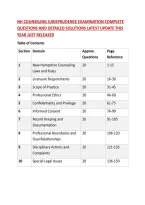
NH COUNSELING JURISPRUDENCE EXAMINATION COMPLETE
QUESTIONS AND DETAILED SOLUTIONS LATEST UPDATE THIS
YEAR JUST RELEASED
Table of Contents
Section Domain Approx. Page
Questions Reference
1 New Hampshire Counseling 20 1-15
Laws and Rules
2 Licensure Requirements 20 16-30
3 Scope of Practice 20 31-45
4 Professional Ethics 20 46-60
5 Confidentiality and Privilege 20 61-75
6 Informed Consent 20 76-90
7 Record Keeping and 20 91-105
Documentation
8 Professional Boundaries and 20 106-120
Dual Relationships
9 Disciplinary Actions and 20 121-135
Complaints
10 Special Legal Issues 20 136-150
,Section 1: New Hampshire Counseling Laws and Rules
1. According to NH RSA 330-A, what is the primary purpose of the
Board of Mental Health Practice?
A. To set national counseling standards.
B. To protect the public by regulating the practice of mental health
counseling.
C. To advocate for higher insurance reimbursement rates.
D. To provide free legal counsel to therapists.
Correct Answer: B
Rationale: The primary statutory mandate of the NH Board of Mental
Health Practice is to safeguard the health, safety, and welfare of the
public by ensuring that licensed professionals meet established
standards.
2. Under NH administrative rules, which of the following is required
for a licensed clinical mental health counselor to maintain their
license?
A. Annual publication of research.
B. Continuous membership in the ACA.
C. Completion of continuing education credits as specified by the Board.
D. Monthly supervision sessions.
Correct Answer: C
Rationale: NH rules mandate specific continuing education
requirements to ensure ongoing professional competence and license
renewal.
3. If a counselor practicing in New Hampshire is convicted of a
misdemeanor related to their practice, what is their obligation to the
,Board?
A. No obligation, as it is a misdemeanor.
B. Self-report the conviction to the Board within a specified timeframe.
C. Wait for the Board to discover it during the next renewal cycle.
D. Report it only if the client files a complaint.
Correct Answer: B
Rationale: Licensees are legally required to self-report certain criminal
convictions, particularly those related to their practice or involving
moral turpitude, to the Board within the mandated timeframe.
4. Which NH statute governs the practice of mental health counseling
and the disciplinary authority of the Board?
A. RSA 330-A
B. RSA 135-C
C. RSA 169-C
D. RSA 491
Correct Answer: A
Rationale: NH RSA 330-A is the specific statute that establishes the
Board of Mental Health Practice and governs the licensure and
regulation of mental health counselors.
5. What is the role of the NH Board of Mental Health Practice
regarding rulemaking?
A. Enacting federal laws.
B. Adopting administrative rules to implement and interpret RSA 330-A.
C. Overriding court decisions.
D. Setting fee schedules for private practice.
Correct Answer: B
Rationale: The Board is authorized to adopt administrative rules (e.g.,
, NH Code of Administrative Rules, Chapter He-P 400) that provide
detailed implementation of the statutory framework.
6. A counselor licensed in NH moves their practice entirely to another
state. What must they do regarding their NH license?
A. Maintain the NH license forever to avoid penalties.
B. Immediately notify the Board and follow procedures for license
inactivation or surrender.
C. Keep it active but not practice in NH.
D. Nothing, as long as they don't see NH clients.
Correct Answer: B
Rationale: Counselors must notify the Board of address changes and
follow specific administrative procedures if they intend to let their
license lapse or surrender it.
7. According to NH rules, what constitutes unprofessional conduct?
A. Failing to cure a client in 10 sessions.
B. Practicing outside one's scope of competence.
C. Disagreeing with a supervisor.
D. Using a sliding scale fee.
Correct Answer: B
Rationale: Practicing outside the boundaries of one's education,
training, and experience constitutes unprofessional conduct and a
violation of NH licensing rules.
8. What is the required response time for a licensee to respond to a
Board inquiry or subpoena?
A. 30 days.
B. 14 days.
C. The timeframe specified in the inquiry or as mandated by law.
QUESTIONS AND DETAILED SOLUTIONS LATEST UPDATE THIS
YEAR JUST RELEASED
Table of Contents
Section Domain Approx. Page
Questions Reference
1 New Hampshire Counseling 20 1-15
Laws and Rules
2 Licensure Requirements 20 16-30
3 Scope of Practice 20 31-45
4 Professional Ethics 20 46-60
5 Confidentiality and Privilege 20 61-75
6 Informed Consent 20 76-90
7 Record Keeping and 20 91-105
Documentation
8 Professional Boundaries and 20 106-120
Dual Relationships
9 Disciplinary Actions and 20 121-135
Complaints
10 Special Legal Issues 20 136-150
,Section 1: New Hampshire Counseling Laws and Rules
1. According to NH RSA 330-A, what is the primary purpose of the
Board of Mental Health Practice?
A. To set national counseling standards.
B. To protect the public by regulating the practice of mental health
counseling.
C. To advocate for higher insurance reimbursement rates.
D. To provide free legal counsel to therapists.
Correct Answer: B
Rationale: The primary statutory mandate of the NH Board of Mental
Health Practice is to safeguard the health, safety, and welfare of the
public by ensuring that licensed professionals meet established
standards.
2. Under NH administrative rules, which of the following is required
for a licensed clinical mental health counselor to maintain their
license?
A. Annual publication of research.
B. Continuous membership in the ACA.
C. Completion of continuing education credits as specified by the Board.
D. Monthly supervision sessions.
Correct Answer: C
Rationale: NH rules mandate specific continuing education
requirements to ensure ongoing professional competence and license
renewal.
3. If a counselor practicing in New Hampshire is convicted of a
misdemeanor related to their practice, what is their obligation to the
,Board?
A. No obligation, as it is a misdemeanor.
B. Self-report the conviction to the Board within a specified timeframe.
C. Wait for the Board to discover it during the next renewal cycle.
D. Report it only if the client files a complaint.
Correct Answer: B
Rationale: Licensees are legally required to self-report certain criminal
convictions, particularly those related to their practice or involving
moral turpitude, to the Board within the mandated timeframe.
4. Which NH statute governs the practice of mental health counseling
and the disciplinary authority of the Board?
A. RSA 330-A
B. RSA 135-C
C. RSA 169-C
D. RSA 491
Correct Answer: A
Rationale: NH RSA 330-A is the specific statute that establishes the
Board of Mental Health Practice and governs the licensure and
regulation of mental health counselors.
5. What is the role of the NH Board of Mental Health Practice
regarding rulemaking?
A. Enacting federal laws.
B. Adopting administrative rules to implement and interpret RSA 330-A.
C. Overriding court decisions.
D. Setting fee schedules for private practice.
Correct Answer: B
Rationale: The Board is authorized to adopt administrative rules (e.g.,
, NH Code of Administrative Rules, Chapter He-P 400) that provide
detailed implementation of the statutory framework.
6. A counselor licensed in NH moves their practice entirely to another
state. What must they do regarding their NH license?
A. Maintain the NH license forever to avoid penalties.
B. Immediately notify the Board and follow procedures for license
inactivation or surrender.
C. Keep it active but not practice in NH.
D. Nothing, as long as they don't see NH clients.
Correct Answer: B
Rationale: Counselors must notify the Board of address changes and
follow specific administrative procedures if they intend to let their
license lapse or surrender it.
7. According to NH rules, what constitutes unprofessional conduct?
A. Failing to cure a client in 10 sessions.
B. Practicing outside one's scope of competence.
C. Disagreeing with a supervisor.
D. Using a sliding scale fee.
Correct Answer: B
Rationale: Practicing outside the boundaries of one's education,
training, and experience constitutes unprofessional conduct and a
violation of NH licensing rules.
8. What is the required response time for a licensee to respond to a
Board inquiry or subpoena?
A. 30 days.
B. 14 days.
C. The timeframe specified in the inquiry or as mandated by law.


