
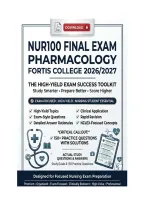
,NUR100 Pharmacology Final Exam Study Guide
& 150 Practice Questions Fortis College
2026/2027
1. A nurse is reviewing the pharmacokinetic properties of a newly prescribed medication. Which
term describes the study of what the body does to a drug, including absorption, distribution,
metabolism, and excretion?
A. Pharmacodynamics
B. Pharmacokinetics
C. Pharmacogenetics
D. Pharmacotherapeutics
Correct Answer: B. Pharmacokinetics
Rationale: Pharmacokinetics is the study of how the body affects a drug, encompassing
absorption, distribution, metabolism, and excretion (ADME). Pharmacodynamics (A) describes
how a drug affects the body, pharmacogenetics (C) examines genetic influences on drug
response, and pharmacotherapeutics (D) refers to the use of drugs to treat disease.
2. A client is receiving a medication that has a half-life of 6 hours. The nurse administers a dose
of 200 mg. Approximately how many milligrams of the drug will remain in the client's body after
24 hours?
,A. 50 mg
B. 25 mg
C. 12.5 mg
D. 6.25 mg
Correct Answer: C. 12.5 mg
Rationale: After 24 hours, four half-lives have elapsed (24 ÷ 6 = 4). After each half-life, the drug
concentration decreases by half: 0 hours: 200 mg; 6 hours: 100 mg; 12 hours: 50 mg; 18 hours:
25 mg; 24 hours: 12.5 mg. Understanding half-life is essential for determining dosing intervals,
predicting drug accumulation, and monitoring for toxicity.
3. A client is prescribed a medication that is 95% protein-bound. Which statement by the nurse
accurately explains the significance of this property?
A. "The medication will be rapidly excreted by the kidneys."
B. "Only 5% of the medication is available to produce a therapeutic effect."
C. "The medication will have a very short duration of action."
, D. "The medication will require higher doses to be effective."
Correct Answer: B. "Only 5% of the medication is available to produce a therapeutic effect."
Rationale: When a drug is highly protein-bound, only the unbound (free) portion is
pharmacologically active. If a drug is 95% protein-bound, only 5% is free to exert its therapeutic
effect. Protein binding does not determine the rate of renal excretion or the duration of action.
4. A nurse is teaching a patient about why nitroglycerin is administered sublingually rather than
orally. The nurse should explain that sublingual administration avoids which phenomenon?
A. Protein binding
B. First-pass hepatic metabolism
C. Renal tubular secretion
D. Enterohepatic recirculation
Correct Answer: B. First-pass hepatic metabolism
Rationale: The first-pass effect describes the extensive hepatic metabolism of drugs absorbed
from the GI tract before they reach systemic circulation; nitroglycerin has nearly 100% first-pass
metabolism, making oral administration ineffective. Sublingual administration allows direct
absorption into the systemic circulation via capillaries under the tongue, bypassing the liver.
HESI frequently tests first-pass effect with nitroglycerin, morphine, and propranolol—remember
these classic examples.
& 150 Practice Questions Fortis College
2026/2027
1. A nurse is reviewing the pharmacokinetic properties of a newly prescribed medication. Which
term describes the study of what the body does to a drug, including absorption, distribution,
metabolism, and excretion?
A. Pharmacodynamics
B. Pharmacokinetics
C. Pharmacogenetics
D. Pharmacotherapeutics
Correct Answer: B. Pharmacokinetics
Rationale: Pharmacokinetics is the study of how the body affects a drug, encompassing
absorption, distribution, metabolism, and excretion (ADME). Pharmacodynamics (A) describes
how a drug affects the body, pharmacogenetics (C) examines genetic influences on drug
response, and pharmacotherapeutics (D) refers to the use of drugs to treat disease.
2. A client is receiving a medication that has a half-life of 6 hours. The nurse administers a dose
of 200 mg. Approximately how many milligrams of the drug will remain in the client's body after
24 hours?
,A. 50 mg
B. 25 mg
C. 12.5 mg
D. 6.25 mg
Correct Answer: C. 12.5 mg
Rationale: After 24 hours, four half-lives have elapsed (24 ÷ 6 = 4). After each half-life, the drug
concentration decreases by half: 0 hours: 200 mg; 6 hours: 100 mg; 12 hours: 50 mg; 18 hours:
25 mg; 24 hours: 12.5 mg. Understanding half-life is essential for determining dosing intervals,
predicting drug accumulation, and monitoring for toxicity.
3. A client is prescribed a medication that is 95% protein-bound. Which statement by the nurse
accurately explains the significance of this property?
A. "The medication will be rapidly excreted by the kidneys."
B. "Only 5% of the medication is available to produce a therapeutic effect."
C. "The medication will have a very short duration of action."
, D. "The medication will require higher doses to be effective."
Correct Answer: B. "Only 5% of the medication is available to produce a therapeutic effect."
Rationale: When a drug is highly protein-bound, only the unbound (free) portion is
pharmacologically active. If a drug is 95% protein-bound, only 5% is free to exert its therapeutic
effect. Protein binding does not determine the rate of renal excretion or the duration of action.
4. A nurse is teaching a patient about why nitroglycerin is administered sublingually rather than
orally. The nurse should explain that sublingual administration avoids which phenomenon?
A. Protein binding
B. First-pass hepatic metabolism
C. Renal tubular secretion
D. Enterohepatic recirculation
Correct Answer: B. First-pass hepatic metabolism
Rationale: The first-pass effect describes the extensive hepatic metabolism of drugs absorbed
from the GI tract before they reach systemic circulation; nitroglycerin has nearly 100% first-pass
metabolism, making oral administration ineffective. Sublingual administration allows direct
absorption into the systemic circulation via capillaries under the tongue, bypassing the liver.
HESI frequently tests first-pass effect with nitroglycerin, morphine, and propranolol—remember
these classic examples.


