
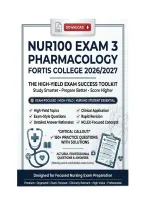
,NUR100 Pharmacology Exam 3 Study Guide &
150 Practice Questions Fortis College
2026/2027
1. A nurse is reviewing the mechanism of action of furosemide (Lasix). Which statement best
describes how this medication works?
A. It inhibits aldosterone in the distal tubule
B. It inhibits sodium and chloride reabsorption in the ascending loop of Henle
C. It blocks calcium channels in vascular smooth muscle
D. It inhibits carbonic anhydrase in the proximal tubule
Correct Answer: B. It inhibits sodium and chloride reabsorption in the ascending loop of Henle
Rationale: Furosemide is a loop diuretic that inhibits the sodium-potassium-chloride
cotransporter in the thick ascending limb of the loop of Henle, producing powerful diuresis. This
results in excretion of sodium, chloride, potassium, and water.
2. A nurse is caring for a patient taking furosemide who reports muscle weakness and cramping.
Which laboratory value should the nurse check first?
A. Serum sodium
,B. Serum potassium
C. Serum calcium
D. Serum magnesium
Correct Answer: B. Serum potassium
Rationale: Furosemide causes potassium loss (hypokalemia). Muscle weakness and cramping
are classic signs of hypokalemia. The nurse should monitor serum potassium levels closely,
especially in patients also taking digoxin, as hypokalemia increases the risk of digoxin toxicity.
3. A nurse is teaching a patient about spironolactone (Aldactone). Which instruction should the
nurse include?
A. "Increase your intake of potassium-rich foods."
B. "Avoid potassium supplements and salt substitutes containing potassium."
C. "Take this medication on an empty stomach."
D. "This medication will cause frequent urination at night."
Correct Answer: B. "Avoid potassium supplements and salt substitutes containing potassium."
, Rationale: Spironolactone is a potassium-sparing diuretic that can cause hyperkalemia. Patients
should avoid potassium supplements and salt substitutes (which often contain potassium
chloride) to prevent dangerously high potassium levels.
4. A nurse is assessing a patient taking spironolactone. Which finding requires immediate
intervention?
A. Serum potassium of 3.5 mEq/L
B. Serum potassium of 5.8 mEq/L
C. Blood pressure of 118/76 mm Hg
D. Urine output of 50 mL/hr
Correct Answer: B. Serum potassium of 5.8 mEq/L
Rationale: Spironolactone causes potassium retention. A serum potassium of 5.8 mEq/L
indicates hyperkalemia (normal: 3.5–5.0 mEq/L), which can cause life-threatening cardiac
dysrhythmias. The nurse should hold the medication and notify the provider immediately.
5. A nurse is teaching a patient about hydrochlorothiazide (HCTZ). Which adverse effect should
the nurse include in patient education?
150 Practice Questions Fortis College
2026/2027
1. A nurse is reviewing the mechanism of action of furosemide (Lasix). Which statement best
describes how this medication works?
A. It inhibits aldosterone in the distal tubule
B. It inhibits sodium and chloride reabsorption in the ascending loop of Henle
C. It blocks calcium channels in vascular smooth muscle
D. It inhibits carbonic anhydrase in the proximal tubule
Correct Answer: B. It inhibits sodium and chloride reabsorption in the ascending loop of Henle
Rationale: Furosemide is a loop diuretic that inhibits the sodium-potassium-chloride
cotransporter in the thick ascending limb of the loop of Henle, producing powerful diuresis. This
results in excretion of sodium, chloride, potassium, and water.
2. A nurse is caring for a patient taking furosemide who reports muscle weakness and cramping.
Which laboratory value should the nurse check first?
A. Serum sodium
,B. Serum potassium
C. Serum calcium
D. Serum magnesium
Correct Answer: B. Serum potassium
Rationale: Furosemide causes potassium loss (hypokalemia). Muscle weakness and cramping
are classic signs of hypokalemia. The nurse should monitor serum potassium levels closely,
especially in patients also taking digoxin, as hypokalemia increases the risk of digoxin toxicity.
3. A nurse is teaching a patient about spironolactone (Aldactone). Which instruction should the
nurse include?
A. "Increase your intake of potassium-rich foods."
B. "Avoid potassium supplements and salt substitutes containing potassium."
C. "Take this medication on an empty stomach."
D. "This medication will cause frequent urination at night."
Correct Answer: B. "Avoid potassium supplements and salt substitutes containing potassium."
, Rationale: Spironolactone is a potassium-sparing diuretic that can cause hyperkalemia. Patients
should avoid potassium supplements and salt substitutes (which often contain potassium
chloride) to prevent dangerously high potassium levels.
4. A nurse is assessing a patient taking spironolactone. Which finding requires immediate
intervention?
A. Serum potassium of 3.5 mEq/L
B. Serum potassium of 5.8 mEq/L
C. Blood pressure of 118/76 mm Hg
D. Urine output of 50 mL/hr
Correct Answer: B. Serum potassium of 5.8 mEq/L
Rationale: Spironolactone causes potassium retention. A serum potassium of 5.8 mEq/L
indicates hyperkalemia (normal: 3.5–5.0 mEq/L), which can cause life-threatening cardiac
dysrhythmias. The nurse should hold the medication and notify the provider immediately.
5. A nurse is teaching a patient about hydrochlorothiazide (HCTZ). Which adverse effect should
the nurse include in patient education?


