BIOL 2051
Lecture 1 –
Microbes—
their ubiquity,
nomenclature, and
basic concepts.
Dr. Nita
This space contain quick notes, details to refer or check for facts !!! Most of my
handouts will have this part. I will explain in class...
What is microbiology all about? What does the video show?
Use the terms that relate to Microbiology!
https://youtu.be/ngSRYacbeUk
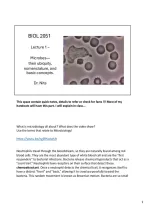
Neutrophils travel through the bloodstream, so they are naturally found among red
blood cells. They are the most abundant type of white blood cell and are the "first
responders" to bacterial infections. Bacteria release chemical byproducts that act as a
"scent trail." Neutrophils have receptors on their surface that detect these
chemoattractant. Once a neutrophil detects the chemical trail, it reorganizes itself to
have a distinct "front" and "back," allowing it to crawl purposefully toward the
bacteria. This random movement is known as Brownian motion. Bacteria are so small
1
,that they are constantly jostled by water molecules. They don't actively try to escape;
their movement just appears erratic. The neutrophil extends its cell membrane to
surround and swallow the bacteria, a process called phagocytosis (literally "cell
eating"). Once inside, the bacterium is destroyed with toxic chemicals.
1
, Homo sapiens are in
the same family:
Pongo (orangutans)
Primates
Gorilla (gorillas)
Pan (chimpanzees
and bonobos)
This space contain quick notes, details to refer or check for facts !!! Most of my
handouts will have this part. I will explain in class...
Nomenclature is a part of the broader field of taxonomy, which involves classifying
organisms into a structural hierarchy (like the Domain, Kingdom, Phylum system
shown in the image). The scientific name helps place an organism within this
hierarchical structure, which often reflects evolutionary relationships.
Nomenclature in microbiology, particularly the use of genus and species names, is
important because it provides a universal, precise, and standardized system for
identifying and communicating about specific microorganisms. The binomial system
(genus and species) is the most specific way to identify an organism, allowing for
clarity in various fields, especially clinical practice and research.
Standardization: A single, internationally accepted system, such as binomial
nomenclature (naming organisms with a two-part name for genus and species),
2
, ensures consistency across the globe.
Clarity and Universality: Scientific names avoid the confusion that arises from
common names, which can vary by region or language, or be used for multiple
different species. The scientific name for an organism is unique and can be used to
identify it anywhere in the world.
Communication: Scientists studying the same microorganism can be certain they are
referring to the exact same organism, facilitating accurate research, collaboration,
and data comparison.
2
Lecture 1 –
Microbes—
their ubiquity,
nomenclature, and
basic concepts.
Dr. Nita
This space contain quick notes, details to refer or check for facts !!! Most of my
handouts will have this part. I will explain in class...
What is microbiology all about? What does the video show?
Use the terms that relate to Microbiology!
https://youtu.be/ngSRYacbeUk
Neutrophils travel through the bloodstream, so they are naturally found among red
blood cells. They are the most abundant type of white blood cell and are the "first
responders" to bacterial infections. Bacteria release chemical byproducts that act as a
"scent trail." Neutrophils have receptors on their surface that detect these
chemoattractant. Once a neutrophil detects the chemical trail, it reorganizes itself to
have a distinct "front" and "back," allowing it to crawl purposefully toward the
bacteria. This random movement is known as Brownian motion. Bacteria are so small
1
,that they are constantly jostled by water molecules. They don't actively try to escape;
their movement just appears erratic. The neutrophil extends its cell membrane to
surround and swallow the bacteria, a process called phagocytosis (literally "cell
eating"). Once inside, the bacterium is destroyed with toxic chemicals.
1
, Homo sapiens are in
the same family:
Pongo (orangutans)
Primates
Gorilla (gorillas)
Pan (chimpanzees
and bonobos)
This space contain quick notes, details to refer or check for facts !!! Most of my
handouts will have this part. I will explain in class...
Nomenclature is a part of the broader field of taxonomy, which involves classifying
organisms into a structural hierarchy (like the Domain, Kingdom, Phylum system
shown in the image). The scientific name helps place an organism within this
hierarchical structure, which often reflects evolutionary relationships.
Nomenclature in microbiology, particularly the use of genus and species names, is
important because it provides a universal, precise, and standardized system for
identifying and communicating about specific microorganisms. The binomial system
(genus and species) is the most specific way to identify an organism, allowing for
clarity in various fields, especially clinical practice and research.
Standardization: A single, internationally accepted system, such as binomial
nomenclature (naming organisms with a two-part name for genus and species),
2
, ensures consistency across the globe.
Clarity and Universality: Scientific names avoid the confusion that arises from
common names, which can vary by region or language, or be used for multiple
different species. The scientific name for an organism is unique and can be used to
identify it anywhere in the world.
Communication: Scientists studying the same microorganism can be certain they are
referring to the exact same organism, facilitating accurate research, collaboration,
and data comparison.
2