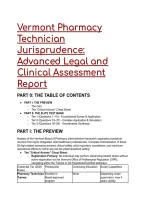
Vermont Pharmacy
Technician
Jurisprudence:
Advanced Legal and
Clinical Assessment
Report
PART 0: THE TABLE OF CONTENTS
● PART I: THE PREVIEW
○ The Intro
○ The "Critical Axioms" Cheat Sheet
● PART II: THE ELITE TEST BANK
○ Tier 1 (Questions 1–18) - Foundational Syntax & Application
○ Tier 2 (Questions 19–37) - Complex Application & Simulation
○ Tier 3 (Questions 38–55) - Grandmaster Synthesis
PART I: THE PREVIEW
Mastery of the Vermont Board of Pharmacy administrative framework separates procedural
novices from highly integrated, elite healthcare professionals. Complete internalization of these
55 high-stakes scenarios ensures clinical safety, strict regulatory compliance, and maximum
operational efficiency within any top-tier pharmaceutical setting.
● The "Critical Axioms" Cheat Sheet:
○ Registration Primacy: No individual may perform dispensing-related duties without
active registration via the Vermont Office of Professional Regulation (OPR),
navigating either the Trainee or full Registered/Certified pathways.
Credential Tier (2026 Prerequisite Continuing Education Scope Capabilities
Rules)
Pharmacy Technician Enrolled in None Dispensing under
Trainee Board-approved supervision; max 4
program years validity.
,Credential Tier (2026 Prerequisite Continuing Education Scope Capabilities
Rules)
Pharmacy Technician Board-approved 6 hrs biennially Full dispensing; TPV
training program eligible (if structured).
Certified Pharmacy National Certification 6 hrs VT (20 hrs Full dispensing; TPV
Technician (PTCB/NHA) National) eligible; Vaccine
eligible.
● Scope Isolation: Technicians are strictly prohibited from performing Drug Utilization
Reviews (DUR), resolving clinical conflicts, receiving new oral prescriptions, or conducting
patient counseling.
● Immunization Thresholds: Trained technicians with active CPR may administer
influenza and COVID-19 vaccines to patients aged 5+, and other ACIP-recommended
vaccines to patients aged 18+, strictly under direct pharmacist supervision.
● Controlled Substance Rigor: Schedule II prescriptions cannot be refilled and EXPIRE
30 days from issue (90 days if a future fill date is explicitly written). Schedule III/IV
prescriptions expire in 6 months or after 5 refills.
● Records and Reporting: Dispensing records must be retained for 3 years. Any theft or
significant loss demands Board notification within 48 hours.
PART II: THE ELITE TEST BANK
Tier 1 - Foundational Syntax & Application
Q1: A sixteen-year-old applicant seeks employment as a pharmacy technician in a Vermont
community pharmacy. The applicant has not completed high school and does not possess a
national certification. Based on the registration frameworks effective under the 2026 Vermont
administrative rules, which action is the MOST APPROPRIATE? A) The applicant is denied
registration because a high school diploma or equivalent is universally required for licensure. B)
The applicant is registered as a Certified Pharmacy Technician provided the employer institutes
a provisional training program. C) The applicant may register as a Pharmacy Technician Trainee
if entering a Board-approved training program, as high school graduation is not legally
mandated. D) The applicant may perform dispensing tasks immediately, provided the formal
application is submitted within 30 days of employment.
● Answer: C (The applicant may register as a Pharmacy Technician Trainee if entering a
Board-approved training program, as high school graduation is not legally mandated.)
● Distractor Analysis:
○ A is incorrect: Vermont law explicitly does not require applicants to hold a high
school diploma or GED for state registration.
○ B is incorrect: The Certified Pharmacy Technician designation requires active
maintenance of a Board-approved national certification (e.g., PTCB).
○ D is incorrect: An individual cannot perform any duties relative to dispensing prior to
official registration being issued by the OPR.
The Mentor's Analysis: Registration is the absolute baseline for legal practice. When facing
uncredentialed onboarding, the immediate priority is securing Trainee registration via a
Board-approved program. By utilizing the Trainee pathway, you bypass the common trap of
unauthorized pre-registration practice. Professional Intuition: State registration must be fully
active before a single dispensing task is performed, regardless of the employer's internal
, onboarding timelines.
Q2: A Vermont pharmacy technician is preparing for the biennial license renewal. The
technician holds a standard state registration but does not administer immunizations. According
to Vermont's 2026 administrative rules, what is the MINIMUM continuing education (CE)
requirement to renew this specific credential? A) Zero hours, as Vermont does not require CE
for standard pharmacy technicians. B) 6 hours of approved CE during the biennial licensing
period. C) 20 hours of approved CE, including 1 hour of Pharmacy Law. D) 8 hours of approved
CE, including 2 hours of immunization training.
● Answer: B (6 hours of approved CE during the biennial licensing period.)
● Distractor Analysis:
○ A is incorrect: This reflects outdated legacy rules; the 2026 rules mandate CE for all
registered technicians.
○ C is incorrect: 20 hours is the standard for maintaining national PTCB certification,
not the minimum baseline for Vermont state renewal.
○ D is incorrect: 2 hours of immunization-related CE is only required for technicians
who actively maintain immunization administration authority.
The Mentor's Analysis: Professional maintenance requires strict adherence to continuing
education metrics. When facing license renewal, the immediate priority is verifying the
completion of at least 6 state-mandated CE hours. By utilizing approved CE tracking, you
bypass the common trap of confusing national certification requirements with baseline state
requirements. Professional Intuition: State renewal requires 6 CE hours biennially; national
PTCB maintenance requires 20 CE hours biennially.
Q3: Under Vermont Board of Pharmacy rules, certain personnel within a pharmacy setting are
exempt from registering as pharmacy technicians. Which of the following individuals is
LEGALLY EXEMPT from registration? A) An individual who enters prescription data into the
pharmacy software but never physically handles medications. B) An individual whose duties are
strictly limited to cashiering and delivering medications. C) An individual who reconstitutes oral
antibiotics under direct pharmacist supervision. D) An individual who retrieves stock bottles from
the shelves for the pharmacist to verify.
● Answer: B (An individual whose duties are strictly limited to cashiering and delivering
medications.)
● Distractor Analysis:
○ A is incorrect: Prescription data entry is explicitly defined as a task requiring
registration as a pharmacy technician.
○ C is incorrect: Reconstitution is a compounding task related to dispensing, requiring
registration. * D is incorrect: Retrieving stock bottles constitutes assisting in the
dispensing process, which mandates registration.
The Mentor's Analysis: Regulatory oversight focuses on tasks directly impacting patient clinical
safety. When facing personnel delegation, the immediate priority is isolating non-dispensing
clerical tasks from dispensing mechanics. By utilizing unregistered staff only for pure retail
cashiering, you bypass the common trap of unauthorized personnel breaching the dispensing
workflow. Professional Intuition: If a task touches the clinical or physical preparation of a
drug order, the individual performing it must be registered.
Q4: A registered pharmacy technician in an institutional pharmacy setting is working alongside a
licensed pharmacist. Under normal operating conditions, without a specific variance granted by
the Board, what is the MAXIMUM pharmacist-to-technician ratio allowed in this institutional
setting? A) One pharmacist to one trained technical person (1:1). B) One pharmacist to two
trained technical persons (1:2). C) One pharmacist to four trained technical persons (1:4). D) No
Technician
Jurisprudence:
Advanced Legal and
Clinical Assessment
Report
PART 0: THE TABLE OF CONTENTS
● PART I: THE PREVIEW
○ The Intro
○ The "Critical Axioms" Cheat Sheet
● PART II: THE ELITE TEST BANK
○ Tier 1 (Questions 1–18) - Foundational Syntax & Application
○ Tier 2 (Questions 19–37) - Complex Application & Simulation
○ Tier 3 (Questions 38–55) - Grandmaster Synthesis
PART I: THE PREVIEW
Mastery of the Vermont Board of Pharmacy administrative framework separates procedural
novices from highly integrated, elite healthcare professionals. Complete internalization of these
55 high-stakes scenarios ensures clinical safety, strict regulatory compliance, and maximum
operational efficiency within any top-tier pharmaceutical setting.
● The "Critical Axioms" Cheat Sheet:
○ Registration Primacy: No individual may perform dispensing-related duties without
active registration via the Vermont Office of Professional Regulation (OPR),
navigating either the Trainee or full Registered/Certified pathways.
Credential Tier (2026 Prerequisite Continuing Education Scope Capabilities
Rules)
Pharmacy Technician Enrolled in None Dispensing under
Trainee Board-approved supervision; max 4
program years validity.
,Credential Tier (2026 Prerequisite Continuing Education Scope Capabilities
Rules)
Pharmacy Technician Board-approved 6 hrs biennially Full dispensing; TPV
training program eligible (if structured).
Certified Pharmacy National Certification 6 hrs VT (20 hrs Full dispensing; TPV
Technician (PTCB/NHA) National) eligible; Vaccine
eligible.
● Scope Isolation: Technicians are strictly prohibited from performing Drug Utilization
Reviews (DUR), resolving clinical conflicts, receiving new oral prescriptions, or conducting
patient counseling.
● Immunization Thresholds: Trained technicians with active CPR may administer
influenza and COVID-19 vaccines to patients aged 5+, and other ACIP-recommended
vaccines to patients aged 18+, strictly under direct pharmacist supervision.
● Controlled Substance Rigor: Schedule II prescriptions cannot be refilled and EXPIRE
30 days from issue (90 days if a future fill date is explicitly written). Schedule III/IV
prescriptions expire in 6 months or after 5 refills.
● Records and Reporting: Dispensing records must be retained for 3 years. Any theft or
significant loss demands Board notification within 48 hours.
PART II: THE ELITE TEST BANK
Tier 1 - Foundational Syntax & Application
Q1: A sixteen-year-old applicant seeks employment as a pharmacy technician in a Vermont
community pharmacy. The applicant has not completed high school and does not possess a
national certification. Based on the registration frameworks effective under the 2026 Vermont
administrative rules, which action is the MOST APPROPRIATE? A) The applicant is denied
registration because a high school diploma or equivalent is universally required for licensure. B)
The applicant is registered as a Certified Pharmacy Technician provided the employer institutes
a provisional training program. C) The applicant may register as a Pharmacy Technician Trainee
if entering a Board-approved training program, as high school graduation is not legally
mandated. D) The applicant may perform dispensing tasks immediately, provided the formal
application is submitted within 30 days of employment.
● Answer: C (The applicant may register as a Pharmacy Technician Trainee if entering a
Board-approved training program, as high school graduation is not legally mandated.)
● Distractor Analysis:
○ A is incorrect: Vermont law explicitly does not require applicants to hold a high
school diploma or GED for state registration.
○ B is incorrect: The Certified Pharmacy Technician designation requires active
maintenance of a Board-approved national certification (e.g., PTCB).
○ D is incorrect: An individual cannot perform any duties relative to dispensing prior to
official registration being issued by the OPR.
The Mentor's Analysis: Registration is the absolute baseline for legal practice. When facing
uncredentialed onboarding, the immediate priority is securing Trainee registration via a
Board-approved program. By utilizing the Trainee pathway, you bypass the common trap of
unauthorized pre-registration practice. Professional Intuition: State registration must be fully
active before a single dispensing task is performed, regardless of the employer's internal
, onboarding timelines.
Q2: A Vermont pharmacy technician is preparing for the biennial license renewal. The
technician holds a standard state registration but does not administer immunizations. According
to Vermont's 2026 administrative rules, what is the MINIMUM continuing education (CE)
requirement to renew this specific credential? A) Zero hours, as Vermont does not require CE
for standard pharmacy technicians. B) 6 hours of approved CE during the biennial licensing
period. C) 20 hours of approved CE, including 1 hour of Pharmacy Law. D) 8 hours of approved
CE, including 2 hours of immunization training.
● Answer: B (6 hours of approved CE during the biennial licensing period.)
● Distractor Analysis:
○ A is incorrect: This reflects outdated legacy rules; the 2026 rules mandate CE for all
registered technicians.
○ C is incorrect: 20 hours is the standard for maintaining national PTCB certification,
not the minimum baseline for Vermont state renewal.
○ D is incorrect: 2 hours of immunization-related CE is only required for technicians
who actively maintain immunization administration authority.
The Mentor's Analysis: Professional maintenance requires strict adherence to continuing
education metrics. When facing license renewal, the immediate priority is verifying the
completion of at least 6 state-mandated CE hours. By utilizing approved CE tracking, you
bypass the common trap of confusing national certification requirements with baseline state
requirements. Professional Intuition: State renewal requires 6 CE hours biennially; national
PTCB maintenance requires 20 CE hours biennially.
Q3: Under Vermont Board of Pharmacy rules, certain personnel within a pharmacy setting are
exempt from registering as pharmacy technicians. Which of the following individuals is
LEGALLY EXEMPT from registration? A) An individual who enters prescription data into the
pharmacy software but never physically handles medications. B) An individual whose duties are
strictly limited to cashiering and delivering medications. C) An individual who reconstitutes oral
antibiotics under direct pharmacist supervision. D) An individual who retrieves stock bottles from
the shelves for the pharmacist to verify.
● Answer: B (An individual whose duties are strictly limited to cashiering and delivering
medications.)
● Distractor Analysis:
○ A is incorrect: Prescription data entry is explicitly defined as a task requiring
registration as a pharmacy technician.
○ C is incorrect: Reconstitution is a compounding task related to dispensing, requiring
registration. * D is incorrect: Retrieving stock bottles constitutes assisting in the
dispensing process, which mandates registration.
The Mentor's Analysis: Regulatory oversight focuses on tasks directly impacting patient clinical
safety. When facing personnel delegation, the immediate priority is isolating non-dispensing
clerical tasks from dispensing mechanics. By utilizing unregistered staff only for pure retail
cashiering, you bypass the common trap of unauthorized personnel breaching the dispensing
workflow. Professional Intuition: If a task touches the clinical or physical preparation of a
drug order, the individual performing it must be registered.
Q4: A registered pharmacy technician in an institutional pharmacy setting is working alongside a
licensed pharmacist. Under normal operating conditions, without a specific variance granted by
the Board, what is the MAXIMUM pharmacist-to-technician ratio allowed in this institutional
setting? A) One pharmacist to one trained technical person (1:1). B) One pharmacist to two
trained technical persons (1:2). C) One pharmacist to four trained technical persons (1:4). D) No