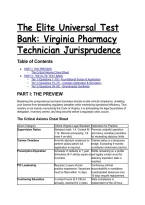
The Elite Universal Test
Bank: Virginia Pharmacy
Technician Jurisprudence
Table of Contents
● PART I: THE PREVIEW
○ The Critical Axioms Cheat Sheet
● PART II: THE ELITE TEST BANK
○ Tier 1 (Questions 1–18) - Foundational Syntax & Application
○ Tier 2 (Questions 19–37) - Complex Application & Simulation
○ Tier 3 (Questions 38–55) - Grandmaster Synthesis
PART I: THE PREVIEW
Mastering this jurisprudence test bank translates directly to elite clinical compliance, shielding
your license from devastating regulatory penalties while maximizing operational efficiency. True
mastery is not merely memorizing the Code of Virginia; it is anticipating the legal boundaries of
delegation, inventory control, and drug security before a regulatory crisis occurs.
The Critical Axioms Cheat Sheet
Axiom Category Critical Virginia Legal Standard Implication for Practice
Supervision Ratios Standard retail: 1:4. Central fill: Prevents unlawful operation
1:12. Remote processing: 1:6 and heavy monetary penalties
(max 4 on-site). for exceeding statutory limits.
Trainee Timelines 9-month absolute maximum to Trainee status is a temporary
perform duties before full bridge. Exceeding 9 months
registration is required. constitutes unlicensed practice.
Prescription Expiration Schedule VI defaults to 1 year. Refills remaining on a profile
Schedules III-V strictly expire at are legally voided once the
6 months. statutory expiration date is
reached.
PIC Leadership Requires 2 years of prior Continuous clinical
practice experience. Vacancies accountability is mandatory.
must be filled within 14 days. Unanticipated absences over
15 days require replacement.
Continuing Education 5 contact hours (0.5 CEUs) State compliance is
annually, retained for 2 years independent of the 20-hour
,Axiom Category Critical Virginia Legal Standard Implication for Practice
post-renewal. biennial PTCB national
requirement.
PART II: THE ELITE TEST BANK
Tier 1 (Questions 1–18) - Foundational Syntax & Application
Q1: A retail pharmacy in Virginia utilizes pharmacy technicians for dispensing and
compounding. One pharmacist is on duty. Based on the Virginia Board of Pharmacy regulations,
which maximum staffing ratio is the MOST APPROPRIATE legal standard? A) One pharmacist
supervising six pharmacy technicians in a standard retail setting. B) One pharmacist supervising
four pharmacy technicians, provided two are board-certified. C) One pharmacist supervising four
persons performing the duties of a pharmacy technician. D) One pharmacist supervising two
pharmacy technician trainees and three registered technicians.
● Answer: C (One pharmacist supervising four persons performing the duties of a pharmacy
technician.)
● Distractor Analysis:
○ A is incorrect: The 1:6 ratio applies specifically to cannabis dispensing facilities or
remote processing, not standard retail.
○ B is incorrect: Virginia enforces a hard 1:4 ratio for standard retail practice; it does
not automatically increase based on the national certification status of the
technicians.
○ D is incorrect: The absolute maximum is four persons total (technicians and
trainees combined) performing restricted duties.
The Mentor's Analysis: The legal baseline for standard retail supervision is strictly capped to
ensure patient safety. When facing personnel allocation, the immediate priority is calculating
total unlicensed personnel performing restricted duties. By utilizing the 1:4 combined limit, you
bypass the common trap of overstaffing based on certification tiers seen in other jurisdictions.
Professional Intuition: A Virginia pharmacist may supervise a maximum of four persons
performing pharmacy technician duties at one time in a standard retail environment.
Q2: A pharmacy technician trainee is hired and immediately enrolled in a board-approved
training program. Based on the Code of Virginia, which timeframe represents the MAXIMUM
duration this individual can perform restricted duties without full registration? A) Six months from
the date of hire. B) Nine months from the date they begin performing restricted duties. C)
Twelve months from the date of enrollment in the training program. D) Eighteen months if an
extension is granted by the Pharmacist-in-Charge.
● Answer: B (Nine months from the date they begin performing restricted duties.)
● Distractor Analysis:
○ A is incorrect: The limit is nine months, not six, and the clock starts upon performing
duties, not necessarily the exact date of hire.
○ C is incorrect: The trainee registration strictly expires nine months from the
commencement of restricted duties.
○ D is incorrect: The PIC has no statutory authority to extend a trainee's working
window beyond the nine-month regulatory ceiling.
The Mentor's Analysis: Trainee status is a temporary bridge, not a permanent exemption. When
facing trainee onboarding, the immediate priority is tracking the exact date restricted duties
commence. By utilizing the strict nine-month cutoff, you bypass the common trap of allowing
, unregistered personnel to incur disciplinary monetary penalties for the pharmacy. Professional
Intuition: Trainee status is a strict 9-month countdown; failure to register by month 10
constitutes unlicensed practice.
Q3: A registered pharmacy technician in Virginia is preparing for annual license renewal. Based
on Virginia continued competency requirements, what is the EXACT continuing education (CE)
obligation? A) 15 contact hours annually, including 3 live hours. B) 5 contact hours (0.5 CEUs)
annually. C) 20 contact hours biennially, including 1 hour of law. D) 10 contact hours annually,
with 2 hours in patient safety.
● Answer: B (5 contact hours (0.5 CEUs) annually.)
● Distractor Analysis:
○ A is incorrect: This is the annual continuing education requirement for a Virginia
registered pharmacist, not a technician.
○ C is incorrect: This reflects the biennial requirement for national certification (e.g.,
PTCB), which is distinct from the state's annual renewal mandate.
○ D is incorrect: There is no 10-hour annual requirement for technicians in Virginia
jurisprudence.
The Mentor's Analysis: State renewal and national certification are parallel but distinct legal
obligations. When facing license renewal, the immediate priority is fulfilling the state-specific
Board of Pharmacy requirements. By utilizing the 5-hour annual rule, you bypass the common
trap of confusing national PTCB biennial requirements with state law. Professional Intuition:
Virginia requires 0.5 CEUs (5 hours) annually for technicians, separate from any national
certification cycles.
Q4: A pharmacy technician receives a written prescription for a Schedule VI medication. The
patient asks how long the prescription is valid before it expires. Based on the Drug Control Act,
which duration is the DEFAULT expiration? A) 6 months from the date of issue. B) 1 year from
the date of issue. C) 2 years from the date of issue. D) It does not expire as long as refills
remain.
● Answer: B (1 year from the date of issue.)
● Distractor Analysis:
○ A is incorrect: Six months is the strict statutory expiration for Schedule III, IV, and V
controlled substances, not Schedule VI.
○ C is incorrect: While a prescriber can specifically authorize a Schedule VI
prescription to be valid for up to two years, one year is the legal default.
○ D is incorrect: All prescriptions have a statutory expiration date in Virginia; indefinite
validity is legally prohibited.
The Mentor's Analysis: Prescription validity is tiered by the abuse potential of the drug schedule.
When facing Schedule VI drug expiration, the immediate priority is applying the one-year default
rule. By utilizing the one-year baseline, you bypass the common trap of confusing maintenance
drug refills with Schedule III-V restrictions. Professional Intuition: Schedule VI prescriptions
expire in 1 year unless explicitly extended by the prescriber (up to 2 years max).
Q5: A pharmacy utilizes an automated data processing system. A patient presents a hard-copy
prescription for a Schedule II controlled substance. Based on Virginia recordkeeping
regulations, which retention protocol is MANDATORY? A) The electronic image may replace the
hard copy immediately upon scanning. B) The hard copy must be maintained in a separate file
for two years from the date of dispensing. C) The hard copy must be maintained for five years in
an integrated Schedule II-V file. D) The hard copy may be returned to the patient once the
electronic data entry is verified.
● Answer: B (The hard copy must be maintained in a separate file for two years from the
Bank: Virginia Pharmacy
Technician Jurisprudence
Table of Contents
● PART I: THE PREVIEW
○ The Critical Axioms Cheat Sheet
● PART II: THE ELITE TEST BANK
○ Tier 1 (Questions 1–18) - Foundational Syntax & Application
○ Tier 2 (Questions 19–37) - Complex Application & Simulation
○ Tier 3 (Questions 38–55) - Grandmaster Synthesis
PART I: THE PREVIEW
Mastering this jurisprudence test bank translates directly to elite clinical compliance, shielding
your license from devastating regulatory penalties while maximizing operational efficiency. True
mastery is not merely memorizing the Code of Virginia; it is anticipating the legal boundaries of
delegation, inventory control, and drug security before a regulatory crisis occurs.
The Critical Axioms Cheat Sheet
Axiom Category Critical Virginia Legal Standard Implication for Practice
Supervision Ratios Standard retail: 1:4. Central fill: Prevents unlawful operation
1:12. Remote processing: 1:6 and heavy monetary penalties
(max 4 on-site). for exceeding statutory limits.
Trainee Timelines 9-month absolute maximum to Trainee status is a temporary
perform duties before full bridge. Exceeding 9 months
registration is required. constitutes unlicensed practice.
Prescription Expiration Schedule VI defaults to 1 year. Refills remaining on a profile
Schedules III-V strictly expire at are legally voided once the
6 months. statutory expiration date is
reached.
PIC Leadership Requires 2 years of prior Continuous clinical
practice experience. Vacancies accountability is mandatory.
must be filled within 14 days. Unanticipated absences over
15 days require replacement.
Continuing Education 5 contact hours (0.5 CEUs) State compliance is
annually, retained for 2 years independent of the 20-hour
,Axiom Category Critical Virginia Legal Standard Implication for Practice
post-renewal. biennial PTCB national
requirement.
PART II: THE ELITE TEST BANK
Tier 1 (Questions 1–18) - Foundational Syntax & Application
Q1: A retail pharmacy in Virginia utilizes pharmacy technicians for dispensing and
compounding. One pharmacist is on duty. Based on the Virginia Board of Pharmacy regulations,
which maximum staffing ratio is the MOST APPROPRIATE legal standard? A) One pharmacist
supervising six pharmacy technicians in a standard retail setting. B) One pharmacist supervising
four pharmacy technicians, provided two are board-certified. C) One pharmacist supervising four
persons performing the duties of a pharmacy technician. D) One pharmacist supervising two
pharmacy technician trainees and three registered technicians.
● Answer: C (One pharmacist supervising four persons performing the duties of a pharmacy
technician.)
● Distractor Analysis:
○ A is incorrect: The 1:6 ratio applies specifically to cannabis dispensing facilities or
remote processing, not standard retail.
○ B is incorrect: Virginia enforces a hard 1:4 ratio for standard retail practice; it does
not automatically increase based on the national certification status of the
technicians.
○ D is incorrect: The absolute maximum is four persons total (technicians and
trainees combined) performing restricted duties.
The Mentor's Analysis: The legal baseline for standard retail supervision is strictly capped to
ensure patient safety. When facing personnel allocation, the immediate priority is calculating
total unlicensed personnel performing restricted duties. By utilizing the 1:4 combined limit, you
bypass the common trap of overstaffing based on certification tiers seen in other jurisdictions.
Professional Intuition: A Virginia pharmacist may supervise a maximum of four persons
performing pharmacy technician duties at one time in a standard retail environment.
Q2: A pharmacy technician trainee is hired and immediately enrolled in a board-approved
training program. Based on the Code of Virginia, which timeframe represents the MAXIMUM
duration this individual can perform restricted duties without full registration? A) Six months from
the date of hire. B) Nine months from the date they begin performing restricted duties. C)
Twelve months from the date of enrollment in the training program. D) Eighteen months if an
extension is granted by the Pharmacist-in-Charge.
● Answer: B (Nine months from the date they begin performing restricted duties.)
● Distractor Analysis:
○ A is incorrect: The limit is nine months, not six, and the clock starts upon performing
duties, not necessarily the exact date of hire.
○ C is incorrect: The trainee registration strictly expires nine months from the
commencement of restricted duties.
○ D is incorrect: The PIC has no statutory authority to extend a trainee's working
window beyond the nine-month regulatory ceiling.
The Mentor's Analysis: Trainee status is a temporary bridge, not a permanent exemption. When
facing trainee onboarding, the immediate priority is tracking the exact date restricted duties
commence. By utilizing the strict nine-month cutoff, you bypass the common trap of allowing
, unregistered personnel to incur disciplinary monetary penalties for the pharmacy. Professional
Intuition: Trainee status is a strict 9-month countdown; failure to register by month 10
constitutes unlicensed practice.
Q3: A registered pharmacy technician in Virginia is preparing for annual license renewal. Based
on Virginia continued competency requirements, what is the EXACT continuing education (CE)
obligation? A) 15 contact hours annually, including 3 live hours. B) 5 contact hours (0.5 CEUs)
annually. C) 20 contact hours biennially, including 1 hour of law. D) 10 contact hours annually,
with 2 hours in patient safety.
● Answer: B (5 contact hours (0.5 CEUs) annually.)
● Distractor Analysis:
○ A is incorrect: This is the annual continuing education requirement for a Virginia
registered pharmacist, not a technician.
○ C is incorrect: This reflects the biennial requirement for national certification (e.g.,
PTCB), which is distinct from the state's annual renewal mandate.
○ D is incorrect: There is no 10-hour annual requirement for technicians in Virginia
jurisprudence.
The Mentor's Analysis: State renewal and national certification are parallel but distinct legal
obligations. When facing license renewal, the immediate priority is fulfilling the state-specific
Board of Pharmacy requirements. By utilizing the 5-hour annual rule, you bypass the common
trap of confusing national PTCB biennial requirements with state law. Professional Intuition:
Virginia requires 0.5 CEUs (5 hours) annually for technicians, separate from any national
certification cycles.
Q4: A pharmacy technician receives a written prescription for a Schedule VI medication. The
patient asks how long the prescription is valid before it expires. Based on the Drug Control Act,
which duration is the DEFAULT expiration? A) 6 months from the date of issue. B) 1 year from
the date of issue. C) 2 years from the date of issue. D) It does not expire as long as refills
remain.
● Answer: B (1 year from the date of issue.)
● Distractor Analysis:
○ A is incorrect: Six months is the strict statutory expiration for Schedule III, IV, and V
controlled substances, not Schedule VI.
○ C is incorrect: While a prescriber can specifically authorize a Schedule VI
prescription to be valid for up to two years, one year is the legal default.
○ D is incorrect: All prescriptions have a statutory expiration date in Virginia; indefinite
validity is legally prohibited.
The Mentor's Analysis: Prescription validity is tiered by the abuse potential of the drug schedule.
When facing Schedule VI drug expiration, the immediate priority is applying the one-year default
rule. By utilizing the one-year baseline, you bypass the common trap of confusing maintenance
drug refills with Schedule III-V restrictions. Professional Intuition: Schedule VI prescriptions
expire in 1 year unless explicitly extended by the prescriber (up to 2 years max).
Q5: A pharmacy utilizes an automated data processing system. A patient presents a hard-copy
prescription for a Schedule II controlled substance. Based on Virginia recordkeeping
regulations, which retention protocol is MANDATORY? A) The electronic image may replace the
hard copy immediately upon scanning. B) The hard copy must be maintained in a separate file
for two years from the date of dispensing. C) The hard copy must be maintained for five years in
an integrated Schedule II-V file. D) The hard copy may be returned to the patient once the
electronic data entry is verified.
● Answer: B (The hard copy must be maintained in a separate file for two years from the