
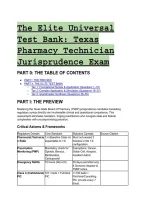
The Elite Universal
Test Bank: Texas
Pharmacy Technician
Jurisprudence Exam
PART 0: THE TABLE OF CONTENTS
● PART I: THE PREVIEW
● PART II: THE ELITE TEST BANK
○ Tier 1: Foundational Syntax & Application (Questions 1–18)
○ Tier 2: Complex Application & Simulation (Questions 19–37)
○ Tier 3: Grandmaster Synthesis (Questions 38–55)
PART I: THE PREVIEW
Mastering the Texas State Board of Pharmacy (TSBP) jurisprudence mandates translating
regulatory syntax directly into invulnerable clinical and operational competence. This
assessment eliminates hesitation, forging practitioners who navigate state and federal
complexities with uncompromising precision.
Critical Axioms & Frameworks
Regulatory Domain Core Standard Statutory Caveats Source Citation
Pharmacist:Technicia 1:4 (Baseline Class A) Must not exceed 3
n Ratio expandable to 1:6 trainees in the 1:6
configuration.
Prescription Mandatory check for Exemptions: Cancer,
Monitoring (PMP) Opioids, Benzos, Sickle Cell, Hospice,
Barbiturates, Inpatient Admin.
Carisoprodol
Emergency Refills 72 hours (Non-CII) 30 days permitted only
if Governor disaster &
TSBP notice.
Class C (Institutional) 101+ beds = Full-time <=100 beds =
PIC PIC Part-time/Consulting
PIC (on-site every 7
days).
,Regulatory Domain Core Standard Statutory Caveats Source Citation
Telepharmacy 1:3 Ratio; 1 year prior Absolutely NO
(Remote) retail experience Schedule II dispensing;
becomes Class A >125
Rx/day.
USP <800> C-SEC Negative Pressure 12 ACPH for non-sterile
HVAC (0.01–0.03 in w.c.) HD; 30 ACPH for sterile
HD.
PART II: THE ELITE TEST BANK
Tier 1: Foundational Syntax & Application
Q1: A pharmacist at a Class A community pharmacy is scheduling the weekend shift. Based on
TSBP regulations, which staffing configuration is the MAXIMUM allowable ratio of pharmacists
to pharmacy technicians? A) One pharmacist to four fully registered technicians and three
trainees B) One pharmacist to seven fully registered technicians C) One pharmacist to six
technicians, provided no more than three are trainees D) One pharmacist to five technicians,
regardless of trainee status
● Answer: C (One pharmacist to six technicians, provided no more than three are trainees)
● Distractor Analysis:
○ A is incorrect: This equates to a 1:7 ratio, exceeding the absolute state maximum
for Class A settings .
○ B is incorrect: A 1:7 ratio is strictly prohibited in Class A pharmacies .
○ D is incorrect: The 1:6 ratio dictates a hard cap on trainees; general configurations
must respect the trainee ceiling .
The Mentor's Analysis: Texas law balances workforce scalability with patient safety by capping
the number of unlicensed trainees a pharmacist can actively supervise. Exceeding the trainee
limit within the expanded ratio fundamentally breaches operational compliance. Professional
Intuition: The Class A ceiling is 1:6, strictly contingent on a maximum of three trainees.
Q2: A pharmacist-in-charge (PIC) is reviewing employment contracts for a health system. Based
on TSBP Class C pharmacy rules, which action is PROHIBITED? A) Serving as a part-time PIC
for three rural hospitals, each with 25 beds B) Serving as the full-time PIC for a hospital with 120
beds and simultaneously serving as PIC for a Class A retail pharmacy C) Serving as PIC for one
110-bed hospital and one 40-bed hospital D) Serving as a consulting PIC for a 90-bed facility,
visiting on-site once every seven days
● Answer: B (Serving as the full-time PIC for a hospital with 120 beds and simultaneously
serving as PIC for a Class A retail pharmacy)
● Distractor Analysis:
○ A is incorrect: A PIC may oversee up to three facilities or 150 beds total if all
facilities have 100 beds or fewer .
○ C is incorrect: A PIC can manage one 101+ bed facility and one <=100 bed facility if
the total does not exceed 150 beds .
○ D is incorrect: Facilities with <=100 beds require at minimum a part-time PIC on-site
every 7 days.
The Mentor's Analysis: The threshold of 101 beds triggers the requirement for dedicated,
continuous oversight. Managing a high-volume institutional pharmacy while attempting to control
a community pharmacy creates an unacceptable division of liability. Professional Intuition: A
, PIC of a Class C pharmacy with 101+ beds is legally barred from serving as a PIC for Class A
or B pharmacies.
Q3: A candidate receives a Pharmacy Technician Trainee registration. Based on TSBP
regulations, which conclusion regarding this credential is MOST ACCURATE? A) It can be
renewed once for an additional two years upon completion of 20 hours of CE. B) It expires
permanently after two years and cannot be renewed or extended. C) It allows the trainee to
perform complex sterile compounding without pharmacist supervision. D) It converts
automatically to a full registration once 500 hours are logged.
● Answer: B (It expires permanently after two years and cannot be renewed or extended.)
● Distractor Analysis:
○ A is incorrect: Trainee registrations are strictly non-renewable .
○ C is incorrect: Trainees cannot perform unsupervised sterile compounding.
○ D is incorrect: Automatic conversion does not exist; candidates must pass a
board-approved exam and submit a new application.
The Mentor's Analysis: The trainee designation is a strict, temporary window designed to force
academic progression. Failure to achieve national certification within this timeframe terminates
the individual's legal ability to practice. Professional Intuition: The trainee license is a
non-renewable, two-year mandate to certify.
Q4: A fully registered pharmacy technician is preparing for license renewal. According to TSBP
continuing education (CE) requirements, which combination of hours is MANDATORY? A) 30
contact hours, including 2 hours of Texas pharmacy law B) 20 contact hours, including 1 hour of
Texas-specific pharmacy law and 1 approved human-trafficking prevention course C) 20 contact
hours, including 3 hours of federal law D) 15 contact hours, all of which must be live sessions
● Answer: B (20 contact hours, including 1 hour of Texas-specific pharmacy law and 1
approved human-trafficking prevention course)
● Distractor Analysis:
○ A is incorrect: Pharmacists require 30 hours; technicians require 20.
○ C is incorrect: The law requirement specifies Texas law, not general federal law.
○ D is incorrect: Texas does not require live CE hours for technicians.
The Mentor's Analysis: Competency requires continual maintenance. The Board isolates
Texas-specific jurisprudence and human trafficking prevention as absolute priorities for
technician re-registration. Professional Intuition: Biennial renewal requires 20 CE hours,
including 1 hour of Texas law and a human-trafficking course.
Q5: Under Texas law, which examination is recognized by the TSBP for upgrading a Pharmacy
Technician Trainee to a fully registered Pharmacy Technician? A) The Multistate Pharmacy
Jurisprudence Examination (MPJE) B) The Pharmacy Technician Certification Exam (PTCE) or
the Exam for the Certification of Pharmacy Technicians (ExCPT) C) The North American
Pharmacist Licensure Examination (NAPLEX) D) The Texas Standardized Technician
Assessment (TSTA)
● Answer: B (The Pharmacy Technician Certification Exam (PTCE) or the Exam for the
Certification of Pharmacy Technicians (ExCPT))
● Distractor Analysis:
○ A is incorrect: The MPJE is the jurisprudence exam for pharmacists.
○ C is incorrect: The NAPLEX is the clinical competency exam for pharmacists.
○ D is incorrect: This is a fabricated exam title; Texas relies on national certification
bodies.
The Mentor's Analysis: Texas utilizes national credentialing bodies to verify baseline
competency. Passing the PTCE or ExCPT is the non-negotiable gateway to full registration and
Test Bank: Texas
Pharmacy Technician
Jurisprudence Exam
PART 0: THE TABLE OF CONTENTS
● PART I: THE PREVIEW
● PART II: THE ELITE TEST BANK
○ Tier 1: Foundational Syntax & Application (Questions 1–18)
○ Tier 2: Complex Application & Simulation (Questions 19–37)
○ Tier 3: Grandmaster Synthesis (Questions 38–55)
PART I: THE PREVIEW
Mastering the Texas State Board of Pharmacy (TSBP) jurisprudence mandates translating
regulatory syntax directly into invulnerable clinical and operational competence. This
assessment eliminates hesitation, forging practitioners who navigate state and federal
complexities with uncompromising precision.
Critical Axioms & Frameworks
Regulatory Domain Core Standard Statutory Caveats Source Citation
Pharmacist:Technicia 1:4 (Baseline Class A) Must not exceed 3
n Ratio expandable to 1:6 trainees in the 1:6
configuration.
Prescription Mandatory check for Exemptions: Cancer,
Monitoring (PMP) Opioids, Benzos, Sickle Cell, Hospice,
Barbiturates, Inpatient Admin.
Carisoprodol
Emergency Refills 72 hours (Non-CII) 30 days permitted only
if Governor disaster &
TSBP notice.
Class C (Institutional) 101+ beds = Full-time <=100 beds =
PIC PIC Part-time/Consulting
PIC (on-site every 7
days).
,Regulatory Domain Core Standard Statutory Caveats Source Citation
Telepharmacy 1:3 Ratio; 1 year prior Absolutely NO
(Remote) retail experience Schedule II dispensing;
becomes Class A >125
Rx/day.
USP <800> C-SEC Negative Pressure 12 ACPH for non-sterile
HVAC (0.01–0.03 in w.c.) HD; 30 ACPH for sterile
HD.
PART II: THE ELITE TEST BANK
Tier 1: Foundational Syntax & Application
Q1: A pharmacist at a Class A community pharmacy is scheduling the weekend shift. Based on
TSBP regulations, which staffing configuration is the MAXIMUM allowable ratio of pharmacists
to pharmacy technicians? A) One pharmacist to four fully registered technicians and three
trainees B) One pharmacist to seven fully registered technicians C) One pharmacist to six
technicians, provided no more than three are trainees D) One pharmacist to five technicians,
regardless of trainee status
● Answer: C (One pharmacist to six technicians, provided no more than three are trainees)
● Distractor Analysis:
○ A is incorrect: This equates to a 1:7 ratio, exceeding the absolute state maximum
for Class A settings .
○ B is incorrect: A 1:7 ratio is strictly prohibited in Class A pharmacies .
○ D is incorrect: The 1:6 ratio dictates a hard cap on trainees; general configurations
must respect the trainee ceiling .
The Mentor's Analysis: Texas law balances workforce scalability with patient safety by capping
the number of unlicensed trainees a pharmacist can actively supervise. Exceeding the trainee
limit within the expanded ratio fundamentally breaches operational compliance. Professional
Intuition: The Class A ceiling is 1:6, strictly contingent on a maximum of three trainees.
Q2: A pharmacist-in-charge (PIC) is reviewing employment contracts for a health system. Based
on TSBP Class C pharmacy rules, which action is PROHIBITED? A) Serving as a part-time PIC
for three rural hospitals, each with 25 beds B) Serving as the full-time PIC for a hospital with 120
beds and simultaneously serving as PIC for a Class A retail pharmacy C) Serving as PIC for one
110-bed hospital and one 40-bed hospital D) Serving as a consulting PIC for a 90-bed facility,
visiting on-site once every seven days
● Answer: B (Serving as the full-time PIC for a hospital with 120 beds and simultaneously
serving as PIC for a Class A retail pharmacy)
● Distractor Analysis:
○ A is incorrect: A PIC may oversee up to three facilities or 150 beds total if all
facilities have 100 beds or fewer .
○ C is incorrect: A PIC can manage one 101+ bed facility and one <=100 bed facility if
the total does not exceed 150 beds .
○ D is incorrect: Facilities with <=100 beds require at minimum a part-time PIC on-site
every 7 days.
The Mentor's Analysis: The threshold of 101 beds triggers the requirement for dedicated,
continuous oversight. Managing a high-volume institutional pharmacy while attempting to control
a community pharmacy creates an unacceptable division of liability. Professional Intuition: A
, PIC of a Class C pharmacy with 101+ beds is legally barred from serving as a PIC for Class A
or B pharmacies.
Q3: A candidate receives a Pharmacy Technician Trainee registration. Based on TSBP
regulations, which conclusion regarding this credential is MOST ACCURATE? A) It can be
renewed once for an additional two years upon completion of 20 hours of CE. B) It expires
permanently after two years and cannot be renewed or extended. C) It allows the trainee to
perform complex sterile compounding without pharmacist supervision. D) It converts
automatically to a full registration once 500 hours are logged.
● Answer: B (It expires permanently after two years and cannot be renewed or extended.)
● Distractor Analysis:
○ A is incorrect: Trainee registrations are strictly non-renewable .
○ C is incorrect: Trainees cannot perform unsupervised sterile compounding.
○ D is incorrect: Automatic conversion does not exist; candidates must pass a
board-approved exam and submit a new application.
The Mentor's Analysis: The trainee designation is a strict, temporary window designed to force
academic progression. Failure to achieve national certification within this timeframe terminates
the individual's legal ability to practice. Professional Intuition: The trainee license is a
non-renewable, two-year mandate to certify.
Q4: A fully registered pharmacy technician is preparing for license renewal. According to TSBP
continuing education (CE) requirements, which combination of hours is MANDATORY? A) 30
contact hours, including 2 hours of Texas pharmacy law B) 20 contact hours, including 1 hour of
Texas-specific pharmacy law and 1 approved human-trafficking prevention course C) 20 contact
hours, including 3 hours of federal law D) 15 contact hours, all of which must be live sessions
● Answer: B (20 contact hours, including 1 hour of Texas-specific pharmacy law and 1
approved human-trafficking prevention course)
● Distractor Analysis:
○ A is incorrect: Pharmacists require 30 hours; technicians require 20.
○ C is incorrect: The law requirement specifies Texas law, not general federal law.
○ D is incorrect: Texas does not require live CE hours for technicians.
The Mentor's Analysis: Competency requires continual maintenance. The Board isolates
Texas-specific jurisprudence and human trafficking prevention as absolute priorities for
technician re-registration. Professional Intuition: Biennial renewal requires 20 CE hours,
including 1 hour of Texas law and a human-trafficking course.
Q5: Under Texas law, which examination is recognized by the TSBP for upgrading a Pharmacy
Technician Trainee to a fully registered Pharmacy Technician? A) The Multistate Pharmacy
Jurisprudence Examination (MPJE) B) The Pharmacy Technician Certification Exam (PTCE) or
the Exam for the Certification of Pharmacy Technicians (ExCPT) C) The North American
Pharmacist Licensure Examination (NAPLEX) D) The Texas Standardized Technician
Assessment (TSTA)
● Answer: B (The Pharmacy Technician Certification Exam (PTCE) or the Exam for the
Certification of Pharmacy Technicians (ExCPT))
● Distractor Analysis:
○ A is incorrect: The MPJE is the jurisprudence exam for pharmacists.
○ C is incorrect: The NAPLEX is the clinical competency exam for pharmacists.
○ D is incorrect: This is a fabricated exam title; Texas relies on national certification
bodies.
The Mentor's Analysis: Texas utilizes national credentialing bodies to verify baseline
competency. Passing the PTCE or ExCPT is the non-negotiable gateway to full registration and


