
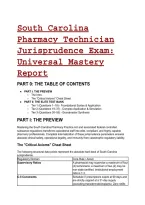
South Carolina
Pharmacy Technician
Jurisprudence Exam:
Universal Mastery
Report
PART 0: THE TABLE OF CONTENTS
● PART I: THE PREVIEW
○ The Intro
○ The "Critical Axioms" Cheat Sheet
● PART II: THE ELITE TEST BANK
○ Tier 1 (Questions 1–18) - Foundational Syntax & Application
○ Tier 2 (Questions 19–37) - Complex Application & Simulation
○ Tier 3 (Questions 38–55) - Grandmaster Synthesis
PART I: THE PREVIEW
Mastering the South Carolina Pharmacy Practice Act and associated federal controlled
substance regulations transforms operational staff into elite, compliant, and highly capable
pharmacy professionals. Complete internalization of these jurisprudence parameters ensures
absolute clinical safety, operational legality, and immunity from catastrophic regulatory liability.
The "Critical Axioms" Cheat Sheet
The following structural data points represent the absolute hard deck of South Carolina
jurisprudence.
Regulatory Domain Core Rule / Axiom
Supervisory Ratios A pharmacist may supervise a maximum of four
(4) technicians; a maximum of two (2) may be
non-state-certified. Institutional employment
ratio is 1:3.
C-II Constraints Schedule II prescriptions expire at 90 days and
are strictly capped at a 31-day supply
(excluding transdermals/implants). Zero refills
,Regulatory Domain Core Rule / Axiom
permitted.
C-III to C-V Constraints Schedules III–V prescriptions expire at 6
months or 5 refills (whichever is first) and are
capped at a 90-day supply per dispense.
Expanded Scope (CPHT) Only State-Certified Technicians (CPHT) may
receive verbal orders, perform one-time
transfers, or execute institutional
"tech-check-tech."
Emergency Refills Without authorization, non-controlled
life-sustaining refills are capped at 14 days.
This expands to 30 days during a
Governor-declared State of Emergency.
Credential Lapses Registrations lapsed < 24 months require 10
CE hours and a lapsed application; lapses ≥ 24
months require 20 CE hours and reinstatement.
PART II: THE ELITE TEST BANK
Tier 1 (Questions 1–18) - Foundational Syntax & Application
Q1: A Pharmacist-in-Charge (PIC) is scheduling the weekend shift for a high-volume outpatient
pharmacy. The roster includes one licensed pharmacist, three state-certified pharmacy
technicians (CPHT), and two non-state-certified pharmacy technicians (PHT). Based on the
principles of the South Carolina Pharmacy Practice Act, which staffing adjustment is the MOST
APPROPRIATE? A) The schedule is legally compliant because the total number of
non-state-certified technicians does not exceed two. B) The pharmacist must dismiss one
state-certified technician and one non-state-certified technician to maintain a 3:1 ratio. C) The
pharmacist must remove one technician from the schedule to ensure the total number of
supervised technicians does not exceed four. D) The schedule is compliant provided the
non-state-certified technicians strictly perform clerical and register duties only.
● Answer: C (The pharmacist must remove one technician from the schedule to ensure the
total number of supervised technicians does not exceed four.)
● Distractor Analysis:
○ A is incorrect: While the subset limit of two non-certified technicians is met, the
absolute hard cap of four total technicians per pharmacist is violated by staffing five.
○ B is incorrect: The South Carolina ratio is 4:1, not 3:1, for standard outpatient
supervision.
○ D is incorrect: Personnel performing purely clerical duties up to the point of
dispensing do not count toward the ratio, but if they are functioning as registered
pharmacy technicians, the 4:1 cap applies regardless of task distribution.
The Mentor's Analysis: State law strictly dictates that one pharmacist may not supervise more
than a total of four pharmacy technicians at a time, including a maximum of two
non-state-certified technicians. When facing staffing variables, the immediate priority is
calculating absolute headcounts against statutory caps. By utilizing the 4:1 total / 2:1
non-certified rule, you bypass the common trap of ignoring absolute limits in favor of subset
limits. Professional Intuition: Never exceed four total technicians per pharmacist; never
exceed two non-certified technicians per pharmacist.
,Q2: A prescriber's agent calls a community pharmacy to initiate a new verbal prescription for
lisinopril 10 mg. Based on the principles of South Carolina technician scope of practice, which
action is LEGALLY PERMISSIBLE? A) A non-state-certified pharmacy technician may
transcribe the order if the pharmacist co-signs it. B) A state-certified pharmacy technician
(CPHT) may receive and initiate the verbal telephone order. C) Any registered technician may
take the order, provided they read the medication name and dosage back to the agent. D) Only
a licensed pharmacist or pharmacy intern may receive verbal telephone orders in an outpatient
setting.
● Answer: B (A state-certified pharmacy technician (CPHT) may receive and initiate the
verbal telephone order.)
● Distractor Analysis:
○ A is incorrect: Non-state-certified technicians are strictly prohibited from receiving
clinical verbal prescription orders, regardless of pharmacist co-signature.
○ C is incorrect: Baseline registration does not authorize this clinical task; national
certification and CPHT status are legally required.
○ D is incorrect: This is an outdated legacy assumption; South Carolina law
specifically delegates this authority to State-Certified Pharmacy Technicians.
The Mentor's Analysis: The CPHT tier unlocks an expanded scope of practice that includes
receiving verbal orders and conducting one-time prescription transfers. When facing delegated
clinical duties, the immediate priority is verifying the technician's state-certified status. By
utilizing the CPHT expanded scope parameters, you bypass the common trap of restricting all
clinical intakes to pharmacists. Professional Intuition: State-Certification (CPHT) is the
absolute legal threshold for receiving verbal orders and executing transfers.
Q3: A patient requests a refill of their hydrocodone/acetaminophen (Schedule II) prescription
that was originally filled 45 days ago. The prescription indicates "zero refills." Based on the
principles of South Carolina Controlled Substances regulations, which conclusion is
ACCURATE? A) The prescription is void because Schedule II prescriptions expire 31 days after
the date of issue. B) The pharmacist may refill the prescription once, provided it is for a 72-hour
emergency supply. C) The prescription cannot be refilled, but a new Schedule II prescription
would be valid up to 90 days from its issue date. D) The prescription cannot be refilled, and the
patient must obtain a new prescription because Schedule II orders expire after 30 days.
● Answer: C (The prescription cannot be refilled, but a new Schedule II prescription would
be valid up to 90 days from its issue date.)
● Distractor Analysis:
○ A is incorrect: Schedule II prescriptions expire at 90 days, not 31 days. The 31-day
metric refers strictly to the maximum quantity supplied, not the expiration date.
○ B is incorrect: Schedule II prescriptions can never be refilled under any
circumstances.
○ D is incorrect: A legacy misconception confuses the 31-day supply limit with the
90-day validity window.
The Mentor's Analysis: Schedule II prescriptions carry strict, non-negotiable parameters: zero
refills, a 90-day expiration window, and a 31-day maximum supply per fill. When facing
Schedule II dispensing parameters, the immediate priority is separating the lifespan of the
document from the quantity of the drug. By utilizing the 90-day expiration rule, you bypass the
common trap of conflating days' supply limits with prescription validity limits. Professional
Intuition: C-II prescriptions live for 90 days but can only feed the patient for a maximum
of 31 days per fill.
Q4: A pharmacy technician's South Carolina registration expired on July 1st of the current year.
, It is now August 15th, and the technician wishes to resume working. Based on the principles of
the South Carolina Board of Pharmacy renewal protocols, which action is REQUIRED? A) The
technician must submit a Lapsed Pharmacy Technician Registration Application, the required
fee, and 10 hours of CE. B) The technician must re-take the national exam and submit a
Pharmacy Technician Registration Reinstatement Application. C) The technician must pay a late
fee online through the standard renewal portal and immediately resume work. D) The technician
must submit an Affidavit of Experience proving 1,000 hours worked in the previous year.
● Answer: A (The technician must submit a Lapsed Pharmacy Technician Registration
Application, the required fee, and 10 hours of CE.)
● Distractor Analysis:
○ B is incorrect: Re-testing and the heavy Reinstatement Application (with 20 CE
hours) are only required if the registration has been lapsed for two years or more.
○ C is incorrect: Once the June 30th window closes, online renewal is disabled; the
technician must submit a paper application for lapsed registration and must cease
practice immediately.
○ D is incorrect: The 1,000-hour affidavit is a prerequisite for initial State-Certification,
not a requirement for renewing a lapsed baseline registration.
The Mentor's Analysis: Registrations expire precisely on June 30th. If lapsed for less than two
years, a specific lapsed paper application, fee, and proof of 10 CE hours are mandatory. When
facing an expired credential, the immediate priority is verifying the duration of the lapse. By
utilizing the "less than two years" pathway, you bypass the common trap of assuming a total
regulatory reset is required. Professional Intuition: A lapse under 24 months requires
standard paperwork and 10 CE hours; a lapse over 24 months requires total
reinstatement and 20 CE hours.
Q5: A community pharmacy is conducting its biennial controlled substance inventory. Based on
the principles of DEA and DHEC recordkeeping, which methodology is MANDATORY? A) All
controlled substances (Schedules II-V) must be physically counted, and the inventory must be
submitted to the DEA. B) An exact physical count is required for Schedule II substances, while
an estimated count is permissible for Schedules III-V unless the container holds more than
1,000 units. C) All controlled substances must be counted exactly, and the records must be
integrated directly into the general pharmacy business files. D) An estimated count is
acceptable for all controlled substances, provided the pharmacist-in-charge signs the inventory
log.
● Answer: B (An exact physical count is required for Schedule II substances, while an
estimated count is permissible for Schedules III-V unless the container holds more than
1,000 units.)
● Distractor Analysis:
○ A is incorrect: Inventories are retained at the pharmacy for 2 years; they are not
routinely submitted to the DEA.
○ C is incorrect: Schedule II records and inventories must be maintained strictly
separate from all other pharmacy records.
○ D is incorrect: Estimations are strictly prohibited for Schedule II medications and for
C-III through C-V open containers holding more than 1,000 units.
The Mentor's Analysis: The Controlled Substances Act demands absolute exactitude for
high-risk drugs. Schedule II drugs require an absolute physical count. When facing inventory
protocols, the immediate priority is bifurcating C-II protocols from C-III–V protocols. By utilizing
the exact vs. estimated distinction, you bypass the common trap of applying uniform counting
rules across all schedules. Professional Intuition: C-II requires exact counts; C-III through V
Pharmacy Technician
Jurisprudence Exam:
Universal Mastery
Report
PART 0: THE TABLE OF CONTENTS
● PART I: THE PREVIEW
○ The Intro
○ The "Critical Axioms" Cheat Sheet
● PART II: THE ELITE TEST BANK
○ Tier 1 (Questions 1–18) - Foundational Syntax & Application
○ Tier 2 (Questions 19–37) - Complex Application & Simulation
○ Tier 3 (Questions 38–55) - Grandmaster Synthesis
PART I: THE PREVIEW
Mastering the South Carolina Pharmacy Practice Act and associated federal controlled
substance regulations transforms operational staff into elite, compliant, and highly capable
pharmacy professionals. Complete internalization of these jurisprudence parameters ensures
absolute clinical safety, operational legality, and immunity from catastrophic regulatory liability.
The "Critical Axioms" Cheat Sheet
The following structural data points represent the absolute hard deck of South Carolina
jurisprudence.
Regulatory Domain Core Rule / Axiom
Supervisory Ratios A pharmacist may supervise a maximum of four
(4) technicians; a maximum of two (2) may be
non-state-certified. Institutional employment
ratio is 1:3.
C-II Constraints Schedule II prescriptions expire at 90 days and
are strictly capped at a 31-day supply
(excluding transdermals/implants). Zero refills
,Regulatory Domain Core Rule / Axiom
permitted.
C-III to C-V Constraints Schedules III–V prescriptions expire at 6
months or 5 refills (whichever is first) and are
capped at a 90-day supply per dispense.
Expanded Scope (CPHT) Only State-Certified Technicians (CPHT) may
receive verbal orders, perform one-time
transfers, or execute institutional
"tech-check-tech."
Emergency Refills Without authorization, non-controlled
life-sustaining refills are capped at 14 days.
This expands to 30 days during a
Governor-declared State of Emergency.
Credential Lapses Registrations lapsed < 24 months require 10
CE hours and a lapsed application; lapses ≥ 24
months require 20 CE hours and reinstatement.
PART II: THE ELITE TEST BANK
Tier 1 (Questions 1–18) - Foundational Syntax & Application
Q1: A Pharmacist-in-Charge (PIC) is scheduling the weekend shift for a high-volume outpatient
pharmacy. The roster includes one licensed pharmacist, three state-certified pharmacy
technicians (CPHT), and two non-state-certified pharmacy technicians (PHT). Based on the
principles of the South Carolina Pharmacy Practice Act, which staffing adjustment is the MOST
APPROPRIATE? A) The schedule is legally compliant because the total number of
non-state-certified technicians does not exceed two. B) The pharmacist must dismiss one
state-certified technician and one non-state-certified technician to maintain a 3:1 ratio. C) The
pharmacist must remove one technician from the schedule to ensure the total number of
supervised technicians does not exceed four. D) The schedule is compliant provided the
non-state-certified technicians strictly perform clerical and register duties only.
● Answer: C (The pharmacist must remove one technician from the schedule to ensure the
total number of supervised technicians does not exceed four.)
● Distractor Analysis:
○ A is incorrect: While the subset limit of two non-certified technicians is met, the
absolute hard cap of four total technicians per pharmacist is violated by staffing five.
○ B is incorrect: The South Carolina ratio is 4:1, not 3:1, for standard outpatient
supervision.
○ D is incorrect: Personnel performing purely clerical duties up to the point of
dispensing do not count toward the ratio, but if they are functioning as registered
pharmacy technicians, the 4:1 cap applies regardless of task distribution.
The Mentor's Analysis: State law strictly dictates that one pharmacist may not supervise more
than a total of four pharmacy technicians at a time, including a maximum of two
non-state-certified technicians. When facing staffing variables, the immediate priority is
calculating absolute headcounts against statutory caps. By utilizing the 4:1 total / 2:1
non-certified rule, you bypass the common trap of ignoring absolute limits in favor of subset
limits. Professional Intuition: Never exceed four total technicians per pharmacist; never
exceed two non-certified technicians per pharmacist.
,Q2: A prescriber's agent calls a community pharmacy to initiate a new verbal prescription for
lisinopril 10 mg. Based on the principles of South Carolina technician scope of practice, which
action is LEGALLY PERMISSIBLE? A) A non-state-certified pharmacy technician may
transcribe the order if the pharmacist co-signs it. B) A state-certified pharmacy technician
(CPHT) may receive and initiate the verbal telephone order. C) Any registered technician may
take the order, provided they read the medication name and dosage back to the agent. D) Only
a licensed pharmacist or pharmacy intern may receive verbal telephone orders in an outpatient
setting.
● Answer: B (A state-certified pharmacy technician (CPHT) may receive and initiate the
verbal telephone order.)
● Distractor Analysis:
○ A is incorrect: Non-state-certified technicians are strictly prohibited from receiving
clinical verbal prescription orders, regardless of pharmacist co-signature.
○ C is incorrect: Baseline registration does not authorize this clinical task; national
certification and CPHT status are legally required.
○ D is incorrect: This is an outdated legacy assumption; South Carolina law
specifically delegates this authority to State-Certified Pharmacy Technicians.
The Mentor's Analysis: The CPHT tier unlocks an expanded scope of practice that includes
receiving verbal orders and conducting one-time prescription transfers. When facing delegated
clinical duties, the immediate priority is verifying the technician's state-certified status. By
utilizing the CPHT expanded scope parameters, you bypass the common trap of restricting all
clinical intakes to pharmacists. Professional Intuition: State-Certification (CPHT) is the
absolute legal threshold for receiving verbal orders and executing transfers.
Q3: A patient requests a refill of their hydrocodone/acetaminophen (Schedule II) prescription
that was originally filled 45 days ago. The prescription indicates "zero refills." Based on the
principles of South Carolina Controlled Substances regulations, which conclusion is
ACCURATE? A) The prescription is void because Schedule II prescriptions expire 31 days after
the date of issue. B) The pharmacist may refill the prescription once, provided it is for a 72-hour
emergency supply. C) The prescription cannot be refilled, but a new Schedule II prescription
would be valid up to 90 days from its issue date. D) The prescription cannot be refilled, and the
patient must obtain a new prescription because Schedule II orders expire after 30 days.
● Answer: C (The prescription cannot be refilled, but a new Schedule II prescription would
be valid up to 90 days from its issue date.)
● Distractor Analysis:
○ A is incorrect: Schedule II prescriptions expire at 90 days, not 31 days. The 31-day
metric refers strictly to the maximum quantity supplied, not the expiration date.
○ B is incorrect: Schedule II prescriptions can never be refilled under any
circumstances.
○ D is incorrect: A legacy misconception confuses the 31-day supply limit with the
90-day validity window.
The Mentor's Analysis: Schedule II prescriptions carry strict, non-negotiable parameters: zero
refills, a 90-day expiration window, and a 31-day maximum supply per fill. When facing
Schedule II dispensing parameters, the immediate priority is separating the lifespan of the
document from the quantity of the drug. By utilizing the 90-day expiration rule, you bypass the
common trap of conflating days' supply limits with prescription validity limits. Professional
Intuition: C-II prescriptions live for 90 days but can only feed the patient for a maximum
of 31 days per fill.
Q4: A pharmacy technician's South Carolina registration expired on July 1st of the current year.
, It is now August 15th, and the technician wishes to resume working. Based on the principles of
the South Carolina Board of Pharmacy renewal protocols, which action is REQUIRED? A) The
technician must submit a Lapsed Pharmacy Technician Registration Application, the required
fee, and 10 hours of CE. B) The technician must re-take the national exam and submit a
Pharmacy Technician Registration Reinstatement Application. C) The technician must pay a late
fee online through the standard renewal portal and immediately resume work. D) The technician
must submit an Affidavit of Experience proving 1,000 hours worked in the previous year.
● Answer: A (The technician must submit a Lapsed Pharmacy Technician Registration
Application, the required fee, and 10 hours of CE.)
● Distractor Analysis:
○ B is incorrect: Re-testing and the heavy Reinstatement Application (with 20 CE
hours) are only required if the registration has been lapsed for two years or more.
○ C is incorrect: Once the June 30th window closes, online renewal is disabled; the
technician must submit a paper application for lapsed registration and must cease
practice immediately.
○ D is incorrect: The 1,000-hour affidavit is a prerequisite for initial State-Certification,
not a requirement for renewing a lapsed baseline registration.
The Mentor's Analysis: Registrations expire precisely on June 30th. If lapsed for less than two
years, a specific lapsed paper application, fee, and proof of 10 CE hours are mandatory. When
facing an expired credential, the immediate priority is verifying the duration of the lapse. By
utilizing the "less than two years" pathway, you bypass the common trap of assuming a total
regulatory reset is required. Professional Intuition: A lapse under 24 months requires
standard paperwork and 10 CE hours; a lapse over 24 months requires total
reinstatement and 20 CE hours.
Q5: A community pharmacy is conducting its biennial controlled substance inventory. Based on
the principles of DEA and DHEC recordkeeping, which methodology is MANDATORY? A) All
controlled substances (Schedules II-V) must be physically counted, and the inventory must be
submitted to the DEA. B) An exact physical count is required for Schedule II substances, while
an estimated count is permissible for Schedules III-V unless the container holds more than
1,000 units. C) All controlled substances must be counted exactly, and the records must be
integrated directly into the general pharmacy business files. D) An estimated count is
acceptable for all controlled substances, provided the pharmacist-in-charge signs the inventory
log.
● Answer: B (An exact physical count is required for Schedule II substances, while an
estimated count is permissible for Schedules III-V unless the container holds more than
1,000 units.)
● Distractor Analysis:
○ A is incorrect: Inventories are retained at the pharmacy for 2 years; they are not
routinely submitted to the DEA.
○ C is incorrect: Schedule II records and inventories must be maintained strictly
separate from all other pharmacy records.
○ D is incorrect: Estimations are strictly prohibited for Schedule II medications and for
C-III through C-V open containers holding more than 1,000 units.
The Mentor's Analysis: The Controlled Substances Act demands absolute exactitude for
high-risk drugs. Schedule II drugs require an absolute physical count. When facing inventory
protocols, the immediate priority is bifurcating C-II protocols from C-III–V protocols. By utilizing
the exact vs. estimated distinction, you bypass the common trap of applying uniform counting
rules across all schedules. Professional Intuition: C-II requires exact counts; C-III through V


