
Pearson Edexcel International GCSE (9–1)
Paper reference: 4WBI1/1BR
Biology (Modular) UNIT 1: 4WBI1 PAPER: 1BR
SECTION A: CELL BIOLOGY AND MICROBIOLOGY
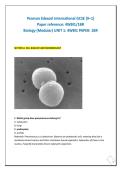
1. Which group does pneumococcus belong to?
A. eukaryotes
B. fungi
C. prokaryotes
D. protists
Rationale: Pneumococcus is a bacterium. Bacteria are prokaryotic cells, meaning they lack a
membrane-bound nucleus and other membrane-bound organelles. Eukaryotes (A) have a true
nucleus. Fungi (B) and protists (D) are eukaryotic organisms.
1
,2. State the word used to describe an organism that causes a disease.
Pathogen
Rationale: A pathogen is defined as a microorganism that causes disease. This includes certain
bacteria, viruses, fungi, and protists.
3. Pneumococcus bacteria may infect human lungs and cause pneumonia. The influenza virus
may also infect human lungs. Complete the table to show differences between a human lung
cell, a pneumococcus cell, and an influenza virus. Place a tick (✓) if the feature is present.
(Features: ribosomes, cell membrane, cell wall, nucleus, protein coat, plasmids)
Human lung cell:
Ribosomes: ✓
Cell membrane: ✓
Cell wall: (No tick)
Nucleus: ✓
Protein coat: (No tick)
Plasmids: (No tick)
Pneumococcus cell:
Ribosomes: ✓
Cell membrane: ✓
Cell wall: ✓
Nucleus: (No tick)
Protein coat: (No tick)
Plasmids: ✓ (often present in bacteria, though not always)
Influenza virus:
Ribosomes: (No tick)
Cell membrane: (No tick)
Cell wall: (No tick)
Nucleus: (No tick)
Protein coat: ✓ (Capsid)
Plasmids: (No tick)
Rationale: Human cells are eukaryotic (have a nucleus, no cell wall). Pneumococcus is a
prokaryote (no nucleus, has a cell wall, may have plasmids). Viruses are acellular; they lack
ribosomes and cell membranes, consisting only of a nucleic acid core surrounded by a protein
coat (capsid).
2
,4. Which of these is correct for the nucleic acid content of viruses?
A. DNA and RNA
B. DNA in all
C. DNA or RNA
D. none
Rationale: Viruses contain either DNA or RNA as their genetic material, but never both. (A is
incorrect because they do not have both; B is incorrect because some viruses, like influenza, are
RNA viruses; D is incorrect because viruses must have genetic material to replicate).
5. Viruses are parasitic. Explain the meaning of the word ‘parasitic’.
A parasitic organism lives on or inside a host organism, causing it harm, and relies completely
on the host's cellular machinery for its own survival and reproduction.
Rationale: Viruses cannot replicate independently. They must attach to a host cell, inject their
nucleic acid, and hijack the host's ribosomes and enzymes to produce new viral particles. This
causes damage to the host cell (often lysis).
6. Which of the following structures is found in a prokaryotic cell but NOT in a eukaryotic cell?
A. Ribosomes
B. Cell membrane
C. Plasmids
D. Cytoplasm
Rationale: Plasmids are small, circular loops of DNA found in bacteria (prokaryotes) that are not
part of the main chromosomal DNA. Ribosomes, cell membranes, and cytoplasm are found in
both cell types.
7. State the function of the protein coat (capsid) in a virus.
It protects the viral nucleic acid (DNA or RNA) and aids in attachment to the host cell.
Rationale: The capsid is made of protein subunits. It provides structural protection for the fragile
genetic material inside and contains receptor-binding proteins that allow the virus to attach to
specific host cells.
8. Which of the following correctly describes the size of a virus compared to a bacterium?
A. Viruses are much smaller than bacteria.
B. Viruses are slightly larger than bacteria.
C. Viruses and bacteria are roughly the same size.
D. Viruses are the same size as human cells.
Rationale: Viruses are typically 20-400 nm in diameter, while bacteria are generally 0.5-5
micrometers. Viruses are significantly smaller and can only be seen with an electron microscope,
whereas many bacteria can be seen with a light microscope.
3
, 9. State one way in which the cell wall of a pneumococcus cell differs from the cell wall of a
human lung cell.
A human lung cell does not have a cell wall, whereas a pneumococcus cell has a cell wall
made of peptidoglycan (murein).
Rationale: Animal cells (like human lung cells) lack a cell wall entirely. Bacterial cells have a rigid
cell wall that provides structural support and prevents osmotic lysis.
10. Which of the following is a characteristic of all living organisms that viruses do NOT
possess?
A. The ability to evolve
B. The possession of genetic material
C. The ability to perform metabolic reactions independently
D. The ability to reproduce
Rationale: Viruses do not have their own metabolism; they are metabolically inert outside a host
cell. Living organisms carry out metabolic reactions (like respiration and protein synthesis)
independently. Viruses do have genetic material and can evolve and reproduce (albeit using host
machinery).
11. Name the process by which bacteria divide.
Binary fission
Rationale: Prokaryotes reproduce asexually by binary fission, where the circular DNA replicates,
and the cell splits into two identical daughter cells.
12. State the function of ribosomes in a cell.
Protein synthesis
Rationale: Ribosomes are the site of translation, where mRNA is decoded to build specific
polypeptide chains (proteins). Both prokaryotes and eukaryotes have ribosomes, though they
differ slightly in size.
13. Explain why antibiotics are effective against pneumococcus bacteria but not against the
influenza virus.
Antibiotics target specific structures or processes unique to bacteria, such as cell wall
synthesis or bacterial ribosomes. Viruses lack these structures (they have no cell wall and use
host ribosomes), so antibiotics have no effect on them.
Rationale: This highlights the structural differences between prokaryotes and viruses. Antibiotics
like penicillin interfere with peptidoglycan cross-linking in bacterial cell walls, a structure entirely
absent in viruses.
4
Paper reference: 4WBI1/1BR
Biology (Modular) UNIT 1: 4WBI1 PAPER: 1BR
SECTION A: CELL BIOLOGY AND MICROBIOLOGY
1. Which group does pneumococcus belong to?
A. eukaryotes
B. fungi
C. prokaryotes
D. protists
Rationale: Pneumococcus is a bacterium. Bacteria are prokaryotic cells, meaning they lack a
membrane-bound nucleus and other membrane-bound organelles. Eukaryotes (A) have a true
nucleus. Fungi (B) and protists (D) are eukaryotic organisms.
1
,2. State the word used to describe an organism that causes a disease.
Pathogen
Rationale: A pathogen is defined as a microorganism that causes disease. This includes certain
bacteria, viruses, fungi, and protists.
3. Pneumococcus bacteria may infect human lungs and cause pneumonia. The influenza virus
may also infect human lungs. Complete the table to show differences between a human lung
cell, a pneumococcus cell, and an influenza virus. Place a tick (✓) if the feature is present.
(Features: ribosomes, cell membrane, cell wall, nucleus, protein coat, plasmids)
Human lung cell:
Ribosomes: ✓
Cell membrane: ✓
Cell wall: (No tick)
Nucleus: ✓
Protein coat: (No tick)
Plasmids: (No tick)
Pneumococcus cell:
Ribosomes: ✓
Cell membrane: ✓
Cell wall: ✓
Nucleus: (No tick)
Protein coat: (No tick)
Plasmids: ✓ (often present in bacteria, though not always)
Influenza virus:
Ribosomes: (No tick)
Cell membrane: (No tick)
Cell wall: (No tick)
Nucleus: (No tick)
Protein coat: ✓ (Capsid)
Plasmids: (No tick)
Rationale: Human cells are eukaryotic (have a nucleus, no cell wall). Pneumococcus is a
prokaryote (no nucleus, has a cell wall, may have plasmids). Viruses are acellular; they lack
ribosomes and cell membranes, consisting only of a nucleic acid core surrounded by a protein
coat (capsid).
2
,4. Which of these is correct for the nucleic acid content of viruses?
A. DNA and RNA
B. DNA in all
C. DNA or RNA
D. none
Rationale: Viruses contain either DNA or RNA as their genetic material, but never both. (A is
incorrect because they do not have both; B is incorrect because some viruses, like influenza, are
RNA viruses; D is incorrect because viruses must have genetic material to replicate).
5. Viruses are parasitic. Explain the meaning of the word ‘parasitic’.
A parasitic organism lives on or inside a host organism, causing it harm, and relies completely
on the host's cellular machinery for its own survival and reproduction.
Rationale: Viruses cannot replicate independently. They must attach to a host cell, inject their
nucleic acid, and hijack the host's ribosomes and enzymes to produce new viral particles. This
causes damage to the host cell (often lysis).
6. Which of the following structures is found in a prokaryotic cell but NOT in a eukaryotic cell?
A. Ribosomes
B. Cell membrane
C. Plasmids
D. Cytoplasm
Rationale: Plasmids are small, circular loops of DNA found in bacteria (prokaryotes) that are not
part of the main chromosomal DNA. Ribosomes, cell membranes, and cytoplasm are found in
both cell types.
7. State the function of the protein coat (capsid) in a virus.
It protects the viral nucleic acid (DNA or RNA) and aids in attachment to the host cell.
Rationale: The capsid is made of protein subunits. It provides structural protection for the fragile
genetic material inside and contains receptor-binding proteins that allow the virus to attach to
specific host cells.
8. Which of the following correctly describes the size of a virus compared to a bacterium?
A. Viruses are much smaller than bacteria.
B. Viruses are slightly larger than bacteria.
C. Viruses and bacteria are roughly the same size.
D. Viruses are the same size as human cells.
Rationale: Viruses are typically 20-400 nm in diameter, while bacteria are generally 0.5-5
micrometers. Viruses are significantly smaller and can only be seen with an electron microscope,
whereas many bacteria can be seen with a light microscope.
3
, 9. State one way in which the cell wall of a pneumococcus cell differs from the cell wall of a
human lung cell.
A human lung cell does not have a cell wall, whereas a pneumococcus cell has a cell wall
made of peptidoglycan (murein).
Rationale: Animal cells (like human lung cells) lack a cell wall entirely. Bacterial cells have a rigid
cell wall that provides structural support and prevents osmotic lysis.
10. Which of the following is a characteristic of all living organisms that viruses do NOT
possess?
A. The ability to evolve
B. The possession of genetic material
C. The ability to perform metabolic reactions independently
D. The ability to reproduce
Rationale: Viruses do not have their own metabolism; they are metabolically inert outside a host
cell. Living organisms carry out metabolic reactions (like respiration and protein synthesis)
independently. Viruses do have genetic material and can evolve and reproduce (albeit using host
machinery).
11. Name the process by which bacteria divide.
Binary fission
Rationale: Prokaryotes reproduce asexually by binary fission, where the circular DNA replicates,
and the cell splits into two identical daughter cells.
12. State the function of ribosomes in a cell.
Protein synthesis
Rationale: Ribosomes are the site of translation, where mRNA is decoded to build specific
polypeptide chains (proteins). Both prokaryotes and eukaryotes have ribosomes, though they
differ slightly in size.
13. Explain why antibiotics are effective against pneumococcus bacteria but not against the
influenza virus.
Antibiotics target specific structures or processes unique to bacteria, such as cell wall
synthesis or bacterial ribosomes. Viruses lack these structures (they have no cell wall and use
host ribosomes), so antibiotics have no effect on them.
Rationale: This highlights the structural differences between prokaryotes and viruses. Antibiotics
like penicillin interfere with peptidoglycan cross-linking in bacterial cell walls, a structure entirely
absent in viruses.
4


