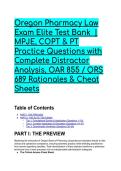
Oregon Pharmacy Law
Exam Elite Test Bank |
MPJE, COPT & PT
Practice Questions with
Complete Distractor
Analysis, OAR 855 / ORS
689 Rationales & Cheat
Sheets
Table of Contents
● PART I: THE PREVIEW
● PART II: THE ELITE TEST BANK
○ Tier 1: Foundational Syntax & Application (Questions 1–18)
○ Tier 2: Complex Application & Simulation (Questions 19–37)
○ Tier 3: Grandmaster Synthesis (Questions 38–55)
PART I: THE PREVIEW
Mastering the intricacies of Oregon Board of Pharmacy jurisprudence translates directly to elite
clinical and operational compliance, ensuring seamless practice while shielding practitioners
from severe regulatory penalties. Total internalization of these statutes transforms a pharmacy
technician from a mere processor into an indispensable administrative safeguard.
● The Critical Axioms Cheat Sheet:
,The following tables synthesize the absolute foundational parameters governing Oregon
pharmacy practice. Mastery of these metrics is non-negotiable.
Category Drug Classification Expiration Timeline Refill Maximum
Non-Controlled Legend Drugs 1 year from date of Up to 1 year (or PRN
issue max 1 yr)
Controlled Schedule III, IV, V 6 months from date of 5 refills maximum
issue
Controlled Schedule II Subject to professional ZERO (Refills strictly
judgment (No strict prohibited)
state/federal hard cap,
CARA partials 30 days)
Compliance Event Required Timeline / Frequency
Record Retention (General) 3 years (Minimum 1 year stored onsite)
Record Retrieval (Off-site) Within 3 business days
C-II Inventory (Retail) At least every 93 days
C-II Inventory (Institutional) At least every 31 days
Complete CS Inventory Annually (Within 367 days)
PIC Change CS Inventory Within 15 days of the change
Significant Drug Loss Notify Board within 1 business day
Permanent Pharmacy Closure Patient notification 15 days prior to closing
Emergency Temporary Closure Notify Board within 72 hours (if > 2 days)
PSE Metric Statutory Limit / Requirement
Purchase Limits 3.6 grams per 24 hours; 9.0 grams per 30 days
Age & ID 18+ years old; Valid government-issued photo
ID required
Record Retention Electronic logbook must be retained for 3 years
Packaging (Non-liquid) Blister packs (Max 2 units/blister) or unit dose
PART II: THE ELITE TEST BANK
Tier 1: Foundational Syntax & Application (Questions
1–18)
Q1: An applicant is seeking licensure as a Certified Oregon Pharmacy Technician (COPT).
Based on the principles of Oregon Board of Pharmacy licensure qualifications (OAR
855-125-0010), which action/conclusion is the MANDATORY prerequisite for this specific
credential? A) The applicant must submit proof of an Associate's degree in Pharmacy
Technology B) The applicant must complete 1,000 hours of clinical rotation in an institutional
setting C) The applicant must take and pass a national pharmacy technician certification
examination offered by PTCB or NHA D) The applicant must be at least 21 years of age
● Answer: C (The applicant must take and pass a national pharmacy technician certification
examination offered by PTCB or NHA)
● Distractor Analysis:
, ○ A is incorrect: A high school diploma or equivalent is required, but a college degree
is not a statutory prerequisite for the COPT license.
○ B is incorrect: Clinical hours are part of training programs but are not the isolated
statutory gatekeeper for COPT licensure.
○ D is incorrect: The minimum age requirement for licensure as a pharmacy
technician in Oregon is 18 years, not 21.
The Mentor's Analysis: Oregon operates on a strict two-tier technician model. When facing
credentialing requirements, the immediate priority is distinguishing the baseline Pharmacy
Technician from the Certified Oregon Pharmacy Technician. By utilizing the national certification
benchmark (PTCB/NHA), you bypass the common trap of confusing state licensure with
employer-specific training expectations. Professional Intuition: The "Certified" title in Oregon
(COPT) is legally gated behind the successful passage of a recognized national
examination (PTCB or NHA).
Q2: A retail pharmacy undergoes its scheduled controlled substance audit. Based on the
principles of Oregon recordkeeping requirements (OAR 855-141-0550), what is the EXACT
duration that general prescription dispensing records must be retained and made available to
the board? A) 1 year onsite and 1 year off-site B) 2 years total, aligning with federal DEA
requirements C) 3 years total, with at least one year stored onsite D) 5 years total, aligning with
Medicare Part D requirements
● Answer: C (3 years total, with at least one year stored onsite)
● Distractor Analysis:
○ A is incorrect: Two years is the federal standard, but Oregon supersedes this with a
longer mandate.
○ B is incorrect: DEA regulations require 2 years, but state law imposes a stricter
3-year minimum.
○ D is incorrect: While 5-10 years may apply to specific PBM or Medicare contracts,
the baseline Board of Pharmacy statutory mandate is 3 years.
The Mentor's Analysis: Record retention creates friction between overlapping regulatory bodies.
When facing document archiving, the immediate priority is defaulting to the stricter state
mandate. By utilizing the 3-year state rule, you bypass the common trap of falling back on the
widely memorized 2-year DEA federal minimum. Professional Intuition: Unless explicitly stated
otherwise, the universal retention baseline for Oregon pharmacy documentation is
precisely 3 years.
Q3: A patient attempts to purchase non-prescription pseudoephedrine (PSE). Based on the
principles of Oregon controlled substance laws (ORS 475.230), which action is PROHIBITED
during a single transaction? A) Selling 3.6 grams of PSE base in a single 24-hour period B)
Selling the product without recording the transaction in an electronic logbook C) Storing the PSE
product behind the pharmacy counter D) Requiring a government-issued photo ID from a
19-year-old purchaser
● Answer: B (Selling the product without recording the transaction in an electronic logbook)
● Distractor Analysis:
○ A is incorrect: Selling up to 3.6 grams per day is the exact legal threshold.
○ C is incorrect: Behind-the-counter storage is a strict legal requirement, not a
prohibited act.
○ D is incorrect: Verifying photo ID for individuals 18 and older is mandatory.
The Mentor's Analysis: Precursor chemical control relies entirely on tracking and deterrence.
When facing PSE sales, the immediate priority is securing the electronic audit trail. By utilizing
the real-time electronic logging mandate, you bypass the common trap of treating PSE like a
Exam Elite Test Bank |
MPJE, COPT & PT
Practice Questions with
Complete Distractor
Analysis, OAR 855 / ORS
689 Rationales & Cheat
Sheets
Table of Contents
● PART I: THE PREVIEW
● PART II: THE ELITE TEST BANK
○ Tier 1: Foundational Syntax & Application (Questions 1–18)
○ Tier 2: Complex Application & Simulation (Questions 19–37)
○ Tier 3: Grandmaster Synthesis (Questions 38–55)
PART I: THE PREVIEW
Mastering the intricacies of Oregon Board of Pharmacy jurisprudence translates directly to elite
clinical and operational compliance, ensuring seamless practice while shielding practitioners
from severe regulatory penalties. Total internalization of these statutes transforms a pharmacy
technician from a mere processor into an indispensable administrative safeguard.
● The Critical Axioms Cheat Sheet:
,The following tables synthesize the absolute foundational parameters governing Oregon
pharmacy practice. Mastery of these metrics is non-negotiable.
Category Drug Classification Expiration Timeline Refill Maximum
Non-Controlled Legend Drugs 1 year from date of Up to 1 year (or PRN
issue max 1 yr)
Controlled Schedule III, IV, V 6 months from date of 5 refills maximum
issue
Controlled Schedule II Subject to professional ZERO (Refills strictly
judgment (No strict prohibited)
state/federal hard cap,
CARA partials 30 days)
Compliance Event Required Timeline / Frequency
Record Retention (General) 3 years (Minimum 1 year stored onsite)
Record Retrieval (Off-site) Within 3 business days
C-II Inventory (Retail) At least every 93 days
C-II Inventory (Institutional) At least every 31 days
Complete CS Inventory Annually (Within 367 days)
PIC Change CS Inventory Within 15 days of the change
Significant Drug Loss Notify Board within 1 business day
Permanent Pharmacy Closure Patient notification 15 days prior to closing
Emergency Temporary Closure Notify Board within 72 hours (if > 2 days)
PSE Metric Statutory Limit / Requirement
Purchase Limits 3.6 grams per 24 hours; 9.0 grams per 30 days
Age & ID 18+ years old; Valid government-issued photo
ID required
Record Retention Electronic logbook must be retained for 3 years
Packaging (Non-liquid) Blister packs (Max 2 units/blister) or unit dose
PART II: THE ELITE TEST BANK
Tier 1: Foundational Syntax & Application (Questions
1–18)
Q1: An applicant is seeking licensure as a Certified Oregon Pharmacy Technician (COPT).
Based on the principles of Oregon Board of Pharmacy licensure qualifications (OAR
855-125-0010), which action/conclusion is the MANDATORY prerequisite for this specific
credential? A) The applicant must submit proof of an Associate's degree in Pharmacy
Technology B) The applicant must complete 1,000 hours of clinical rotation in an institutional
setting C) The applicant must take and pass a national pharmacy technician certification
examination offered by PTCB or NHA D) The applicant must be at least 21 years of age
● Answer: C (The applicant must take and pass a national pharmacy technician certification
examination offered by PTCB or NHA)
● Distractor Analysis:
, ○ A is incorrect: A high school diploma or equivalent is required, but a college degree
is not a statutory prerequisite for the COPT license.
○ B is incorrect: Clinical hours are part of training programs but are not the isolated
statutory gatekeeper for COPT licensure.
○ D is incorrect: The minimum age requirement for licensure as a pharmacy
technician in Oregon is 18 years, not 21.
The Mentor's Analysis: Oregon operates on a strict two-tier technician model. When facing
credentialing requirements, the immediate priority is distinguishing the baseline Pharmacy
Technician from the Certified Oregon Pharmacy Technician. By utilizing the national certification
benchmark (PTCB/NHA), you bypass the common trap of confusing state licensure with
employer-specific training expectations. Professional Intuition: The "Certified" title in Oregon
(COPT) is legally gated behind the successful passage of a recognized national
examination (PTCB or NHA).
Q2: A retail pharmacy undergoes its scheduled controlled substance audit. Based on the
principles of Oregon recordkeeping requirements (OAR 855-141-0550), what is the EXACT
duration that general prescription dispensing records must be retained and made available to
the board? A) 1 year onsite and 1 year off-site B) 2 years total, aligning with federal DEA
requirements C) 3 years total, with at least one year stored onsite D) 5 years total, aligning with
Medicare Part D requirements
● Answer: C (3 years total, with at least one year stored onsite)
● Distractor Analysis:
○ A is incorrect: Two years is the federal standard, but Oregon supersedes this with a
longer mandate.
○ B is incorrect: DEA regulations require 2 years, but state law imposes a stricter
3-year minimum.
○ D is incorrect: While 5-10 years may apply to specific PBM or Medicare contracts,
the baseline Board of Pharmacy statutory mandate is 3 years.
The Mentor's Analysis: Record retention creates friction between overlapping regulatory bodies.
When facing document archiving, the immediate priority is defaulting to the stricter state
mandate. By utilizing the 3-year state rule, you bypass the common trap of falling back on the
widely memorized 2-year DEA federal minimum. Professional Intuition: Unless explicitly stated
otherwise, the universal retention baseline for Oregon pharmacy documentation is
precisely 3 years.
Q3: A patient attempts to purchase non-prescription pseudoephedrine (PSE). Based on the
principles of Oregon controlled substance laws (ORS 475.230), which action is PROHIBITED
during a single transaction? A) Selling 3.6 grams of PSE base in a single 24-hour period B)
Selling the product without recording the transaction in an electronic logbook C) Storing the PSE
product behind the pharmacy counter D) Requiring a government-issued photo ID from a
19-year-old purchaser
● Answer: B (Selling the product without recording the transaction in an electronic logbook)
● Distractor Analysis:
○ A is incorrect: Selling up to 3.6 grams per day is the exact legal threshold.
○ C is incorrect: Behind-the-counter storage is a strict legal requirement, not a
prohibited act.
○ D is incorrect: Verifying photo ID for individuals 18 and older is mandatory.
The Mentor's Analysis: Precursor chemical control relies entirely on tracking and deterrence.
When facing PSE sales, the immediate priority is securing the electronic audit trail. By utilizing
the real-time electronic logging mandate, you bypass the common trap of treating PSE like a