
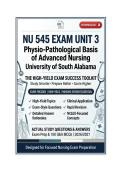
,NU 545 Physio-Pathological Basis of Advanced
Nursing Unit 3 Exam Study Guide University of
South Alabama Exam Prep & 100 Q&A MCQs
2026/2027
1. A graduate nursing student is reviewing the mechanisms of hormonal regulation. Which of
the following hormones is water-soluble and therefore requires a membrane receptor to exert
its effects?
A. Cortisol
B. Insulin
C. Thyroxine (T4)
D. Aldosterone
Correct Answer: B
Rationale: Insulin is a peptide hormone and is water-soluble. Water-soluble hormones cannot
cross the lipid bilayer of the cell membrane and must bind to surface receptors to initiate signal
transduction. Cortisol, thyroxine, and aldosterone are lipid-soluble hormones that can cross the
cell membrane and bind to intracellular receptors.
2. Which of the following hormones is lipid-soluble and can therefore cross the cell membrane
to bind to intracellular receptors?
A. Growth hormone
,B. Insulin
C. Cortisol
D. Parathyroid hormone
Correct Answer: C
Rationale: Cortisol is a steroid hormone derived from cholesterol and is lipid-soluble. Lipid-
soluble hormones can diffuse across the cell membrane and bind to intracellular receptors,
often directly influencing gene transcription. Growth hormone, insulin, and parathyroid
hormone are water-soluble peptides.
3. A patient is diagnosed with syndrome of inappropriate antidiuretic hormone (SIADH). Which
of the following findings is most consistent with this condition?
A. Hypernatremia and polyuria
B. Hyponatremia and concentrated urine
C. Hyperkalemia and hypotension
D. Hypercalcemia and polyuria
Correct Answer: B
Rationale: SIADH is characterized by excessive release of antidiuretic hormone (ADH), leading to
excessive water reabsorption in the kidneys. This results in dilutional hyponatremia and
concentrated urine (high urine osmolality). Patients do not typically have polyuria; instead, they
have decreased urine output.
, 4. A patient with central diabetes insipidus is prescribed desmopressin. What is the mechanism
of action of this medication?
A. It blocks aldosterone receptors
B. It replaces antidiuretic hormone (ADH)
C. It inhibits insulin secretion
D. It stimulates cortisol production
Correct Answer: B
Rationale: Central diabetes insipidus results from insufficient production of antidiuretic
hormone (ADH) by the posterior pituitary. Desmopressin is a synthetic analog of ADH that
replaces the deficient hormone, reducing urine output and increasing urine concentration.
5. Which of the following is the primary function of parathyroid hormone (PTH)?
A. To decrease serum calcium levels
B. To increase serum calcium levels
C. To increase serum potassium levels
D. To decrease serum sodium levels
Correct Answer: B
Nursing Unit 3 Exam Study Guide University of
South Alabama Exam Prep & 100 Q&A MCQs
2026/2027
1. A graduate nursing student is reviewing the mechanisms of hormonal regulation. Which of
the following hormones is water-soluble and therefore requires a membrane receptor to exert
its effects?
A. Cortisol
B. Insulin
C. Thyroxine (T4)
D. Aldosterone
Correct Answer: B
Rationale: Insulin is a peptide hormone and is water-soluble. Water-soluble hormones cannot
cross the lipid bilayer of the cell membrane and must bind to surface receptors to initiate signal
transduction. Cortisol, thyroxine, and aldosterone are lipid-soluble hormones that can cross the
cell membrane and bind to intracellular receptors.
2. Which of the following hormones is lipid-soluble and can therefore cross the cell membrane
to bind to intracellular receptors?
A. Growth hormone
,B. Insulin
C. Cortisol
D. Parathyroid hormone
Correct Answer: C
Rationale: Cortisol is a steroid hormone derived from cholesterol and is lipid-soluble. Lipid-
soluble hormones can diffuse across the cell membrane and bind to intracellular receptors,
often directly influencing gene transcription. Growth hormone, insulin, and parathyroid
hormone are water-soluble peptides.
3. A patient is diagnosed with syndrome of inappropriate antidiuretic hormone (SIADH). Which
of the following findings is most consistent with this condition?
A. Hypernatremia and polyuria
B. Hyponatremia and concentrated urine
C. Hyperkalemia and hypotension
D. Hypercalcemia and polyuria
Correct Answer: B
Rationale: SIADH is characterized by excessive release of antidiuretic hormone (ADH), leading to
excessive water reabsorption in the kidneys. This results in dilutional hyponatremia and
concentrated urine (high urine osmolality). Patients do not typically have polyuria; instead, they
have decreased urine output.
, 4. A patient with central diabetes insipidus is prescribed desmopressin. What is the mechanism
of action of this medication?
A. It blocks aldosterone receptors
B. It replaces antidiuretic hormone (ADH)
C. It inhibits insulin secretion
D. It stimulates cortisol production
Correct Answer: B
Rationale: Central diabetes insipidus results from insufficient production of antidiuretic
hormone (ADH) by the posterior pituitary. Desmopressin is a synthetic analog of ADH that
replaces the deficient hormone, reducing urine output and increasing urine concentration.
5. Which of the following is the primary function of parathyroid hormone (PTH)?
A. To decrease serum calcium levels
B. To increase serum calcium levels
C. To increase serum potassium levels
D. To decrease serum sodium levels
Correct Answer: B


