
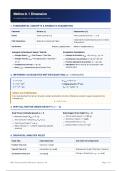
Motion in 1 Dimension
Complete Revision Notes, Advanced Formulas
1. FUNDAMENTAL CONCEPTS & KINEMATIC PARAMETERS
Parameter Distance ( ) s Displacement ( Δr)
Nature Scalar quantity (≥ 0) Vector quantity (Can be +, −, or 0)
Independent of path (depends only on initial &
Path Dependency Depends on actual path taken
final position)
Key Relation Distance ≥ |Displacement| • Distance / |Displacement| ≥ 1
Average & Instantaneous Speed / Velocity Acceleration Formulations
Average Speed: vavg = Total Distance / Total Time Average Acceleration:ạavg = Δṿ / Δt = (ṿf − ṿi) / Δt
Average Velocity: ṿavg = Net Displacement / Total Time = Instantaneous Acceleration: ạ = dṿ / dt = d2ṛ / dt2
Δṛ / Δt Position-dependent Acceleration: a = v (dv / dx)
Instantaneous Velocity: ṿ = dṛ / dt Retardation: When velocity and acceleration have
Note: |ṿinst| = Instantaneous Speed (Always True) opposite signs.
2. UNIFORMLY ACCELERATED MOTION EQUATIONS ( A = CONSTANT)
1. v = u + at 4. savg = ½(u + v)t
2. s = ut + ½at2 5. Displacement in nth sec:
3. v2 = u2 + 2as Sn = u + ½a(2n − 1)
Galileo's Law of Odd Numbers
For a body starting from rest ( u = 0) under constant acceleration, the ratio of distances covered in equal consecutive time
τ
intervals ( ) is:
1 : 3 : 5 : 7 : 9 : ...
3. VERTICAL MOTION UNDER GRAVITY ( A = −G)
Body Thrown Vertically Upwards ( u > 0) Body Dropped From Height H ( u = 0)
Maximum Height: Hmax = ug Time to reach ground: t = √(2H / g)
Velocity on impact: v = √(2gH)
Time of Ascent = Descent: ta = td = u / g
Velocity after time t: v = gt
Total Time of Flight: T = 2u / g
Distance fallen in time t: h = ½gt2
Return Velocity: v = −u (Same magnitude, opposite
direction)
4. GRAPHICAL ANALYSIS RULES
Graph Type Slope Represents Area Under Curve Represents
Position-Time (x-t) Velocity ( v = dx/dt) —
Velocity-Time (v-t) Acceleration ( a = dv/dt) Displacement ( ∫v dt) | Total Area = Distance
Acceleration-Time (a-t) Jerk (da/dt) Change in Velocity ( Δv = vf − vi = ∫a dt)
NEET Physics Notes & PYQ Sheet • Motion in 1D Page 1 of 3
Complete Revision Notes, Advanced Formulas
1. FUNDAMENTAL CONCEPTS & KINEMATIC PARAMETERS
Parameter Distance ( ) s Displacement ( Δr)
Nature Scalar quantity (≥ 0) Vector quantity (Can be +, −, or 0)
Independent of path (depends only on initial &
Path Dependency Depends on actual path taken
final position)
Key Relation Distance ≥ |Displacement| • Distance / |Displacement| ≥ 1
Average & Instantaneous Speed / Velocity Acceleration Formulations
Average Speed: vavg = Total Distance / Total Time Average Acceleration:ạavg = Δṿ / Δt = (ṿf − ṿi) / Δt
Average Velocity: ṿavg = Net Displacement / Total Time = Instantaneous Acceleration: ạ = dṿ / dt = d2ṛ / dt2
Δṛ / Δt Position-dependent Acceleration: a = v (dv / dx)
Instantaneous Velocity: ṿ = dṛ / dt Retardation: When velocity and acceleration have
Note: |ṿinst| = Instantaneous Speed (Always True) opposite signs.
2. UNIFORMLY ACCELERATED MOTION EQUATIONS ( A = CONSTANT)
1. v = u + at 4. savg = ½(u + v)t
2. s = ut + ½at2 5. Displacement in nth sec:
3. v2 = u2 + 2as Sn = u + ½a(2n − 1)
Galileo's Law of Odd Numbers
For a body starting from rest ( u = 0) under constant acceleration, the ratio of distances covered in equal consecutive time
τ
intervals ( ) is:
1 : 3 : 5 : 7 : 9 : ...
3. VERTICAL MOTION UNDER GRAVITY ( A = −G)
Body Thrown Vertically Upwards ( u > 0) Body Dropped From Height H ( u = 0)
Maximum Height: Hmax = ug Time to reach ground: t = √(2H / g)
Velocity on impact: v = √(2gH)
Time of Ascent = Descent: ta = td = u / g
Velocity after time t: v = gt
Total Time of Flight: T = 2u / g
Distance fallen in time t: h = ½gt2
Return Velocity: v = −u (Same magnitude, opposite
direction)
4. GRAPHICAL ANALYSIS RULES
Graph Type Slope Represents Area Under Curve Represents
Position-Time (x-t) Velocity ( v = dx/dt) —
Velocity-Time (v-t) Acceleration ( a = dv/dt) Displacement ( ∫v dt) | Total Area = Distance
Acceleration-Time (a-t) Jerk (da/dt) Change in Velocity ( Δv = vf − vi = ∫a dt)
NEET Physics Notes & PYQ Sheet • Motion in 1D Page 1 of 3


