MGMT 311 (TAMU) Exam 1 Test Questions and Answers Rated A
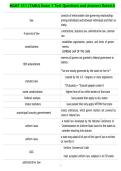
consists of enforceable rules governing relationships
law among individuals and between individuals and their so-
ciety.
constitutions, statutory law, administrative law, common
4 sources of law
law
establishes organization, powers, and limits of govern-
constitutions ments.
SUPREME LAW OF THE LAND
reserves all powers not granted to federal government to
states.
10th amendment
**we are mostly governed by the state we live in**
created by the U.S. Congress or state legislatures
statutory law
"S"tatuatory = "S"pecial people create it
state constitutions highest form of law within borders of that state
federal statues laws passed that apply to ALL states
state statutes laws passed that only apply WITHIN that state
enacts ordinances, which govern matters not covered by
municipal/county government
state or federal law.
A model law developed by the National Conference of
uniform laws Commissioners on Uniform State Laws for the states to
consider enacting into statute
a state may adapt all of part of this type of law as written
uniform laws
or rewrite it
Uniform Commercial Code
UCC
most accepted uniform law; adopted in all 50 states
administrative law
, MGMT 311 (TAMU) Exam 1 Test Questions and Answers Rated A
The body of law created by administrative agencies (in the
form of rules, regulations, orders, and decisions) in order
to carry out their duties and responsibilities.
subject to the authority of the president, who has the
power to appoint and remove their oflcers
executive agencies
Ex) Federal Drug Administration
Federal regulatory agencies that are independent, thus
not fully under the power of the president.
Serve a fixed term and oflcers do not change with the
independent regulatory agencies change in presidency.
Ex. Federal Trade Commission, Securities and Exchange
Commission.
a body of unwritten laws based on legal precedents and
Common (Case) Law
customs established by the courts
a court of law is limited to awarding payments of money
Courts of LAW and Remedies at LAW
or property as compensation
A form of compensatory damages that awards a sum of
money for specific, identifiable expenses associated with
the injured person's loss, such as medical expenses or lost
Special Damages wages.
out of pocket, quantifiable losses
loss of time, money or property damages
special damages also known as "hard' damages
non-monetary aspects of harm..
also known as 'soft' damages
, General Damages pain and suttering, injury to reputation, mental anguish,
disfigurement, loss of earning capacity
Punative/Exemplary Damages purpose is to punish wrongdoer
A small monetary award (often one dollar) granted to a
plaintitt when NO actual damage was suttered.
Nominal Damages
there is a technical wrong but no actual harm
money or something of value is not enough.
Courts at EQUITY & Remedies at EQUITY
only available if legal remedies (money damages) are
legally inadequate
part of a court will award an item to one party.
Specific Performance
Ex) house in a divorce
an authoritative command or order to stop one party from
injunction
taking an action or to undo some wrong/injury
the unmaking of a contract so as to return the parties to
Recission
the positions they occupied before the contract was made
General propositions or principles of law that have to do
equitable maxims
with fairness (equity).
a party can now request BOTH legal and equitable reme-
legal/ethical remedies today
dies in the same action
to "S"tand on "D"ecided cases
stare decisis
judges are obligated to follow precedents established in
prior decisions within their jurisdiction
precedent previously decided cases
binding/controlling precedent any source of law a court must follow when deciding a case
pursuasive precedent
consists of enforceable rules governing relationships
law among individuals and between individuals and their so-
ciety.
constitutions, statutory law, administrative law, common
4 sources of law
law
establishes organization, powers, and limits of govern-
constitutions ments.
SUPREME LAW OF THE LAND
reserves all powers not granted to federal government to
states.
10th amendment
**we are mostly governed by the state we live in**
created by the U.S. Congress or state legislatures
statutory law
"S"tatuatory = "S"pecial people create it
state constitutions highest form of law within borders of that state
federal statues laws passed that apply to ALL states
state statutes laws passed that only apply WITHIN that state
enacts ordinances, which govern matters not covered by
municipal/county government
state or federal law.
A model law developed by the National Conference of
uniform laws Commissioners on Uniform State Laws for the states to
consider enacting into statute
a state may adapt all of part of this type of law as written
uniform laws
or rewrite it
Uniform Commercial Code
UCC
most accepted uniform law; adopted in all 50 states
administrative law
, MGMT 311 (TAMU) Exam 1 Test Questions and Answers Rated A
The body of law created by administrative agencies (in the
form of rules, regulations, orders, and decisions) in order
to carry out their duties and responsibilities.
subject to the authority of the president, who has the
power to appoint and remove their oflcers
executive agencies
Ex) Federal Drug Administration
Federal regulatory agencies that are independent, thus
not fully under the power of the president.
Serve a fixed term and oflcers do not change with the
independent regulatory agencies change in presidency.
Ex. Federal Trade Commission, Securities and Exchange
Commission.
a body of unwritten laws based on legal precedents and
Common (Case) Law
customs established by the courts
a court of law is limited to awarding payments of money
Courts of LAW and Remedies at LAW
or property as compensation
A form of compensatory damages that awards a sum of
money for specific, identifiable expenses associated with
the injured person's loss, such as medical expenses or lost
Special Damages wages.
out of pocket, quantifiable losses
loss of time, money or property damages
special damages also known as "hard' damages
non-monetary aspects of harm..
also known as 'soft' damages
, General Damages pain and suttering, injury to reputation, mental anguish,
disfigurement, loss of earning capacity
Punative/Exemplary Damages purpose is to punish wrongdoer
A small monetary award (often one dollar) granted to a
plaintitt when NO actual damage was suttered.
Nominal Damages
there is a technical wrong but no actual harm
money or something of value is not enough.
Courts at EQUITY & Remedies at EQUITY
only available if legal remedies (money damages) are
legally inadequate
part of a court will award an item to one party.
Specific Performance
Ex) house in a divorce
an authoritative command or order to stop one party from
injunction
taking an action or to undo some wrong/injury
the unmaking of a contract so as to return the parties to
Recission
the positions they occupied before the contract was made
General propositions or principles of law that have to do
equitable maxims
with fairness (equity).
a party can now request BOTH legal and equitable reme-
legal/ethical remedies today
dies in the same action
to "S"tand on "D"ecided cases
stare decisis
judges are obligated to follow precedents established in
prior decisions within their jurisdiction
precedent previously decided cases
binding/controlling precedent any source of law a court must follow when deciding a case
pursuasive precedent