[STUDY GUIDE] • HIGH-YIELD PRACTICE & REVIEW EDITION
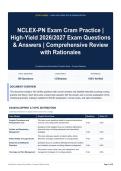
NCLEX-PN Exam Cram Practice |
High-Yield 2026/2027 Exam Questions
& Answers | Comprehensive Review
with Rationales
Comprehensive Examination Question Bank • Concept Mapping
TOTAL QUESTIONS EXAM TOPICS RATIONALES
100 Questions 12 Modules 100% Verified
DOCUMENT OVERVIEW
This document contains 100 verified questions with correct answers and detailed rationales covering nursing
practice and theory. Each item pairs a board-style question with the answer and a concise explanation of the
underlying principle, making it suitable for NCLEX preparation, course review, and rapid remediation.
EXAM BLUEPRINT & TOPIC DISTRIBUTION
Systematic breakdown of subject domains and exam coverage.
Topic Module Scope & Core Focus Questions Share (%)
Surgical Procedures and This topic covers questions related to surgical interventions,
Postoperative Care recovery, and postoperative assessments. 9 Qs 9.0%
Questions in this category focus on conditions affecting the
Cardiac and Respiratory heart and lungs, including assessment and intervention
Management strategies. 9 Qs 9.0%
This topic addresses aspects of patient safety, ethical
Patient Safety and Legal Issues dilemmas, and legal considerations in nursing practice. 9 Qs 9.0%
Endocrine and Metabolic Questions focus on conditions affecting the endocrine system
Disorders and metabolic processes, including diabetes management. 9 Qs 9.0%
This section covers cancer care, pain assessment, and
Oncology and Pain Management management strategies for oncology patients. 8 Qs 8.0%
Confidential • Student Study Edition • Practice & Review Guide Page 1 of 52
,STUDENT STUDY & MASTERY EDITION PRACTICE & REVIEW GUIDE
Questions related to neurological assessments, interventions,
Neurological Disorders and management of neurological conditions. 8 Qs 8.0%
This topic includes questions on gastrointestinal disorders,
Gastrointestinal Health dietary considerations, and surgical interventions. 8 Qs 8.0%
Infection Control and Questions in this category focus on infection prevention,
Management control measures, and management of infectious diseases. 8 Qs 8.0%
This topic covers questions related to maternity nursing,
Maternal and Newborn Care newborn assessments, and postpartum care. 8 Qs 8.0%
Musculoskeletal and Questions address musculoskeletal disorders, rehabilitation
Rehabilitation strategies, and mobility assessments. 8 Qs 8.0%
Psychiatric and Behavioral This section covers mental health conditions, therapeutic
Health communication, and management of psychiatric disorders. 8 Qs 8.0%
Pharmacology and Medication Questions regarding medication administration,
Management pharmacological effects, and safety precautions. 8 Qs 8.0%
Total Exam Coverage 12 Integrated Topic Modules 100 Qs 100.0%
Confidential • Student Study Edition • Practice & Review Guide Page 2 of 52
,STUDENT STUDY & MASTERY EDITION PRACTICE & REVIEW GUIDE
TOPIC 1: SURGICAL PROCEDURES AND POSTOPERATIVE CARE
9 Questions • 9.0% of Exam • This topic covers questions related to surgical interventions, recovery, and postoperative assessments.
QUESTION 1
The nurse is caring for a client scheduled for removal of a pituitary tumor using the
transsphenoidal approach. the nurse should be particularly alert to:
[A] Nasal congestion
[B] Abdominal Tenderness
[C] Muscle Tetany
[D] Oliguria
Answer: A. Nasal congestion why? removal of the pituitary gland is usually done by transsphernoidal
approach through the nose.
Nasal congestion further interferes with the airway.
Rationale: Transsphenoidal pituitary surgery involves accessing the pituitary gland through the nasal cavity, making nasal
congestion a direct post-operative concern due to potential airway compromise. This question tests understanding of
surgical access routes and their immediate implications for patient care.
QUESTION 2
A removal of the left lower lobe of the lung is performed on a client with lung cancer.
Which post-operative measure would usually be included?
[A] Closed chest drainage
[B] A tracheostomy
[C] A mediastinal tube
[D] Percussion vibration and drainage
Answer: A. A closed chest drainage why?
The client with a lung resection will have chest tubes and a drainage-collection device. He probably will not
have a tracheoostomy or mediastinal tube, and he will not have an order for percussion, vibration, or
drainage.
Rationale: Closed chest drainage is instituted post-lobectomy to re-expand the lung by removing air and fluid and
re-establishing negative intrapleural pressure. This procedure is standard for any thoracic surgery involving pleural space
disruption, unlike a tracheostomy or chest physiotherapy which are indicated for other specific complications.
Confidential • Student Study Edition • Practice & Review Guide Page 3 of 52
, STUDENT STUDY & MASTERY EDITION PRACTICE & REVIEW GUIDE
QUESTION 3
The nurse notes the patient care assistant looking through the personal items of the
client with cancer. Which action should be taken by the RN?
[A] Notify the police department as a robbery
[B] Report this behavior to the charge nurse
[C] Monitor the situation and note whether any items are missing
[D] Ignore the situation until items are reported missing
Answer: B. Report the behavior to the charge nurse why?
The best action at this time is to report the incident to the charge nurse. Further action might be needed, but
it should be determined by the charge nurse.
Rationale: The registered nurse should report suspected breaches of patient privacy and professional conduct to the
charge nurse, who has the authority to initiate an investigation and determine appropriate disciplinary or corrective actions.
This approach upholds the principle of patient advocacy and ensures adherence to established hospital policy and ethical
standards.
QUESTION 4
A client is 2 days post-operative colon resection. After a coughing episode, the client's
wound eviscerates. Which nursing action is most appropriate?
[A] Reinsert the protruding organ and cover with 4 × 4s
[B] Cover the wound with a sterile 4 × 4 and ABD dressing
[C] Cover the wound with a sterile saline-soaked dressing
[D] Apply an abdominal binder and manual pressure to the wound
Answer: C. Cover the wound with a sterile saline-soaked dressing. why?
If the client eviscerates, the abdominal content should be covered with a sterile saline-soaked dressing.
Rationale: Covering eviscerated abdominal contents with a sterile, saline-soaked dressing maintains tissue viability and
prevents desiccation and further contamination until surgical reintervention. This intervention addresses the immediate risk
of organ drying and infection, which is the key principle in managing wound evisceration.
Confidential • Student Study Edition • Practice & Review Guide Page 4 of 52
NCLEX-PN Exam Cram Practice |
High-Yield 2026/2027 Exam Questions
& Answers | Comprehensive Review
with Rationales
Comprehensive Examination Question Bank • Concept Mapping
TOTAL QUESTIONS EXAM TOPICS RATIONALES
100 Questions 12 Modules 100% Verified
DOCUMENT OVERVIEW
This document contains 100 verified questions with correct answers and detailed rationales covering nursing
practice and theory. Each item pairs a board-style question with the answer and a concise explanation of the
underlying principle, making it suitable for NCLEX preparation, course review, and rapid remediation.
EXAM BLUEPRINT & TOPIC DISTRIBUTION
Systematic breakdown of subject domains and exam coverage.
Topic Module Scope & Core Focus Questions Share (%)
Surgical Procedures and This topic covers questions related to surgical interventions,
Postoperative Care recovery, and postoperative assessments. 9 Qs 9.0%
Questions in this category focus on conditions affecting the
Cardiac and Respiratory heart and lungs, including assessment and intervention
Management strategies. 9 Qs 9.0%
This topic addresses aspects of patient safety, ethical
Patient Safety and Legal Issues dilemmas, and legal considerations in nursing practice. 9 Qs 9.0%
Endocrine and Metabolic Questions focus on conditions affecting the endocrine system
Disorders and metabolic processes, including diabetes management. 9 Qs 9.0%
This section covers cancer care, pain assessment, and
Oncology and Pain Management management strategies for oncology patients. 8 Qs 8.0%
Confidential • Student Study Edition • Practice & Review Guide Page 1 of 52
,STUDENT STUDY & MASTERY EDITION PRACTICE & REVIEW GUIDE
Questions related to neurological assessments, interventions,
Neurological Disorders and management of neurological conditions. 8 Qs 8.0%
This topic includes questions on gastrointestinal disorders,
Gastrointestinal Health dietary considerations, and surgical interventions. 8 Qs 8.0%
Infection Control and Questions in this category focus on infection prevention,
Management control measures, and management of infectious diseases. 8 Qs 8.0%
This topic covers questions related to maternity nursing,
Maternal and Newborn Care newborn assessments, and postpartum care. 8 Qs 8.0%
Musculoskeletal and Questions address musculoskeletal disorders, rehabilitation
Rehabilitation strategies, and mobility assessments. 8 Qs 8.0%
Psychiatric and Behavioral This section covers mental health conditions, therapeutic
Health communication, and management of psychiatric disorders. 8 Qs 8.0%
Pharmacology and Medication Questions regarding medication administration,
Management pharmacological effects, and safety precautions. 8 Qs 8.0%
Total Exam Coverage 12 Integrated Topic Modules 100 Qs 100.0%
Confidential • Student Study Edition • Practice & Review Guide Page 2 of 52
,STUDENT STUDY & MASTERY EDITION PRACTICE & REVIEW GUIDE
TOPIC 1: SURGICAL PROCEDURES AND POSTOPERATIVE CARE
9 Questions • 9.0% of Exam • This topic covers questions related to surgical interventions, recovery, and postoperative assessments.
QUESTION 1
The nurse is caring for a client scheduled for removal of a pituitary tumor using the
transsphenoidal approach. the nurse should be particularly alert to:
[A] Nasal congestion
[B] Abdominal Tenderness
[C] Muscle Tetany
[D] Oliguria
Answer: A. Nasal congestion why? removal of the pituitary gland is usually done by transsphernoidal
approach through the nose.
Nasal congestion further interferes with the airway.
Rationale: Transsphenoidal pituitary surgery involves accessing the pituitary gland through the nasal cavity, making nasal
congestion a direct post-operative concern due to potential airway compromise. This question tests understanding of
surgical access routes and their immediate implications for patient care.
QUESTION 2
A removal of the left lower lobe of the lung is performed on a client with lung cancer.
Which post-operative measure would usually be included?
[A] Closed chest drainage
[B] A tracheostomy
[C] A mediastinal tube
[D] Percussion vibration and drainage
Answer: A. A closed chest drainage why?
The client with a lung resection will have chest tubes and a drainage-collection device. He probably will not
have a tracheoostomy or mediastinal tube, and he will not have an order for percussion, vibration, or
drainage.
Rationale: Closed chest drainage is instituted post-lobectomy to re-expand the lung by removing air and fluid and
re-establishing negative intrapleural pressure. This procedure is standard for any thoracic surgery involving pleural space
disruption, unlike a tracheostomy or chest physiotherapy which are indicated for other specific complications.
Confidential • Student Study Edition • Practice & Review Guide Page 3 of 52
, STUDENT STUDY & MASTERY EDITION PRACTICE & REVIEW GUIDE
QUESTION 3
The nurse notes the patient care assistant looking through the personal items of the
client with cancer. Which action should be taken by the RN?
[A] Notify the police department as a robbery
[B] Report this behavior to the charge nurse
[C] Monitor the situation and note whether any items are missing
[D] Ignore the situation until items are reported missing
Answer: B. Report the behavior to the charge nurse why?
The best action at this time is to report the incident to the charge nurse. Further action might be needed, but
it should be determined by the charge nurse.
Rationale: The registered nurse should report suspected breaches of patient privacy and professional conduct to the
charge nurse, who has the authority to initiate an investigation and determine appropriate disciplinary or corrective actions.
This approach upholds the principle of patient advocacy and ensures adherence to established hospital policy and ethical
standards.
QUESTION 4
A client is 2 days post-operative colon resection. After a coughing episode, the client's
wound eviscerates. Which nursing action is most appropriate?
[A] Reinsert the protruding organ and cover with 4 × 4s
[B] Cover the wound with a sterile 4 × 4 and ABD dressing
[C] Cover the wound with a sterile saline-soaked dressing
[D] Apply an abdominal binder and manual pressure to the wound
Answer: C. Cover the wound with a sterile saline-soaked dressing. why?
If the client eviscerates, the abdominal content should be covered with a sterile saline-soaked dressing.
Rationale: Covering eviscerated abdominal contents with a sterile, saline-soaked dressing maintains tissue viability and
prevents desiccation and further contamination until surgical reintervention. This intervention addresses the immediate risk
of organ drying and infection, which is the key principle in managing wound evisceration.
Confidential • Student Study Edition • Practice & Review Guide Page 4 of 52