
NR547 Final Exam | Differential Diagnosis in Psychiatric-Mental Health Across the Lifespan Practicum | Chamberlain University
Edition
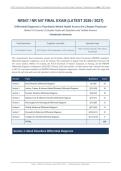
NR547 / NR 547 FINAL EXAM (LATEST )
Differential Diagnosis in Psychiatric-Mental Health Across the Lifespan Practicum
Weeks 5-8 Covered | Complete Guide with Questions and Verified Answers
Chamberlain University
Total Questions Cognitive Level Mix Question Style
80% Scenario-Based | 20% Direct
120 Multiple Choice 20% Recall | 50% Application | 30% Analysis
Knowledge
This comprehensive final examination assesses the Psychiatric-Mental Health Nurse Practitioner (PMHNP) candidate's
differential diagnostic competency across the lifespan. The examination is aligned with the Chamberlain University NR
547 course syllabus (Weeks 5-8 content), the AACN Essentials of Master's Education in Nursing, and the PMHNP
Differential Diagnosis Competencies (2026/2027 Edition). Each item includes a verified answer and a rationale that maps
to NR 547 curriculum standards and PMHNP differential diagnosis competencies. Students should select the single best
answer for each item and review the rationale to reinforce clinical reasoning.
Section Topic Questions Count
Section 1 Mood Disorders Differential Diagnosis Q1-Q20 20
Section 2 Anxiety, Trauma, & Stressor-Related Disorders Differential Diagnosis Q21-Q38 18
Section 3 Psychotic Disorders Differential Diagnosis Q39-Q56 18
Section 4 Substance Use & Addictive Disorders Differential Diagnosis Q57-Q71 15
Section 5 Neurocognitive & Neurological Differential Diagnosis Q72-Q86 15
Section 6 Child & Adolescent Differential Diagnosis Q87-Q101 15
Section 7 Personality & Behavioral Differential Diagnosis Q102-Q111 10
Section 8 Complex & Comorbid Differential Diagnosis Q112-Q120 9
TOTAL 120
Section 1: Mood Disorders Differential Diagnosis
Page 1 | NR547 Final Exam (Latest ) — Verified Answers & Rationales
,NR547 Final Exam | Differential Diagnosis in Psychiatric-Mental Health Across the Lifespan Practicum | Chamberlain University
Edition
Q1: A 47-year-old female presents with persistent sadness, fatigue, hypersomnia, weight gain of 12 pounds,
and a sensation of 'leaden limbs' for the past 4 months. She reports sensitivity to rejection but denies suicidal
ideation. Her PHQ-9 score is 18. Which constellation of symptoms most strongly suggests atypical depression
rather than major depressive disorder (MDD) with melancholic features?
A. Anhedonia, early morning awakening, and significant weight loss
B. Mood reactivity with parasitic rejection sensitivity, hyperphagia, and hypersomnia *[CORRECT]*
C. Diurnal mood variation worse in evening, psychomotor agitation, and profound anhedonia
D. Early morning awakening, guilt preoccupation, and psychomotor retardation
Correct Answer: B
Rationale: Atypical depression is characterized by mood reactivity (mood brightens in response to positive events),
significant weight gain or hyperphagia, hypersomnia, leaden paralysis, and a long-standing pattern of interpersonal
rejection sensitivity. The melancholic specifier (options A, C, D) features anhedonia, early morning awakening, weight
loss, and worsening in the morning. The PMHNP must distinguish these specifiers because atypical depression responds
preferentially to MAOIs and may respond poorly to tricyclics.
Q2: A 62-year-old male with a 30-year history of bipolar I disorder presents for routine follow-up. He reports
sleeping 2 hours per night for the past 5 days, has written a 400-page 'manifesto' outlining his plan to 'save
humanity through fusion energy,' has maxed out three credit cards purchasing laboratory equipment, and is
meeting with contractors to break ground on a reactor in his backyard. He denies psychotic features and has
full insight that his prior hospitalization was 'a mistake.' What is the most accurate diagnostic
characterization?
A. Bipolar I disorder, current episode manic, severe with psychotic features
B. Bipolar I disorder, current episode manic, severe without psychotic features, with rapid-cycling specifier
*[CORRECT]*
C. Cyclothymic disorder with elevated mood episodes
D. Bipolar II disorder, current episode hypomanic
Correct Answer: B
Rationale: Mania is defined by ≥1 week of elevated/irrititable mood plus ≥3 associated symptoms (decreased need for
sleep, pressured speech, flight of ideas, grandiosity, goal-directed activity, risk-taking). His grandiosity is severe (writing
manifestos, building reactors) but he lacks frank delusions or hallucinations, so 'without psychotic features' is correct.
Bipolar II requires hypomania (no marked impairment, no hospitalization, ≥4 days). Rapid cycling requires ≥4 mood
episodes in 12 months and is not established here.
Page 2 | NR547 Final Exam (Latest ) — Verified Answers & Rationales
,NR547 Final Exam | Differential Diagnosis in Psychiatric-Mental Health Across the Lifespan Practicum | Chamberlain University
Edition
Q3: A 28-year-old female presents with depressed mood that she describes as 'my baseline for as long as I can
remember.' She reports her mood is 'always gray,' with poor appetite, low energy, and low self-esteem, but no
major depressive episodes meeting full criteria. Symptoms have been present nearly continuously for 5 years.
She functions adequately at work but feels 'joyless.' What is the most likely diagnosis?
A. Major depressive disorder, recurrent, moderate
B. Persistent depressive disorder (dysthymia), early onset *[CORRECT]*
C. Cyclothymic disorder
D. Adjustment disorder with depressed mood
Correct Answer: B
Rationale: Persistent depressive disorder (dysthymia) requires depressed mood for most of the day, more days than not,
for at least 2 years (1 year in children/adolescents), plus two or more associated symptoms. Early-onset specifier applies
when onset is before age 21. The absence of discrete major depressive episodes, the chronicity, and the preserved but
diminished functioning distinguish it from MDD. Adjustment disorder requires identifiable stressor and symptom
resolution within 6 months of stressor cessation.
Q4: A 35-year-old female presents with cyclical depressive symptoms including marked affective lability,
irritability, feelings of being 'overwhelmed,' bloating, breast tenderness, and headache beginning 5 days
before menses and resolving within 2 days of menstruation onset. Symptoms have occurred in 80% of cycles
over the past year and interfere with work productivity. She is symptom-free the week after menses. What is
the most accurate diagnosis, and what is the diagnostic gold standard for confirmation?
A. Premenstrual syndrome (PMS); clinical interview alone
B. Premenstrual dysphoric disorder (PMDD); prospective daily symptom ratings over 2 menstrual cycles
*[CORRECT]*
C. Cyclothymic disorder; retrospective symptom checklist
D. Bipolar II disorder; Mood Disorder Questionnaire (MDQ)
Correct Answer: B
Rationale: PMDD requires ≥5 symptoms (including ≥1 affective) in the week before menses, resolving within a few days
of onset, present in most cycles over 12 months, with marked interference. PMDD is distinguished from PMS by severity
and number of symptoms. Prospective daily symptom ratings (e.g., DRSP) over at least 2 cycles are the gold standard
because retrospective recall is unreliable. It is critical to rule out bipolar spectrum disorders, which can mimic PMDD but
require different treatment.
Page 3 | NR547 Final Exam (Latest ) — Verified Answers & Rationales
, NR547 Final Exam | Differential Diagnosis in Psychiatric-Mental Health Across the Lifespan Practicum | Chamberlain University
Edition
Q5: A 9-year-old boy presents with severe recurrent temper outbursts grossly disproportionate to
provocation, occurring 4 times per week. Between outbursts, he is persistently irritable and 'grumpy' almost
every day. Symptoms have been present for 18 months and are evident across home, school, and soccer
practice. His parents deny distinct manic episodes. What is the most likely diagnosis, and what is the key
differential that must be ruled out?
A. Oppositional defiant disorder; rule out pediatric bipolar disorder
B. Disruptive mood dysregulation disorder (DMDD); rule out pediatric bipolar disorder *[CORRECT]*
C. Intermittent explosive disorder; rule out ADHD
D. Conduct disorder; rule out pediatric bipolar disorder
Correct Answer: B
Rationale: DMDD requires severe recurrent temper outbursts (verbal or behavioral) grossly disproportionate to situation,
occurring ≥3 times per week, plus persistent irritable/angry mood between outbursts, lasting ≥12 months across ≥2 settings,
onset before age 10, age 6-18. The key differential is pediatric bipolar disorder: DMDD was added to DSM-5 precisely to
address overdiagnosis of pediatric bipolar disorder. Bipolar disorder requires distinct episodes of mania/hypomania with
euphoria or grandiosity, not chronic irritability alone.
Q6: A 54-year-old male with newly diagnosed hypothyroidism (TSH 28 mIU/L) presents with fatigue, weight
gain, depressed mood, cognitive slowing, and constipation over the past 4 months. PHQ-9 score is 14. He has
no prior psychiatric history. What is the most appropriate diagnostic and management approach?
A. Diagnose MDD and start SSRI; re-evaluate thyroid in 6 months
B. Diagnose depressive disorder due to another medical condition (hypothyroidism); treat underlying thyroid
disorder first and re-evaluate mood *[CORRECT]*
C. Diagnose persistent depressive disorder; start CBT alone
D. Diagnose adjustment disorder; refer for short-term psychotherapy
Correct Answer: B
Rationale: When depressed mood is judged to be a direct physiological consequence of a medical condition, the diagnosis
is depressive disorder due to another medical condition. Hypothyroidism is a classic mimicker of MDD and must be ruled
in/out before psychiatric diagnosis. The PMHNP must complete a medical workup (TSH, CBC, B12, Vitamin D,
comprehensive metabolic panel) when evaluating any new-onset depression, especially in older adults or atypical
presentations. Treatment targets the underlying medical condition first.
Page 4 | NR547 Final Exam (Latest ) — Verified Answers & Rationales
Edition
NR547 / NR 547 FINAL EXAM (LATEST )
Differential Diagnosis in Psychiatric-Mental Health Across the Lifespan Practicum
Weeks 5-8 Covered | Complete Guide with Questions and Verified Answers
Chamberlain University
Total Questions Cognitive Level Mix Question Style
80% Scenario-Based | 20% Direct
120 Multiple Choice 20% Recall | 50% Application | 30% Analysis
Knowledge
This comprehensive final examination assesses the Psychiatric-Mental Health Nurse Practitioner (PMHNP) candidate's
differential diagnostic competency across the lifespan. The examination is aligned with the Chamberlain University NR
547 course syllabus (Weeks 5-8 content), the AACN Essentials of Master's Education in Nursing, and the PMHNP
Differential Diagnosis Competencies (2026/2027 Edition). Each item includes a verified answer and a rationale that maps
to NR 547 curriculum standards and PMHNP differential diagnosis competencies. Students should select the single best
answer for each item and review the rationale to reinforce clinical reasoning.
Section Topic Questions Count
Section 1 Mood Disorders Differential Diagnosis Q1-Q20 20
Section 2 Anxiety, Trauma, & Stressor-Related Disorders Differential Diagnosis Q21-Q38 18
Section 3 Psychotic Disorders Differential Diagnosis Q39-Q56 18
Section 4 Substance Use & Addictive Disorders Differential Diagnosis Q57-Q71 15
Section 5 Neurocognitive & Neurological Differential Diagnosis Q72-Q86 15
Section 6 Child & Adolescent Differential Diagnosis Q87-Q101 15
Section 7 Personality & Behavioral Differential Diagnosis Q102-Q111 10
Section 8 Complex & Comorbid Differential Diagnosis Q112-Q120 9
TOTAL 120
Section 1: Mood Disorders Differential Diagnosis
Page 1 | NR547 Final Exam (Latest ) — Verified Answers & Rationales
,NR547 Final Exam | Differential Diagnosis in Psychiatric-Mental Health Across the Lifespan Practicum | Chamberlain University
Edition
Q1: A 47-year-old female presents with persistent sadness, fatigue, hypersomnia, weight gain of 12 pounds,
and a sensation of 'leaden limbs' for the past 4 months. She reports sensitivity to rejection but denies suicidal
ideation. Her PHQ-9 score is 18. Which constellation of symptoms most strongly suggests atypical depression
rather than major depressive disorder (MDD) with melancholic features?
A. Anhedonia, early morning awakening, and significant weight loss
B. Mood reactivity with parasitic rejection sensitivity, hyperphagia, and hypersomnia *[CORRECT]*
C. Diurnal mood variation worse in evening, psychomotor agitation, and profound anhedonia
D. Early morning awakening, guilt preoccupation, and psychomotor retardation
Correct Answer: B
Rationale: Atypical depression is characterized by mood reactivity (mood brightens in response to positive events),
significant weight gain or hyperphagia, hypersomnia, leaden paralysis, and a long-standing pattern of interpersonal
rejection sensitivity. The melancholic specifier (options A, C, D) features anhedonia, early morning awakening, weight
loss, and worsening in the morning. The PMHNP must distinguish these specifiers because atypical depression responds
preferentially to MAOIs and may respond poorly to tricyclics.
Q2: A 62-year-old male with a 30-year history of bipolar I disorder presents for routine follow-up. He reports
sleeping 2 hours per night for the past 5 days, has written a 400-page 'manifesto' outlining his plan to 'save
humanity through fusion energy,' has maxed out three credit cards purchasing laboratory equipment, and is
meeting with contractors to break ground on a reactor in his backyard. He denies psychotic features and has
full insight that his prior hospitalization was 'a mistake.' What is the most accurate diagnostic
characterization?
A. Bipolar I disorder, current episode manic, severe with psychotic features
B. Bipolar I disorder, current episode manic, severe without psychotic features, with rapid-cycling specifier
*[CORRECT]*
C. Cyclothymic disorder with elevated mood episodes
D. Bipolar II disorder, current episode hypomanic
Correct Answer: B
Rationale: Mania is defined by ≥1 week of elevated/irrititable mood plus ≥3 associated symptoms (decreased need for
sleep, pressured speech, flight of ideas, grandiosity, goal-directed activity, risk-taking). His grandiosity is severe (writing
manifestos, building reactors) but he lacks frank delusions or hallucinations, so 'without psychotic features' is correct.
Bipolar II requires hypomania (no marked impairment, no hospitalization, ≥4 days). Rapid cycling requires ≥4 mood
episodes in 12 months and is not established here.
Page 2 | NR547 Final Exam (Latest ) — Verified Answers & Rationales
,NR547 Final Exam | Differential Diagnosis in Psychiatric-Mental Health Across the Lifespan Practicum | Chamberlain University
Edition
Q3: A 28-year-old female presents with depressed mood that she describes as 'my baseline for as long as I can
remember.' She reports her mood is 'always gray,' with poor appetite, low energy, and low self-esteem, but no
major depressive episodes meeting full criteria. Symptoms have been present nearly continuously for 5 years.
She functions adequately at work but feels 'joyless.' What is the most likely diagnosis?
A. Major depressive disorder, recurrent, moderate
B. Persistent depressive disorder (dysthymia), early onset *[CORRECT]*
C. Cyclothymic disorder
D. Adjustment disorder with depressed mood
Correct Answer: B
Rationale: Persistent depressive disorder (dysthymia) requires depressed mood for most of the day, more days than not,
for at least 2 years (1 year in children/adolescents), plus two or more associated symptoms. Early-onset specifier applies
when onset is before age 21. The absence of discrete major depressive episodes, the chronicity, and the preserved but
diminished functioning distinguish it from MDD. Adjustment disorder requires identifiable stressor and symptom
resolution within 6 months of stressor cessation.
Q4: A 35-year-old female presents with cyclical depressive symptoms including marked affective lability,
irritability, feelings of being 'overwhelmed,' bloating, breast tenderness, and headache beginning 5 days
before menses and resolving within 2 days of menstruation onset. Symptoms have occurred in 80% of cycles
over the past year and interfere with work productivity. She is symptom-free the week after menses. What is
the most accurate diagnosis, and what is the diagnostic gold standard for confirmation?
A. Premenstrual syndrome (PMS); clinical interview alone
B. Premenstrual dysphoric disorder (PMDD); prospective daily symptom ratings over 2 menstrual cycles
*[CORRECT]*
C. Cyclothymic disorder; retrospective symptom checklist
D. Bipolar II disorder; Mood Disorder Questionnaire (MDQ)
Correct Answer: B
Rationale: PMDD requires ≥5 symptoms (including ≥1 affective) in the week before menses, resolving within a few days
of onset, present in most cycles over 12 months, with marked interference. PMDD is distinguished from PMS by severity
and number of symptoms. Prospective daily symptom ratings (e.g., DRSP) over at least 2 cycles are the gold standard
because retrospective recall is unreliable. It is critical to rule out bipolar spectrum disorders, which can mimic PMDD but
require different treatment.
Page 3 | NR547 Final Exam (Latest ) — Verified Answers & Rationales
, NR547 Final Exam | Differential Diagnosis in Psychiatric-Mental Health Across the Lifespan Practicum | Chamberlain University
Edition
Q5: A 9-year-old boy presents with severe recurrent temper outbursts grossly disproportionate to
provocation, occurring 4 times per week. Between outbursts, he is persistently irritable and 'grumpy' almost
every day. Symptoms have been present for 18 months and are evident across home, school, and soccer
practice. His parents deny distinct manic episodes. What is the most likely diagnosis, and what is the key
differential that must be ruled out?
A. Oppositional defiant disorder; rule out pediatric bipolar disorder
B. Disruptive mood dysregulation disorder (DMDD); rule out pediatric bipolar disorder *[CORRECT]*
C. Intermittent explosive disorder; rule out ADHD
D. Conduct disorder; rule out pediatric bipolar disorder
Correct Answer: B
Rationale: DMDD requires severe recurrent temper outbursts (verbal or behavioral) grossly disproportionate to situation,
occurring ≥3 times per week, plus persistent irritable/angry mood between outbursts, lasting ≥12 months across ≥2 settings,
onset before age 10, age 6-18. The key differential is pediatric bipolar disorder: DMDD was added to DSM-5 precisely to
address overdiagnosis of pediatric bipolar disorder. Bipolar disorder requires distinct episodes of mania/hypomania with
euphoria or grandiosity, not chronic irritability alone.
Q6: A 54-year-old male with newly diagnosed hypothyroidism (TSH 28 mIU/L) presents with fatigue, weight
gain, depressed mood, cognitive slowing, and constipation over the past 4 months. PHQ-9 score is 14. He has
no prior psychiatric history. What is the most appropriate diagnostic and management approach?
A. Diagnose MDD and start SSRI; re-evaluate thyroid in 6 months
B. Diagnose depressive disorder due to another medical condition (hypothyroidism); treat underlying thyroid
disorder first and re-evaluate mood *[CORRECT]*
C. Diagnose persistent depressive disorder; start CBT alone
D. Diagnose adjustment disorder; refer for short-term psychotherapy
Correct Answer: B
Rationale: When depressed mood is judged to be a direct physiological consequence of a medical condition, the diagnosis
is depressive disorder due to another medical condition. Hypothyroidism is a classic mimicker of MDD and must be ruled
in/out before psychiatric diagnosis. The PMHNP must complete a medical workup (TSH, CBC, B12, Vitamin D,
comprehensive metabolic panel) when evaluating any new-onset depression, especially in older adults or atypical
presentations. Treatment targets the underlying medical condition first.
Page 4 | NR547 Final Exam (Latest ) — Verified Answers & Rationales


