
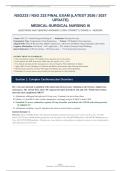
NSG 233 Final Exam (2026/2027) - Herzing University Medical-Surgical Nursing III
NSG233 / NSG 233 FINAL EXAM (LATEST
UPDATE)
MEDICAL-SURGICAL NURSING III
QUESTIONS AND VERIFIED ANSWERS | 100% CORRECT | GRADE A - HERZING
Course: NSG 233 - Medical-Surgical Nursing III | Institution: Herzing University
Examination Type: Comprehensive Final Examination | Format: 150 Multiple Choice Questions
Aligned With: NCLEX-RN Test Plan, QSEN Competencies, AHA/ACC/ATS/IDSA Clinical Guidelines (2024-2026)
Cognitive Distribution: 20% Recall | 50% Application | 30% Analysis (Priority/Critical Thinking)
Special Inclusions: 20 Priority-Setting | 49 Pharmacology | 27 Lab Interpretation Questions
INSTRUCTIONS TO CANDIDATE:
1. This examination contains 150 multiple-choice questions across 10 sections.
2. Each question has ONE best answer. Mark only one option (A, B, C, or D).
3. Use clinical reasoning and the nursing process (Assess, Diagnose, Plan, Implement, Evaluate).
4. Apply ABC (Airway, Breathing, Circulation) and Maslow prioritization when selecting interventions.
5. Pharmacology questions reference FDA-approved labeling and current clinical guidelines.
6. Rationales for correct answers are provided after each question for self-evaluation.
Section 1: Complex Cardiovascular Disorders
Q1: A 62-year-old male is admitted with substernal chest pressure radiating to the left jaw, diaphoresis,
and nausea. The 12-lead ECG shows ST-segment elevation in leads II, III, and aVF. Which intervention
must the nurse implement FIRST?
A. Administer sublingual nitroglycerin 0.4 mg every 5 minutes for up to three doses.
B. Obtain a 12-lead ECG, draw cardiac biomarkers, and apply oxygen if SpO2 is below 90%.
C. Establish IV access, administer aspirin 325 mg chewable, and initiate the STEMI activation protocol.
*[CORRECT]*
D. Administer morphine 4 mg IV and place the client in semi-Fowler's position.
Correct Answer: C
Rationale: Inferior STEMI (II, III, aVF) demands immediate reperfusion; the nurse's first actions are IV access, chewable
aspirin 162-325 mg to inhibit platelet aggregation, and activation of the cath lab/STEMI pathway (NCLEX-RN Management of
Care; AHA 2026 STEMI guideline). Nitroglycerin, oxygen titration, and morphine are adjunctive and may worsen hypotension in
right-sided infarcts if given first.
Page 1
Confidential - NSG 233 Examination Materials
,NSG 233 Final Exam (2026/2027) - Herzing University Medical-Surgical Nursing III
Q2: A client who is 6 hours post-PCI for STEMI suddenly develops coarse crackles in the lung bases, an
S3 heart sound, SpO2 88% on room air, and pink frothy sputum. Blood pressure is 88/52 mmHg. Which
order should the nurse implement FIRST?
A. Administer furosemide 40 mg IV push.
B. Place the client in high-Fowler's position and apply bi-level positive airway pressure (BiPAP).
*[CORRECT]*
C. Increase the IV nitroglycerin infusion rate to 50 mcg/min.
D. Obtain a STAT bedside echocardiogram.
Correct Answer: B
Rationale: Clinical presentation indicates acute decompensated heart failure with cardiogenic shock. The first nursing action is
non-pharmacologic: high-Fowler's plus BiPAP reduces preload and afterload, improves oxygenation, and decreases work of
breathing while awaiting physician orders (NSG 233 heart failure module; QSEN Safety). Furosemide and nitroglycerin may
worsen hypotension.
Q3: A client has a pulmonary artery catheter in place following CABG. The pulmonary capillary wedge
pressure (PCWP) reads 22 mmHg, cardiac output is 3.2 L/min, and SVR is elevated at 1,980
dynes/sec/cm5. The nurse recognizes which hemodynamic profile?
A. Hypovolemic shock
B. Cardiogenic shock *[CORRECT]*
C. Distributive shock
D. Obstructive shock
Correct Answer: B
Rationale: Cardiogenic shock presents with elevated filling pressures (PCWP > 18 mmHg), low cardiac output (< 4 L/min), and
high SVR due to compensatory vasoconstriction. Hypovolemic shock shows low PCWP; distributive shock shows low SVR;
obstructive shock shows equalization of pressures (NSG 233 hemodynamic monitoring module).
Q4: The nurse is caring for a client with a new permanent pacemaker inserted 4 hours ago. Which
assessment finding requires IMMEDIATE physician notification?
A. Mild tenderness at the generator insertion site.
B. Hiccups that persist for more than 10 minutes. *[CORRECT]*
C. Heart rate of 80 bpm paced at 60 bpm.
D. Temperature of 99.2°F (37.3°C).
Correct Answer: B
Rationale: Persistent hiccups after pacemaker insertion suggest diaphragmatic stimulation from lead perforation or malposition,
a medical emergency requiring immediate evaluation (NSG 233 pacemaker module; NCLEX-RN Reduction of Risk). Other
findings are expected.
Q5: A client receiving IV heparin for acute DVT has an aPTT of 110 seconds (control 30-40 sec). Which
order should the nurse anticipate?
A. Increase heparin infusion rate by 100 units/hr.
B. Discontinue heparin and administer protamine sulfate.
C. Hold the next heparin dose and decrease the infusion rate per protocol. *[CORRECT]*
D. Administer vitamin K 10 mg IV.
Correct Answer: C
Rationale: An aPTT > 100 sec places the client at high bleeding risk. The nurse should hold heparin, notify the provider, and
reduce the infusion rate per the institution's weight-based nomogram. Protamine is reserved for serious bleeding; vitamin K
reverses warfarin, not heparin (NSG 233 anticoagulation module).
Page 2
Confidential - NSG 233 Examination Materials
,NSG 233 Final Exam (2026/2027) - Herzing University Medical-Surgical Nursing III
Q6: Which rhythm on the cardiac monitor requires immediate synchronized cardioversion per ACLS
algorithm?
A. Atrial fibrillation with a ventricular response of 110 bpm and a systolic BP of 118/72.
B. Atrial flutter with a ventricular rate of 150 bpm, BP 78/44, and altered mental status. *[CORRECT]*
C. Sinus tachycardia at 130 bpm in a febrile client.
D. Ventricular paced rhythm at 70 bpm with BP 122/78.
Correct Answer: B
Rationale: Unstable tachyarrhythmia (hypotension, altered mental status) requires immediate synchronized cardioversion. Stable
atrial fibrillation can be rate-controlled pharmacologically; sinus tachycardia requires treatment of the underlying cause (NSG
233 ACLS/dysrhythmia module; AHA ACLS 2026).
Q7: A client postoperative day 2 from a mitral valve replacement with a mechanical valve asks why they
must take warfarin for the rest of their life. The nurse's BEST response is:
A. Mechanical valves do not require lifelong anticoagulation; only biological valves do.
B. Mechanical valves are thrombogenic and require lifelong warfarin with a target INR of 2.5-3.5.
*[CORRECT]*
C. Warfarin prevents infective endocarditis from developing on the valve.
D. Lifelong warfarin is only needed for the first 6 months postoperatively.
Correct Answer: B
Rationale: Mechanical valves are highly thrombogenic, requiring lifelong anticoagulation with a goal INR of 2.5-3.5 (or 3.0-4.0
for mitral position in some references). Biological valves only need short-term anticoagulation (NSG 233 valvular disorders;
AHA/ACC 2020 Valvular Guideline).
Q8: The nurse notes a client's PA catheter wedge pressure is 4 mmHg, cardiac index is 2.0 L/min/m2, and
SVR is 1,050 dynes/sec/cm5. The client is post-operative day 1 from CABG. Which action is most
appropriate?
A. Administer IV metoprolol 5 mg.
B. Administer a 250 mL isotonic fluid bolus and reassess. *[CORRECT]*
C. Increase dobutamine infusion.
D. Administer IV furosemide 20 mg.
Correct Answer: B
Rationale: Low PCWP (< 6 mmHg), low cardiac index, and low-normal SVR indicate hypovolemia post-cardiac surgery. A
fluid challenge with isotonic crystalloid is the first-line intervention to restore preload and cardiac output (NSG 233
hemodynamic monitoring module). Beta-blockers, diuretics, and inotropes would worsen the condition.
Q9: A client with heart failure has a BNP of 1,820 pg/mL, weight gain of 4 pounds in 3 days, and bilateral
crackles. The nurse understands which pathophysiologic process is occurring?
A. Volume overload and increased ventricular wall stress *[CORRECT]*
B. Decreased intravascular volume and decreased preload
C. Right ventricular infarction with cardiogenic shock
D. Acute pericardial tamponade
Correct Answer: A
Rationale: Elevated BNP (> 400 pg/mL) with weight gain and crackles indicates acute decompensated heart failure from volume
overload. BNP is released from overstretched ventricles; the higher the value, the more severe the wall stress and fluid overload
(NSG 233 heart failure; QSEN Evidence-Based Practice).
Page 3
Confidential - NSG 233 Examination Materials
, NSG 233 Final Exam (2026/2027) - Herzing University Medical-Surgical Nursing III
Q10: A client presents with sudden severe tearing chest pain radiating to the back, BP 180/110 in the right
arm and 92/60 in the left arm. Which action is the priority?
A. Administer aspirin 325 mg PO.
B. Initiate two large-bore IVs, prepare for CT angiography, and administer IV esmolol. *[CORRECT]*
C. Administer IV morphine 4 mg and nitroglycerin.
D. Activate the STEMI team for cath lab.
Correct Answer: B
Rationale: Systolic BP differential > 20 mmHg with tearing pain indicates aortic dissection. Priority is heart rate and BP control
with IV beta-blocker (esmolol) before vasodilators, plus imaging to confirm extent. Aspirin and STEMI activation are
contraindicated; nitroglycerin alone may worsen dissection propagation (NSG 233 vascular emergencies).
Q11: A client has just had an ICD implanted. Which statement by the client indicates the need for further
teaching?
A. I will avoid leaning over running engines or arc welding equipment.
B. I will carry my ICD identification card with me at all times.
C. If I receive a shock, I should call 911 only if I receive more than one shock.
D. I can resume playing competitive contact sports in 2 weeks. *[CORRECT]*
Correct Answer: D
Rationale: Contact sports risk damaging the ICD generator and leads; the client should avoid them indefinitely. Other statements
reflect correct understanding (NSG 233 cardiac devices; QSEN Patient-Centered Care).
Q12: Which laboratory value requires the nurse to withhold warfarin and notify the provider?
A. INR 2.5
B. INR 1.8
C. INR 4.8 *[CORRECT]*
D. PT 25 seconds (control 11-13 sec)
Correct Answer: C
Rationale: An INR > 4.5 in a client on warfarin significantly increases bleeding risk; the nurse should hold the dose and notify
the provider (NSG 233 anticoagulation module). INR 2.5 is therapeutic for atrial fibrillation; INR 1.8 requires dosage increase;
PT alone is not used to manage warfarin therapy.
Q13: A client with chronic stable angina is prescribed ranolazine. The nurse understands this medication:
A. Decreases heart rate and blood pressure through beta-blockade.
B. Relaxes vascular smooth muscle through nitric oxide release.
C. Reduces myocardial oxygen demand by inhibiting late sodium current. *[CORRECT]*
D. Prevents platelet aggregation by blocking glycoprotein IIb/IIIa receptors.
Correct Answer: C
Rationale: Ranolazine is a late sodium current inhibitor that reduces myocardial wall stress and oxygen demand without
affecting hemodynamics (HR/BP), making it an add-on for refractory angina (NSG 233 cardiovascular pharmacology module).
Page 4
Confidential - NSG 233 Examination Materials
NSG233 / NSG 233 FINAL EXAM (LATEST
UPDATE)
MEDICAL-SURGICAL NURSING III
QUESTIONS AND VERIFIED ANSWERS | 100% CORRECT | GRADE A - HERZING
Course: NSG 233 - Medical-Surgical Nursing III | Institution: Herzing University
Examination Type: Comprehensive Final Examination | Format: 150 Multiple Choice Questions
Aligned With: NCLEX-RN Test Plan, QSEN Competencies, AHA/ACC/ATS/IDSA Clinical Guidelines (2024-2026)
Cognitive Distribution: 20% Recall | 50% Application | 30% Analysis (Priority/Critical Thinking)
Special Inclusions: 20 Priority-Setting | 49 Pharmacology | 27 Lab Interpretation Questions
INSTRUCTIONS TO CANDIDATE:
1. This examination contains 150 multiple-choice questions across 10 sections.
2. Each question has ONE best answer. Mark only one option (A, B, C, or D).
3. Use clinical reasoning and the nursing process (Assess, Diagnose, Plan, Implement, Evaluate).
4. Apply ABC (Airway, Breathing, Circulation) and Maslow prioritization when selecting interventions.
5. Pharmacology questions reference FDA-approved labeling and current clinical guidelines.
6. Rationales for correct answers are provided after each question for self-evaluation.
Section 1: Complex Cardiovascular Disorders
Q1: A 62-year-old male is admitted with substernal chest pressure radiating to the left jaw, diaphoresis,
and nausea. The 12-lead ECG shows ST-segment elevation in leads II, III, and aVF. Which intervention
must the nurse implement FIRST?
A. Administer sublingual nitroglycerin 0.4 mg every 5 minutes for up to three doses.
B. Obtain a 12-lead ECG, draw cardiac biomarkers, and apply oxygen if SpO2 is below 90%.
C. Establish IV access, administer aspirin 325 mg chewable, and initiate the STEMI activation protocol.
*[CORRECT]*
D. Administer morphine 4 mg IV and place the client in semi-Fowler's position.
Correct Answer: C
Rationale: Inferior STEMI (II, III, aVF) demands immediate reperfusion; the nurse's first actions are IV access, chewable
aspirin 162-325 mg to inhibit platelet aggregation, and activation of the cath lab/STEMI pathway (NCLEX-RN Management of
Care; AHA 2026 STEMI guideline). Nitroglycerin, oxygen titration, and morphine are adjunctive and may worsen hypotension in
right-sided infarcts if given first.
Page 1
Confidential - NSG 233 Examination Materials
,NSG 233 Final Exam (2026/2027) - Herzing University Medical-Surgical Nursing III
Q2: A client who is 6 hours post-PCI for STEMI suddenly develops coarse crackles in the lung bases, an
S3 heart sound, SpO2 88% on room air, and pink frothy sputum. Blood pressure is 88/52 mmHg. Which
order should the nurse implement FIRST?
A. Administer furosemide 40 mg IV push.
B. Place the client in high-Fowler's position and apply bi-level positive airway pressure (BiPAP).
*[CORRECT]*
C. Increase the IV nitroglycerin infusion rate to 50 mcg/min.
D. Obtain a STAT bedside echocardiogram.
Correct Answer: B
Rationale: Clinical presentation indicates acute decompensated heart failure with cardiogenic shock. The first nursing action is
non-pharmacologic: high-Fowler's plus BiPAP reduces preload and afterload, improves oxygenation, and decreases work of
breathing while awaiting physician orders (NSG 233 heart failure module; QSEN Safety). Furosemide and nitroglycerin may
worsen hypotension.
Q3: A client has a pulmonary artery catheter in place following CABG. The pulmonary capillary wedge
pressure (PCWP) reads 22 mmHg, cardiac output is 3.2 L/min, and SVR is elevated at 1,980
dynes/sec/cm5. The nurse recognizes which hemodynamic profile?
A. Hypovolemic shock
B. Cardiogenic shock *[CORRECT]*
C. Distributive shock
D. Obstructive shock
Correct Answer: B
Rationale: Cardiogenic shock presents with elevated filling pressures (PCWP > 18 mmHg), low cardiac output (< 4 L/min), and
high SVR due to compensatory vasoconstriction. Hypovolemic shock shows low PCWP; distributive shock shows low SVR;
obstructive shock shows equalization of pressures (NSG 233 hemodynamic monitoring module).
Q4: The nurse is caring for a client with a new permanent pacemaker inserted 4 hours ago. Which
assessment finding requires IMMEDIATE physician notification?
A. Mild tenderness at the generator insertion site.
B. Hiccups that persist for more than 10 minutes. *[CORRECT]*
C. Heart rate of 80 bpm paced at 60 bpm.
D. Temperature of 99.2°F (37.3°C).
Correct Answer: B
Rationale: Persistent hiccups after pacemaker insertion suggest diaphragmatic stimulation from lead perforation or malposition,
a medical emergency requiring immediate evaluation (NSG 233 pacemaker module; NCLEX-RN Reduction of Risk). Other
findings are expected.
Q5: A client receiving IV heparin for acute DVT has an aPTT of 110 seconds (control 30-40 sec). Which
order should the nurse anticipate?
A. Increase heparin infusion rate by 100 units/hr.
B. Discontinue heparin and administer protamine sulfate.
C. Hold the next heparin dose and decrease the infusion rate per protocol. *[CORRECT]*
D. Administer vitamin K 10 mg IV.
Correct Answer: C
Rationale: An aPTT > 100 sec places the client at high bleeding risk. The nurse should hold heparin, notify the provider, and
reduce the infusion rate per the institution's weight-based nomogram. Protamine is reserved for serious bleeding; vitamin K
reverses warfarin, not heparin (NSG 233 anticoagulation module).
Page 2
Confidential - NSG 233 Examination Materials
,NSG 233 Final Exam (2026/2027) - Herzing University Medical-Surgical Nursing III
Q6: Which rhythm on the cardiac monitor requires immediate synchronized cardioversion per ACLS
algorithm?
A. Atrial fibrillation with a ventricular response of 110 bpm and a systolic BP of 118/72.
B. Atrial flutter with a ventricular rate of 150 bpm, BP 78/44, and altered mental status. *[CORRECT]*
C. Sinus tachycardia at 130 bpm in a febrile client.
D. Ventricular paced rhythm at 70 bpm with BP 122/78.
Correct Answer: B
Rationale: Unstable tachyarrhythmia (hypotension, altered mental status) requires immediate synchronized cardioversion. Stable
atrial fibrillation can be rate-controlled pharmacologically; sinus tachycardia requires treatment of the underlying cause (NSG
233 ACLS/dysrhythmia module; AHA ACLS 2026).
Q7: A client postoperative day 2 from a mitral valve replacement with a mechanical valve asks why they
must take warfarin for the rest of their life. The nurse's BEST response is:
A. Mechanical valves do not require lifelong anticoagulation; only biological valves do.
B. Mechanical valves are thrombogenic and require lifelong warfarin with a target INR of 2.5-3.5.
*[CORRECT]*
C. Warfarin prevents infective endocarditis from developing on the valve.
D. Lifelong warfarin is only needed for the first 6 months postoperatively.
Correct Answer: B
Rationale: Mechanical valves are highly thrombogenic, requiring lifelong anticoagulation with a goal INR of 2.5-3.5 (or 3.0-4.0
for mitral position in some references). Biological valves only need short-term anticoagulation (NSG 233 valvular disorders;
AHA/ACC 2020 Valvular Guideline).
Q8: The nurse notes a client's PA catheter wedge pressure is 4 mmHg, cardiac index is 2.0 L/min/m2, and
SVR is 1,050 dynes/sec/cm5. The client is post-operative day 1 from CABG. Which action is most
appropriate?
A. Administer IV metoprolol 5 mg.
B. Administer a 250 mL isotonic fluid bolus and reassess. *[CORRECT]*
C. Increase dobutamine infusion.
D. Administer IV furosemide 20 mg.
Correct Answer: B
Rationale: Low PCWP (< 6 mmHg), low cardiac index, and low-normal SVR indicate hypovolemia post-cardiac surgery. A
fluid challenge with isotonic crystalloid is the first-line intervention to restore preload and cardiac output (NSG 233
hemodynamic monitoring module). Beta-blockers, diuretics, and inotropes would worsen the condition.
Q9: A client with heart failure has a BNP of 1,820 pg/mL, weight gain of 4 pounds in 3 days, and bilateral
crackles. The nurse understands which pathophysiologic process is occurring?
A. Volume overload and increased ventricular wall stress *[CORRECT]*
B. Decreased intravascular volume and decreased preload
C. Right ventricular infarction with cardiogenic shock
D. Acute pericardial tamponade
Correct Answer: A
Rationale: Elevated BNP (> 400 pg/mL) with weight gain and crackles indicates acute decompensated heart failure from volume
overload. BNP is released from overstretched ventricles; the higher the value, the more severe the wall stress and fluid overload
(NSG 233 heart failure; QSEN Evidence-Based Practice).
Page 3
Confidential - NSG 233 Examination Materials
, NSG 233 Final Exam (2026/2027) - Herzing University Medical-Surgical Nursing III
Q10: A client presents with sudden severe tearing chest pain radiating to the back, BP 180/110 in the right
arm and 92/60 in the left arm. Which action is the priority?
A. Administer aspirin 325 mg PO.
B. Initiate two large-bore IVs, prepare for CT angiography, and administer IV esmolol. *[CORRECT]*
C. Administer IV morphine 4 mg and nitroglycerin.
D. Activate the STEMI team for cath lab.
Correct Answer: B
Rationale: Systolic BP differential > 20 mmHg with tearing pain indicates aortic dissection. Priority is heart rate and BP control
with IV beta-blocker (esmolol) before vasodilators, plus imaging to confirm extent. Aspirin and STEMI activation are
contraindicated; nitroglycerin alone may worsen dissection propagation (NSG 233 vascular emergencies).
Q11: A client has just had an ICD implanted. Which statement by the client indicates the need for further
teaching?
A. I will avoid leaning over running engines or arc welding equipment.
B. I will carry my ICD identification card with me at all times.
C. If I receive a shock, I should call 911 only if I receive more than one shock.
D. I can resume playing competitive contact sports in 2 weeks. *[CORRECT]*
Correct Answer: D
Rationale: Contact sports risk damaging the ICD generator and leads; the client should avoid them indefinitely. Other statements
reflect correct understanding (NSG 233 cardiac devices; QSEN Patient-Centered Care).
Q12: Which laboratory value requires the nurse to withhold warfarin and notify the provider?
A. INR 2.5
B. INR 1.8
C. INR 4.8 *[CORRECT]*
D. PT 25 seconds (control 11-13 sec)
Correct Answer: C
Rationale: An INR > 4.5 in a client on warfarin significantly increases bleeding risk; the nurse should hold the dose and notify
the provider (NSG 233 anticoagulation module). INR 2.5 is therapeutic for atrial fibrillation; INR 1.8 requires dosage increase;
PT alone is not used to manage warfarin therapy.
Q13: A client with chronic stable angina is prescribed ranolazine. The nurse understands this medication:
A. Decreases heart rate and blood pressure through beta-blockade.
B. Relaxes vascular smooth muscle through nitric oxide release.
C. Reduces myocardial oxygen demand by inhibiting late sodium current. *[CORRECT]*
D. Prevents platelet aggregation by blocking glycoprotein IIb/IIIa receptors.
Correct Answer: C
Rationale: Ranolazine is a late sodium current inhibitor that reduces myocardial wall stress and oxygen demand without
affecting hemodynamics (HR/BP), making it an add-on for refractory angina (NSG 233 cardiovascular pharmacology module).
Page 4
Confidential - NSG 233 Examination Materials


