
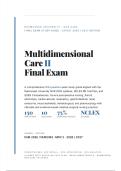
RASMUSSEN UN IVERSITY · N UR 2 392
FI N A L EX A M S T UD Y GUI D E · L AT ES T 2 0 2 0 2 7 ED I T I O N
Multidimensional
Care II
Final Exam
A comprehensive 150-question exam study guide aligned with the
Rasmussen University NUR 2392 syllabus, NCLEX-RN Test Plan, and
QSEN Competencies. Covers perioperative nursing, fluid &
electrolyte, cardiovascular, respiratory, gastrointestinal, renal,
endocrine, musculoskeletal, hematological, and pharmacology with
rationale and evidence-based medical-surgical nursing practice.
150
QUE STI ONS
10
SE CTI ONS
75%
SCE NA RI O-BA SE D
NCLEX
A LI GNE D
COURSE · E D ITION
NUR 2392 / NUR2392 · MDC 2 ·
C O G N I T I V E M I X : 2 0 % R E C A L L · 5 0 % A P P L I C A T I O N · 3 0 % A N A LY S I S
A LIGNE D WITH NCLE X -RN TE ST PLA N · QSE N COMPE TE NCIE S · RA SMUSSE N
NUR 2392 SY LLABUS
,NUR 2392 Multidimensional Care II / MDC 2 Final Exam Study Guide
NUR 2392 / NUR2392: MULTIDIMENSIONAL
CARE II / MDC 2
FINAL EXAM STUDY GUIDE
Latest Edition · Rasmussen University · 150 Questions · 10 Sections
About this guide: This comprehensive final exam study guide contains 150 multiple-choice questions aligned with the
Rasmussen University NUR 2392 course syllabus, the NCLEX-RN Test Plan, QSEN Competencies, and current
medical-surgical nursing standards. Each question includes four options (A–D) with one correct answer marked
[CORRECT], the correct answer letter, and a 2–4 sentence rationale with curriculum and NCLEX-RN references. Cognitive
level distribution: ~20% recall, ~50% application, ~30% analysis (including prioritization and clinical reasoning).
Approximately 75% of items are scenario-based.
Section 1: Perioperative Nursing
Questions 1–15 · Preoperative assessment, informed consent, anesthesia, PACU, postoperative complications, wound
and drain care, discharge
Q1: The nurse is preparing to obtain informed consent from a 67-year-old patient scheduled for a
cholecystectomy. Which action by the nurse is most appropriate?
A. Witness the patient's signature after the surgeon has explained the procedure. [CORRECT]
B. Explain the surgical risks, benefits, and alternatives in detail before the patient signs.
C. Ask the patient's spouse to sign the consent if the patient appears anxious.
D. Obtain consent immediately before transferring the patient to the operating room.
Correct Answer: A
Rationale: The nurse's role in informed consent is to witness the patient's signature and verify that the patient is competent,
understands the information, and signs voluntarily (NUR 2392 perioperative standards; NCLEX-RN informed consent
scope of practice). The surgeon — not the nurse — is responsible for explaining the procedure, risks, benefits, and
alternatives (B). A spouse may sign only if the patient is legally incompetent (C); anxiety alone does not justify surrogate
consent. Consent should be obtained well before transfer to the OR, after the patient has had time to consider options (D).
Q2: A patient is scheduled for an elective herniorrhaphy. Which preoperative assessment finding requires
immediate follow-up by the nurse?
A. Blood pressure 138/86 mm Hg
B. Serum potassium 3.0 mEq/L [CORRECT]
C. Hemoglobin 13.2 g/dL
D. Heart rate 78 beats/min
Correct Answer: B
Rationale: Hypokalemia (K+ < 3.5 mEq/L) increases the risk of cardiac dysrhythmias under anesthesia and potentiates
neuromuscular blockade, so elective surgery should be postponed pending correction (NUR 2392 perioperative risk
assessment; NCLEX-RN laboratory interpretation). The remaining findings — mild BP elevation, hemoglobin 13.2 g/dL,
and heart rate 78 — are within acceptable or borderline ranges for elective surgery and do not require urgent intervention
(A, C, D).
Rasmussen University · Latest 2026/2027 Edition Page 1
,NUR 2392 Multidimensional Care II / MDC 2 Final Exam Study Guide
Q3: The nurse is caring for four postoperative patients. Which patient should the nurse assess first?
A. A patient 4 hours post-colonoscopy complaining of mild abdominal cramping.
B. A patient 6 hours post-colectomy with absent bowel sounds in all four quadrants.
C. A patient 2 hours post-thyroidectomy with intermittent stridor and restlessness. [CORRECT]
D. A patient 12 hours post-appendectomy requesting analgesia for incisional pain.
Correct Answer: C
Rationale: Stridor and restlessness 2 hours post-thyroidectomy suggest airway compromise from hematoma or bilateral
recurrent laryngeal nerve injury — an immediate life-threatening complication requiring emergency intervention (NUR
2392 postoperative complications; NCLEX-RN airway, breathing, circulation priority). Mild cramping after colonoscopy,
absent bowel sounds early postoperatively, and incisional pain after appendectomy are expected findings that do not take
priority over airway compromise (A, B, D).
Q4: Which type of anesthesia is most appropriate for a patient undergoing repair of a complex abdominal
aortic aneurysm?
A. Local anesthesia with sedation
B. Epidural anesthesia
C. General anesthesia with endotracheal intubation [CORRECT]
D. Conscious sedation (moderate)
Correct Answer: C
Rationale: Major intra-abdominal vascular procedures require general anesthesia with endotracheal intubation to secure the
airway, provide complete muscle relaxation, and control ventilation during hemodynamic fluctuations (NUR 2392
anesthesia types; NCLEX-RN intraoperative care). Local, epidural, and moderate sedation cannot provide the surgical
exposure, immobility, or airway protection required for this procedure (A, B, D).
Q5: A patient is admitted to the PACU following general anesthesia. Initial assessment reveals SpO2 90%,
respiratory rate 8/min, and diminished gag reflex. Which action should the nurse take first?
A. Administer prescribed naloxone 0.4 mg IV push.
B. Suction the oropharynx to clear secretions.
C. Position the patient lateral decubitus and apply oxygen per mask. [CORRECT]
D. Increase the IV opioid analgesic rate.
Correct Answer: C
Rationale: The first priority in PACU is airway patency and oxygenation; positioning the patient lateral (recovery position)
with oxygen relieves airway obstruction from the relaxed tongue/secretions — the most likely cause of hypoventilation in this
scenario (NUR 2392 PACU care; NCLEX-RN ABC priority). Naloxone reverses opioids (A) but airway positioning must
occur first. Suctioning (B) is appropriate but secondary to positioning and oxygenation. Increasing opioids (D) would worsen
respiratory depression.
Q6: Twelve hours after colectomy, a patient's abdominal dressing becomes saturated with bright red
blood. Vital signs: BP 96/58, HR 122, RR 24. Which action is most important?
A. Reinforce the dressing and document the finding.
B. Apply direct pressure to the incision site and call the surgeon. [CORRECT]
C. Increase the patient's IV opioid infusion.
D. Obtain an abdominal ultrasound.
Correct Answer: B
Rationale: Bright red sanguineous drainage plus hypotension and tachycardia indicate active postoperative hemorrhage —
a surgical emergency. The nurse must apply direct pressure, support perfusion with IV fluids, and immediately notify the
surgeon (NUR 2392 postoperative hemorrhage; NCLEX-RN clinical deterioration response). Reinforcement alone (A)
delays intervention. Opioids (C) worsen hypotension and mask symptoms. Ultrasound (D) is not the priority during active
Rasmussen University · Latest 2026/2027 Edition Page 2
, NUR 2392 Multidimensional Care II / MDC 2 Final Exam Study Guide
bleeding.
Q7: Which intervention best prevents venous thromboembolism (VTE) in a postoperative patient?
A. Maintaining bed rest for the first 48 hours
B. Administering enoxaparin 40 mg subcutaneously daily as prescribed [CORRECT]
C. Placing the patient in Trendelenburg position
D. Applying elastic compression stockings only when ambulating
Correct Answer: B
Rationale: Pharmacologic prophylaxis with low-molecular-weight heparin (enoxaparin) is the most effective strategy for
VTE prevention in surgical patients and is recommended by NUR 2392 postoperative care and the NCLEX-RN safety
framework. Bed rest (A) increases stasis and VTE risk. Trendelenburg (C) is contraindicated for DVT prevention. Elastic
stockings alone (D) are adjunctive and must be worn continuously, not only when ambulating.
Q8: A postoperative patient suddenly develops dyspnea, tachycardia, hemoptysis, and pleuritic chest pain.
Which condition is most likely?
A. Atelectasis
B. Pulmonary embolism [CORRECT]
C. Myocardial infarction
D. Pneumonia
Correct Answer: B
Rationale: The classic triad of dyspnea, tachycardia, hemoptysis, and pleuritic chest pain in a postoperative patient is
consistent with pulmonary embolism — a life-threatening complication requiring immediate intervention (NUR 2392
postoperative complications; NCLEX-RN clinical reasoning). Atelectasis presents with low-grade fever and decreased breath
sounds without hemoptysis (A). MI typically presents with substernal chest pressure and diaphoresis, not pleuritic pain (C).
Pneumonia develops more gradually with purulent sputum (D).
Q9: Which nursing measure is most effective in preventing postoperative atelectasis?
A. Administering prescribed opioids around the clock
B. Restricting oral fluids for the first 24 hours
C. Encouraging incentive spirometry use every 1–2 hours while awake [CORRECT]
D. Maintaining strict bed rest for 72 hours
Correct Answer: C
Rationale: Incentive spirometry every 1–2 hours promotes sustained maximal inspiration, alveolar recruitment, and
prevention of postoperative atelectasis — a core NUR 2392 perioperative nursing measure and NCLEX-RN evidence-based
practice. Opioids (A) depress respirations and worsen atelectasis. Fluid restriction (B) is not indicated. Bed rest (D) increases
pulmonary complications.
Q10: While changing a postoperative abdominal dressing, the nurse observes protrusion of intestinal
loops through the wound. Which action should the nurse take first?
A. Reinsert the loops gently using sterile technique
B. Cover the wound with sterile saline-soaked gauze [CORRECT]
C. Apply an abdominal binder tightly
D. Notify the surgeon and keep the patient NPO
Correct Answer: B
Rationale: Wound evisceration is a surgical emergency; the nurse must immediately cover the protruding viscera with sterile
saline-soaked gauze to prevent drying and contamination, then notify the surgeon and keep the patient NPO while preparing
for emergency surgery (NUR 2392 postoperative wound complications; NCLEX-RN priority action). Reinsertion of viscera
Rasmussen University · Latest 2026/2027 Edition Page 3
FI N A L EX A M S T UD Y GUI D E · L AT ES T 2 0 2 0 2 7 ED I T I O N
Multidimensional
Care II
Final Exam
A comprehensive 150-question exam study guide aligned with the
Rasmussen University NUR 2392 syllabus, NCLEX-RN Test Plan, and
QSEN Competencies. Covers perioperative nursing, fluid &
electrolyte, cardiovascular, respiratory, gastrointestinal, renal,
endocrine, musculoskeletal, hematological, and pharmacology with
rationale and evidence-based medical-surgical nursing practice.
150
QUE STI ONS
10
SE CTI ONS
75%
SCE NA RI O-BA SE D
NCLEX
A LI GNE D
COURSE · E D ITION
NUR 2392 / NUR2392 · MDC 2 ·
C O G N I T I V E M I X : 2 0 % R E C A L L · 5 0 % A P P L I C A T I O N · 3 0 % A N A LY S I S
A LIGNE D WITH NCLE X -RN TE ST PLA N · QSE N COMPE TE NCIE S · RA SMUSSE N
NUR 2392 SY LLABUS
,NUR 2392 Multidimensional Care II / MDC 2 Final Exam Study Guide
NUR 2392 / NUR2392: MULTIDIMENSIONAL
CARE II / MDC 2
FINAL EXAM STUDY GUIDE
Latest Edition · Rasmussen University · 150 Questions · 10 Sections
About this guide: This comprehensive final exam study guide contains 150 multiple-choice questions aligned with the
Rasmussen University NUR 2392 course syllabus, the NCLEX-RN Test Plan, QSEN Competencies, and current
medical-surgical nursing standards. Each question includes four options (A–D) with one correct answer marked
[CORRECT], the correct answer letter, and a 2–4 sentence rationale with curriculum and NCLEX-RN references. Cognitive
level distribution: ~20% recall, ~50% application, ~30% analysis (including prioritization and clinical reasoning).
Approximately 75% of items are scenario-based.
Section 1: Perioperative Nursing
Questions 1–15 · Preoperative assessment, informed consent, anesthesia, PACU, postoperative complications, wound
and drain care, discharge
Q1: The nurse is preparing to obtain informed consent from a 67-year-old patient scheduled for a
cholecystectomy. Which action by the nurse is most appropriate?
A. Witness the patient's signature after the surgeon has explained the procedure. [CORRECT]
B. Explain the surgical risks, benefits, and alternatives in detail before the patient signs.
C. Ask the patient's spouse to sign the consent if the patient appears anxious.
D. Obtain consent immediately before transferring the patient to the operating room.
Correct Answer: A
Rationale: The nurse's role in informed consent is to witness the patient's signature and verify that the patient is competent,
understands the information, and signs voluntarily (NUR 2392 perioperative standards; NCLEX-RN informed consent
scope of practice). The surgeon — not the nurse — is responsible for explaining the procedure, risks, benefits, and
alternatives (B). A spouse may sign only if the patient is legally incompetent (C); anxiety alone does not justify surrogate
consent. Consent should be obtained well before transfer to the OR, after the patient has had time to consider options (D).
Q2: A patient is scheduled for an elective herniorrhaphy. Which preoperative assessment finding requires
immediate follow-up by the nurse?
A. Blood pressure 138/86 mm Hg
B. Serum potassium 3.0 mEq/L [CORRECT]
C. Hemoglobin 13.2 g/dL
D. Heart rate 78 beats/min
Correct Answer: B
Rationale: Hypokalemia (K+ < 3.5 mEq/L) increases the risk of cardiac dysrhythmias under anesthesia and potentiates
neuromuscular blockade, so elective surgery should be postponed pending correction (NUR 2392 perioperative risk
assessment; NCLEX-RN laboratory interpretation). The remaining findings — mild BP elevation, hemoglobin 13.2 g/dL,
and heart rate 78 — are within acceptable or borderline ranges for elective surgery and do not require urgent intervention
(A, C, D).
Rasmussen University · Latest 2026/2027 Edition Page 1
,NUR 2392 Multidimensional Care II / MDC 2 Final Exam Study Guide
Q3: The nurse is caring for four postoperative patients. Which patient should the nurse assess first?
A. A patient 4 hours post-colonoscopy complaining of mild abdominal cramping.
B. A patient 6 hours post-colectomy with absent bowel sounds in all four quadrants.
C. A patient 2 hours post-thyroidectomy with intermittent stridor and restlessness. [CORRECT]
D. A patient 12 hours post-appendectomy requesting analgesia for incisional pain.
Correct Answer: C
Rationale: Stridor and restlessness 2 hours post-thyroidectomy suggest airway compromise from hematoma or bilateral
recurrent laryngeal nerve injury — an immediate life-threatening complication requiring emergency intervention (NUR
2392 postoperative complications; NCLEX-RN airway, breathing, circulation priority). Mild cramping after colonoscopy,
absent bowel sounds early postoperatively, and incisional pain after appendectomy are expected findings that do not take
priority over airway compromise (A, B, D).
Q4: Which type of anesthesia is most appropriate for a patient undergoing repair of a complex abdominal
aortic aneurysm?
A. Local anesthesia with sedation
B. Epidural anesthesia
C. General anesthesia with endotracheal intubation [CORRECT]
D. Conscious sedation (moderate)
Correct Answer: C
Rationale: Major intra-abdominal vascular procedures require general anesthesia with endotracheal intubation to secure the
airway, provide complete muscle relaxation, and control ventilation during hemodynamic fluctuations (NUR 2392
anesthesia types; NCLEX-RN intraoperative care). Local, epidural, and moderate sedation cannot provide the surgical
exposure, immobility, or airway protection required for this procedure (A, B, D).
Q5: A patient is admitted to the PACU following general anesthesia. Initial assessment reveals SpO2 90%,
respiratory rate 8/min, and diminished gag reflex. Which action should the nurse take first?
A. Administer prescribed naloxone 0.4 mg IV push.
B. Suction the oropharynx to clear secretions.
C. Position the patient lateral decubitus and apply oxygen per mask. [CORRECT]
D. Increase the IV opioid analgesic rate.
Correct Answer: C
Rationale: The first priority in PACU is airway patency and oxygenation; positioning the patient lateral (recovery position)
with oxygen relieves airway obstruction from the relaxed tongue/secretions — the most likely cause of hypoventilation in this
scenario (NUR 2392 PACU care; NCLEX-RN ABC priority). Naloxone reverses opioids (A) but airway positioning must
occur first. Suctioning (B) is appropriate but secondary to positioning and oxygenation. Increasing opioids (D) would worsen
respiratory depression.
Q6: Twelve hours after colectomy, a patient's abdominal dressing becomes saturated with bright red
blood. Vital signs: BP 96/58, HR 122, RR 24. Which action is most important?
A. Reinforce the dressing and document the finding.
B. Apply direct pressure to the incision site and call the surgeon. [CORRECT]
C. Increase the patient's IV opioid infusion.
D. Obtain an abdominal ultrasound.
Correct Answer: B
Rationale: Bright red sanguineous drainage plus hypotension and tachycardia indicate active postoperative hemorrhage —
a surgical emergency. The nurse must apply direct pressure, support perfusion with IV fluids, and immediately notify the
surgeon (NUR 2392 postoperative hemorrhage; NCLEX-RN clinical deterioration response). Reinforcement alone (A)
delays intervention. Opioids (C) worsen hypotension and mask symptoms. Ultrasound (D) is not the priority during active
Rasmussen University · Latest 2026/2027 Edition Page 2
, NUR 2392 Multidimensional Care II / MDC 2 Final Exam Study Guide
bleeding.
Q7: Which intervention best prevents venous thromboembolism (VTE) in a postoperative patient?
A. Maintaining bed rest for the first 48 hours
B. Administering enoxaparin 40 mg subcutaneously daily as prescribed [CORRECT]
C. Placing the patient in Trendelenburg position
D. Applying elastic compression stockings only when ambulating
Correct Answer: B
Rationale: Pharmacologic prophylaxis with low-molecular-weight heparin (enoxaparin) is the most effective strategy for
VTE prevention in surgical patients and is recommended by NUR 2392 postoperative care and the NCLEX-RN safety
framework. Bed rest (A) increases stasis and VTE risk. Trendelenburg (C) is contraindicated for DVT prevention. Elastic
stockings alone (D) are adjunctive and must be worn continuously, not only when ambulating.
Q8: A postoperative patient suddenly develops dyspnea, tachycardia, hemoptysis, and pleuritic chest pain.
Which condition is most likely?
A. Atelectasis
B. Pulmonary embolism [CORRECT]
C. Myocardial infarction
D. Pneumonia
Correct Answer: B
Rationale: The classic triad of dyspnea, tachycardia, hemoptysis, and pleuritic chest pain in a postoperative patient is
consistent with pulmonary embolism — a life-threatening complication requiring immediate intervention (NUR 2392
postoperative complications; NCLEX-RN clinical reasoning). Atelectasis presents with low-grade fever and decreased breath
sounds without hemoptysis (A). MI typically presents with substernal chest pressure and diaphoresis, not pleuritic pain (C).
Pneumonia develops more gradually with purulent sputum (D).
Q9: Which nursing measure is most effective in preventing postoperative atelectasis?
A. Administering prescribed opioids around the clock
B. Restricting oral fluids for the first 24 hours
C. Encouraging incentive spirometry use every 1–2 hours while awake [CORRECT]
D. Maintaining strict bed rest for 72 hours
Correct Answer: C
Rationale: Incentive spirometry every 1–2 hours promotes sustained maximal inspiration, alveolar recruitment, and
prevention of postoperative atelectasis — a core NUR 2392 perioperative nursing measure and NCLEX-RN evidence-based
practice. Opioids (A) depress respirations and worsen atelectasis. Fluid restriction (B) is not indicated. Bed rest (D) increases
pulmonary complications.
Q10: While changing a postoperative abdominal dressing, the nurse observes protrusion of intestinal
loops through the wound. Which action should the nurse take first?
A. Reinsert the loops gently using sterile technique
B. Cover the wound with sterile saline-soaked gauze [CORRECT]
C. Apply an abdominal binder tightly
D. Notify the surgeon and keep the patient NPO
Correct Answer: B
Rationale: Wound evisceration is a surgical emergency; the nurse must immediately cover the protruding viscera with sterile
saline-soaked gauze to prevent drying and contamination, then notify the surgeon and keep the patient NPO while preparing
for emergency surgery (NUR 2392 postoperative wound complications; NCLEX-RN priority action). Reinsertion of viscera
Rasmussen University · Latest 2026/2027 Edition Page 3


