
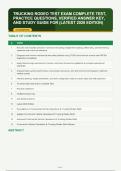
,This study document brings together 140 carefully worded exam questions drawn from Trucking
rodeo test Exam Complete Test, Practice Questions, Verified Answer Key, and Study Guide for
(Latest 2026 Edition), with the strongest emphasis placed on Execute and evaluate precision
maneuvers including straight-line backing, offset alley, and diminishing clearance with sub-inch
tolerance, Diagnose and correct mechanical and safety defects using CVSA out-of-service criteria
and FMCSA inspection procedures, Apply federal cargo securement, hazmat and and
hours-of-service regulations to complex operational scenarios. Every item follows the wording style
and level of reasoning you meet in the real paper, and each one is paired with a clear rationale so
the correct choice is never a guess. Work through the set at your own pace, mark the questions
that slow you down, then come back to them until the reasoning feels automatic. Learners who
revise this way walk into the exam room recognising the pattern behind the questions instead of
meeting them for the first time. Keep going - steady, honest practice is what turns a difficult paper
into a comfortable pass.
Q1 EXECUTE AND EVALUATE PRECISION MANEUVERS INCLUDING STRAIGHT-LINE
BACKING, OFFSET ALLEY, AND DIMINISHING CLEARANCE WITH SUB-INCH TOLERANCE
In the straight-line backing event, a driver must back a 53-foot trailer through a
12-foot-wide lane for 100 feet. If the tractor's rear axle is 4 feet off-center at the
start, which steering correction sequence minimizes lateral drift?
A. Steer hard opposite the drift, then counter-steer immediately to straighten.
B. Make small, timed steering inputs toward the drift, allowing the trailer to pivot gradually.
CORRECT
C. Hold the wheel steady and use the trailer brake to pull the vehicle straight.
D. Steer away from the drift, then overcorrect to align the tractor and trailer.
RATIONALE: Small, timed steering inputs toward the drift allow the trailer to pivot gradually and
minimize overcorrection, which is critical in tight backing. Hard or overcorrections (A, D) cause
jackknifing or loss of control. Using trailer brakes alone (C) does not correct lateral alignment
effectively.
Page 2
,Q2 EXECUTE AND EVALUATE PRECISION MANEUVERS INCLUDING STRAIGHT-LINE
BACKING, OFFSET ALLEY, AND DIMINISHING CLEARANCE WITH SUB-INCH TOLERANCE
During a pre-trip inspection, a driver finds a brake chamber pushrod stroke of 2.5
inches on a type 30/30 long-stroke chamber. According to CVSA out-of-service
criteria, what is the correct action?
A. The vehicle is out of service because the stroke exceeds the adjustment limit. CORRECT
B. The vehicle is serviceable if the slack adjuster is not loose.
C. The vehicle requires immediate brake re-adjustment but is not out of service.
D. The vehicle is serviceable because long-stroke chambers allow up to 3 inches.
RATIONALE: CVSA out-of-service criteria for long-stroke chambers specify a maximum pushrod
stroke of 2.0 inches; 2.5 inches exceeds this, making the vehicle out of service. Options B and D
incorrectly suggest it is serviceable, and C understates the severity-out-of-service is required.
Q3 EXECUTE AND EVALUATE PRECISION MANEUVERS INCLUDING STRAIGHT-LINE
BACKING, OFFSET ALLEY, AND DIMINISHING CLEARANCE WITH SUB-INCH TOLERANCE
A driver must secure a 20,000 lb steel coil using the federal cargo securement
rules. Which tie-down configuration is compliant for a coil loaded in a sided
vehicle?
A. Two chains with a working load limit of 5,000 lb each, placed diagonally.
B. Four chains with a working load limit of 4,000 lb each, placed vertically.
C. Two straps with a working load limit of 10,000 lb each, placed horizontally.
D. Four chains with a working load limit of 5,000 lb each, placed diagonally. CORRECT
RATIONALE: FMCSA requires aggregate WLL of tie-downs to be at least 50% of cargo weight
(10,000 lb for 20,000 lb). Four chains at 5,000 lb each provide 20,000 lb aggregate, and diagonal
placement prevents shifting. Options A and C provide insufficient WLL; B uses vertical
placement, which is less effective.
Page 3
, Q4 EXECUTE AND EVALUATE PRECISION MANEUVERS INCLUDING STRAIGHT-LINE
BACKING, OFFSET ALLEY, AND DIMINISHING CLEARANCE WITH SUB-INCH TOLERANCE
In the diminishing clearance event, a driver approaches a 9-foot-wide gap with a
vehicle 8.5 feet wide. Which technique best ensures passage without touching the
barriers?
A. Aim the vehicle's center at the gap's center and maintain constant speed.
B. Align the left side of the vehicle with the left barrier and steer straight through.
C. Use the right mirror to judge clearance and make continuous small adjustments. CORRECT
D. Slow to a crawl, then steer sharply left immediately after entering the gap.
RATIONALE: Continuous small adjustments based on mirror reference points allow precise
tracking through diminishing clearance. Centering (A) is insufficient for asymmetric clearance;
aligning one side (B) ignores the other side; sharp steering (D) risks contact.
Q5 EXECUTE AND EVALUATE PRECISION MANEUVERS INCLUDING STRAIGHT-LINE
BACKING, OFFSET ALLEY, AND DIMINISHING CLEARANCE WITH SUB-INCH TOLERANCE
A tractor-trailer combination has a GCWR of 80,000 lb. If the tractor weighs 18,000
lb and the trailer weighs 12,000 lb empty, what is the maximum legal payload?
A. 50,000 lb CORRECT
B. 62,000 lb
C. 68,000 lb
D. 80,000 lb
RATIONALE: Payload = GCWR - (tractor weight + trailer empty weight) = 80,000 - (18,000 +
12,000) = 50,000 lb. Options B, C, and D incorrectly add or omit weights.
Page 4
rodeo test Exam Complete Test, Practice Questions, Verified Answer Key, and Study Guide for
(Latest 2026 Edition), with the strongest emphasis placed on Execute and evaluate precision
maneuvers including straight-line backing, offset alley, and diminishing clearance with sub-inch
tolerance, Diagnose and correct mechanical and safety defects using CVSA out-of-service criteria
and FMCSA inspection procedures, Apply federal cargo securement, hazmat and and
hours-of-service regulations to complex operational scenarios. Every item follows the wording style
and level of reasoning you meet in the real paper, and each one is paired with a clear rationale so
the correct choice is never a guess. Work through the set at your own pace, mark the questions
that slow you down, then come back to them until the reasoning feels automatic. Learners who
revise this way walk into the exam room recognising the pattern behind the questions instead of
meeting them for the first time. Keep going - steady, honest practice is what turns a difficult paper
into a comfortable pass.
Q1 EXECUTE AND EVALUATE PRECISION MANEUVERS INCLUDING STRAIGHT-LINE
BACKING, OFFSET ALLEY, AND DIMINISHING CLEARANCE WITH SUB-INCH TOLERANCE
In the straight-line backing event, a driver must back a 53-foot trailer through a
12-foot-wide lane for 100 feet. If the tractor's rear axle is 4 feet off-center at the
start, which steering correction sequence minimizes lateral drift?
A. Steer hard opposite the drift, then counter-steer immediately to straighten.
B. Make small, timed steering inputs toward the drift, allowing the trailer to pivot gradually.
CORRECT
C. Hold the wheel steady and use the trailer brake to pull the vehicle straight.
D. Steer away from the drift, then overcorrect to align the tractor and trailer.
RATIONALE: Small, timed steering inputs toward the drift allow the trailer to pivot gradually and
minimize overcorrection, which is critical in tight backing. Hard or overcorrections (A, D) cause
jackknifing or loss of control. Using trailer brakes alone (C) does not correct lateral alignment
effectively.
Page 2
,Q2 EXECUTE AND EVALUATE PRECISION MANEUVERS INCLUDING STRAIGHT-LINE
BACKING, OFFSET ALLEY, AND DIMINISHING CLEARANCE WITH SUB-INCH TOLERANCE
During a pre-trip inspection, a driver finds a brake chamber pushrod stroke of 2.5
inches on a type 30/30 long-stroke chamber. According to CVSA out-of-service
criteria, what is the correct action?
A. The vehicle is out of service because the stroke exceeds the adjustment limit. CORRECT
B. The vehicle is serviceable if the slack adjuster is not loose.
C. The vehicle requires immediate brake re-adjustment but is not out of service.
D. The vehicle is serviceable because long-stroke chambers allow up to 3 inches.
RATIONALE: CVSA out-of-service criteria for long-stroke chambers specify a maximum pushrod
stroke of 2.0 inches; 2.5 inches exceeds this, making the vehicle out of service. Options B and D
incorrectly suggest it is serviceable, and C understates the severity-out-of-service is required.
Q3 EXECUTE AND EVALUATE PRECISION MANEUVERS INCLUDING STRAIGHT-LINE
BACKING, OFFSET ALLEY, AND DIMINISHING CLEARANCE WITH SUB-INCH TOLERANCE
A driver must secure a 20,000 lb steel coil using the federal cargo securement
rules. Which tie-down configuration is compliant for a coil loaded in a sided
vehicle?
A. Two chains with a working load limit of 5,000 lb each, placed diagonally.
B. Four chains with a working load limit of 4,000 lb each, placed vertically.
C. Two straps with a working load limit of 10,000 lb each, placed horizontally.
D. Four chains with a working load limit of 5,000 lb each, placed diagonally. CORRECT
RATIONALE: FMCSA requires aggregate WLL of tie-downs to be at least 50% of cargo weight
(10,000 lb for 20,000 lb). Four chains at 5,000 lb each provide 20,000 lb aggregate, and diagonal
placement prevents shifting. Options A and C provide insufficient WLL; B uses vertical
placement, which is less effective.
Page 3
, Q4 EXECUTE AND EVALUATE PRECISION MANEUVERS INCLUDING STRAIGHT-LINE
BACKING, OFFSET ALLEY, AND DIMINISHING CLEARANCE WITH SUB-INCH TOLERANCE
In the diminishing clearance event, a driver approaches a 9-foot-wide gap with a
vehicle 8.5 feet wide. Which technique best ensures passage without touching the
barriers?
A. Aim the vehicle's center at the gap's center and maintain constant speed.
B. Align the left side of the vehicle with the left barrier and steer straight through.
C. Use the right mirror to judge clearance and make continuous small adjustments. CORRECT
D. Slow to a crawl, then steer sharply left immediately after entering the gap.
RATIONALE: Continuous small adjustments based on mirror reference points allow precise
tracking through diminishing clearance. Centering (A) is insufficient for asymmetric clearance;
aligning one side (B) ignores the other side; sharp steering (D) risks contact.
Q5 EXECUTE AND EVALUATE PRECISION MANEUVERS INCLUDING STRAIGHT-LINE
BACKING, OFFSET ALLEY, AND DIMINISHING CLEARANCE WITH SUB-INCH TOLERANCE
A tractor-trailer combination has a GCWR of 80,000 lb. If the tractor weighs 18,000
lb and the trailer weighs 12,000 lb empty, what is the maximum legal payload?
A. 50,000 lb CORRECT
B. 62,000 lb
C. 68,000 lb
D. 80,000 lb
RATIONALE: Payload = GCWR - (tractor weight + trailer empty weight) = 80,000 - (18,000 +
12,000) = 50,000 lb. Options B, C, and D incorrectly add or omit weights.
Page 4


