
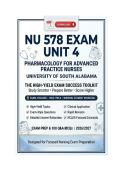
,NU 578 Pharmacology for Advanced Practice
Nurses Unit 4 Exam Study Guide University of
South Alabama Exam Prep & 100 Q&A MCQs
2026/2027
1. Which of the following is the most appropriate first-line pharmacologic therapy for a patient
newly diagnosed with type 2 diabetes with an A1c of 7.5%?
A. Insulin glargine
B. Metformin
C. Glipizide
D. Sitagliptin
Correct Answer: B
Rationale: Metformin is the first-line pharmacologic therapy for type 2 diabetes due to its
efficacy, safety profile, and low risk of hypoglycemia. It reduces hepatic glucose production and
improves insulin sensitivity. Lifestyle modifications should also be initiated concurrently.
2. A patient on metformin is scheduled for a CT scan with IV contrast. What is the most
important action?
A. Continue metformin as usual
B. Hold metformin 48 hours before and after the procedure
C. Increase the metformin dose
,D. Switch to insulin temporarily
Correct Answer: B
Rationale: Metformin should be held 48 hours before and after IV contrast administration to
prevent contrast-induced nephropathy and lactic acidosis. Renal function should be assessed
before restarting the medication.
3. Which of the following is a common adverse effect of metformin?
A. Hypoglycemia
B. Weight gain
C. Gastrointestinal upset
D. Bradycardia
Correct Answer: C
Rationale: Gastrointestinal upset (diarrhea, nausea, abdominal discomfort) is a common
adverse effect of metformin. It is often mitigated by taking the medication with food or using
extended-release formulations. Metformin does not typically cause hypoglycemia when used as
monotherapy.
4. A patient with type 2 diabetes and a history of heart failure is prescribed a medication. Which
class has proven cardiovascular benefit in this population?
, A. Sulfonylureas
B. SGLT2 inhibitors
C. DPP-4 inhibitors
D. Alpha-glucosidase inhibitors
Correct Answer: B
Rationale: SGLT2 inhibitors (e.g., empagliflozin, dapagliflozin) have proven cardiovascular and
renal benefits, including reduced heart failure hospitalizations. They are recommended for
patients with type 2 diabetes and established cardiovascular disease or heart failure.
5. Which of the following medications is a GLP-1 receptor agonist?
A. Metformin
B. Liraglutide
C. Glipizide
D. Pioglitazone
Correct Answer: B
Rationale: Liraglutide is a GLP-1 receptor agonist. Other GLP-1 agonists include semaglutide,
dulaglutide, and exenatide. These agents stimulate glucose-dependent insulin secretion,
suppress glucagon release, slow gastric emptying, and promote weight loss.
Nurses Unit 4 Exam Study Guide University of
South Alabama Exam Prep & 100 Q&A MCQs
2026/2027
1. Which of the following is the most appropriate first-line pharmacologic therapy for a patient
newly diagnosed with type 2 diabetes with an A1c of 7.5%?
A. Insulin glargine
B. Metformin
C. Glipizide
D. Sitagliptin
Correct Answer: B
Rationale: Metformin is the first-line pharmacologic therapy for type 2 diabetes due to its
efficacy, safety profile, and low risk of hypoglycemia. It reduces hepatic glucose production and
improves insulin sensitivity. Lifestyle modifications should also be initiated concurrently.
2. A patient on metformin is scheduled for a CT scan with IV contrast. What is the most
important action?
A. Continue metformin as usual
B. Hold metformin 48 hours before and after the procedure
C. Increase the metformin dose
,D. Switch to insulin temporarily
Correct Answer: B
Rationale: Metformin should be held 48 hours before and after IV contrast administration to
prevent contrast-induced nephropathy and lactic acidosis. Renal function should be assessed
before restarting the medication.
3. Which of the following is a common adverse effect of metformin?
A. Hypoglycemia
B. Weight gain
C. Gastrointestinal upset
D. Bradycardia
Correct Answer: C
Rationale: Gastrointestinal upset (diarrhea, nausea, abdominal discomfort) is a common
adverse effect of metformin. It is often mitigated by taking the medication with food or using
extended-release formulations. Metformin does not typically cause hypoglycemia when used as
monotherapy.
4. A patient with type 2 diabetes and a history of heart failure is prescribed a medication. Which
class has proven cardiovascular benefit in this population?
, A. Sulfonylureas
B. SGLT2 inhibitors
C. DPP-4 inhibitors
D. Alpha-glucosidase inhibitors
Correct Answer: B
Rationale: SGLT2 inhibitors (e.g., empagliflozin, dapagliflozin) have proven cardiovascular and
renal benefits, including reduced heart failure hospitalizations. They are recommended for
patients with type 2 diabetes and established cardiovascular disease or heart failure.
5. Which of the following medications is a GLP-1 receptor agonist?
A. Metformin
B. Liraglutide
C. Glipizide
D. Pioglitazone
Correct Answer: B
Rationale: Liraglutide is a GLP-1 receptor agonist. Other GLP-1 agonists include semaglutide,
dulaglutide, and exenatide. These agents stimulate glucose-dependent insulin secretion,
suppress glucagon release, slow gastric emptying, and promote weight loss.


