
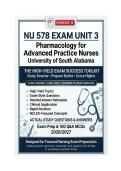
,NU 578 Pharmacology for Advanced Practice
Nurses Unit 3 Exam Study Guide University of
South Alabama Exam Prep & 100 Q&A MCQs
2026/2027
1. Which class of antihypertensive drugs works primarily by blocking the conversion of
angiotensin I to angiotensin II?
A. Beta-blockers
B. ACE inhibitors
C. Calcium channel blockers
D. Thiazide diuretics
Correct Answer: B
Rationale: ACE inhibitors (e.g., lisinopril, enalapril) block the angiotensin-converting enzyme,
preventing the conversion of angiotensin I to angiotensin II. This reduces vasoconstriction and
aldosterone secretion, lowering blood pressure. They also increase bradykinin levels, which
contributes to their vasodilatory effects and the characteristic dry cough side effect.
2. A patient taking an ACE inhibitor develops a persistent dry cough. Which mechanism best
explains this adverse effect?
A. Accumulation of bradykinin
B. Blockade of beta-2 receptors
,C. Increased angiotensin II levels
D. Sodium retention
Correct Answer: A
Rationale: ACE inhibitors block the enzyme that degrades bradykinin, leading to bradykinin
accumulation in the respiratory tract. This causes the dry, persistent cough that affects
approximately 10-20% of patients on ACE inhibitors. Switching to an ARB (e.g., losartan) often
resolves the cough while maintaining RAAS blockade.
3. Which of the following is a contraindication to ACE inhibitor therapy?
A. Hypertension
B. History of angioedema
C. Diabetes mellitus
D. Heart failure
Correct Answer: B
Rationale: ACE inhibitors are contraindicated in patients with a history of angioedema
(hereditary or ACE inhibitor-induced) due to the risk of life-threatening airway swelling. They are
also contraindicated in pregnancy (teratogenic) and bilateral renal artery stenosis.
, 4. A patient with diabetes and hypertension is prescribed an ACE inhibitor. Which additional
benefit does this drug class provide?
A. Weight loss
B. Renoprotection
C. Increased heart rate
D. Bronchodilation
Correct Answer: B
Rationale: ACE inhibitors provide renoprotective effects in patients with diabetes by reducing
intraglomerular pressure through dilation of the efferent arteriole. This slows the progression of
diabetic nephropathy and reduces proteinuria.
5. What is the mechanism of action of angiotensin II receptor blockers (ARBs)?
A. Blocking ACE enzyme
B. Blocking angiotensin II at the AT1 receptor
C. Inhibiting renin secretion
D. Blocking calcium channels
Correct Answer: B
Rationale: ARBs (e.g., losartan, valsartan) selectively block the AT1 receptor, preventing
angiotensin II from exerting its vasoconstrictive and aldosterone-secreting effects. Unlike ACE
inhibitors, ARBs do not affect bradykinin levels, so they are less likely to cause cough.
Nurses Unit 3 Exam Study Guide University of
South Alabama Exam Prep & 100 Q&A MCQs
2026/2027
1. Which class of antihypertensive drugs works primarily by blocking the conversion of
angiotensin I to angiotensin II?
A. Beta-blockers
B. ACE inhibitors
C. Calcium channel blockers
D. Thiazide diuretics
Correct Answer: B
Rationale: ACE inhibitors (e.g., lisinopril, enalapril) block the angiotensin-converting enzyme,
preventing the conversion of angiotensin I to angiotensin II. This reduces vasoconstriction and
aldosterone secretion, lowering blood pressure. They also increase bradykinin levels, which
contributes to their vasodilatory effects and the characteristic dry cough side effect.
2. A patient taking an ACE inhibitor develops a persistent dry cough. Which mechanism best
explains this adverse effect?
A. Accumulation of bradykinin
B. Blockade of beta-2 receptors
,C. Increased angiotensin II levels
D. Sodium retention
Correct Answer: A
Rationale: ACE inhibitors block the enzyme that degrades bradykinin, leading to bradykinin
accumulation in the respiratory tract. This causes the dry, persistent cough that affects
approximately 10-20% of patients on ACE inhibitors. Switching to an ARB (e.g., losartan) often
resolves the cough while maintaining RAAS blockade.
3. Which of the following is a contraindication to ACE inhibitor therapy?
A. Hypertension
B. History of angioedema
C. Diabetes mellitus
D. Heart failure
Correct Answer: B
Rationale: ACE inhibitors are contraindicated in patients with a history of angioedema
(hereditary or ACE inhibitor-induced) due to the risk of life-threatening airway swelling. They are
also contraindicated in pregnancy (teratogenic) and bilateral renal artery stenosis.
, 4. A patient with diabetes and hypertension is prescribed an ACE inhibitor. Which additional
benefit does this drug class provide?
A. Weight loss
B. Renoprotection
C. Increased heart rate
D. Bronchodilation
Correct Answer: B
Rationale: ACE inhibitors provide renoprotective effects in patients with diabetes by reducing
intraglomerular pressure through dilation of the efferent arteriole. This slows the progression of
diabetic nephropathy and reduces proteinuria.
5. What is the mechanism of action of angiotensin II receptor blockers (ARBs)?
A. Blocking ACE enzyme
B. Blocking angiotensin II at the AT1 receptor
C. Inhibiting renin secretion
D. Blocking calcium channels
Correct Answer: B
Rationale: ARBs (e.g., losartan, valsartan) selectively block the AT1 receptor, preventing
angiotensin II from exerting its vasoconstrictive and aldosterone-secreting effects. Unlike ACE
inhibitors, ARBs do not affect bradykinin levels, so they are less likely to cause cough.


