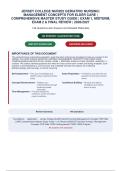
JERSEY COLLEGE NUR202 GERIATRIC NURSING:
MANAGEMENT CONCEPTS FOR ELDER CARE |
COMPREHENSIVE MASTER STUDY GUIDE | EXAM 1, MIDTERM,
EXAM 2 & FINAL REVIEW | 2026/2027
146 Questions with Answers and Detailed Rationales
100 PERCENT GUARANTEED PASS
INSTANT DOWNLOAD ANSWERS INCLUDED
IMPORTANCE OF THIS DOCUMENT
This comprehensive examination preparation guide has been meticulously developed to help you succeed in the
JERSEY COLLEGE NUR202 GERIATRIC NURSING: MANAGEMENT CONCEPTS FOR ELDER CARE |
COMPREHENSIVE MASTER STUDY GUIDE | EXAM 1, MIDTERM, EXAM 2 & FINAL REVIEW | 2026/2027. It
contains 146 carefully selected questions that reflect the most current exam content and testing strategies. Each
question is accompanied by a correct answer and a detailed rationale that explains the underlying
pathophysiology, pharmacology, or clinical reasoning.
Self-Assessment – Test your knowledge and Exam Preparation – Familiarize yourself with the
identify areas requiring further question format and content
study areas
Concept Reinforcement – Deepen your Confidence Building – Develop test-taking
understanding through strategies and reduce
evidence-based exam anxiety
rationales
Time Management – Practice answering
questions under simulated
exam conditions
Review Summary 146 Questions
Foundations - Application - Jersey College Nur202 Geriatric Nursing Management Concepts FOR Elder
CARE Comprehensive Master Study Guide 1 2 & Review 2026/2027 Geriatric Nursing / Management
Concepts FOR Elder CARE Undergraduate YEAR 3 BSN Program
All answers with rationales
,Table of Contents
Content Area Questions Key Topics
Aging Demographics AND 1-25 Older, Adult, Finding, Dementia, Reflects
Theories OF Aging
Comprehensive Geriatric 26-50 Older, Adult, Nursing, Finding, Medication
Assessment AND Functional
Status
Health Promotion Disease 51-75 Older, Adult, Nursing, Finding, Rather
Prevention AND Wellness IN
Older Adults
Management OF Chronic 76-100 Older, Adult, Finding, Intervention, Strongly
Conditions AND
Multimorbidity IN THE Elderly
Geriatric Pharmacotherapy 101-125 Older Adult, Finding, Assessing, Reviewing, Appropriate
AND Polypharmacy
Safety FALL Prevention AND 126-146 Older, Adult, Finding, Assessing, Intervention
Injury RISK Reduction
TOTAL 146 All questions include answers and detailed rationales
,Section A - Aging Demographics AND Theories OF Aging
Q1.
A nurse is reviewing medication records for an older adult with reduced serum albumin
and decreased hepatic blood flow. Which pharmacokinetic change most directly increases
the risk of toxicity from highly protein-bound drugs?
A. Increased volume of distribution for B. Decreased first-pass metabolism and
fat-soluble drugs increased free drug fraction
C. Enhanced renal tubular secretion of D. Increased gastric pH reducing drug
active metabolites ionization
Correct: B - Decreased first-pass metabolism and increased free drug fraction
Rationale:Reduced serum albumin decreases protein binding, increasing the free (active)
fraction of highly protein-bound drugs, while decreased hepatic blood flow reduces first-pass
metabolism - both elevate plasma drug levels and toxicity risk. Increased fat-soluble
distribution and gastric pH changes affect lipid-soluble drugs and absorption, not
protein-bound toxicity. Enhanced renal secretion would lower, not raise, drug levels.
Why the other answers are wrong:
A. Increased fat distribution prolongs half-life of lipophilic drugs but does not directly cause
toxicity of protein-bound drugs.
C. Renal tubular secretion typically declines with age, and enhanced secretion would reduce
rather than increase toxicity.
D. Gastric pH changes alter absorption of weak acids/bases, not protein binding or hepatic
metabolism.
Reference: Lehne, R.A. (2026). Pharmacology for Nursing Care, 12th Ed., Ch. 6 (Geriatric
Considerations)
Q2.
During a home visit, a nurse notices an older adult's caregiver frequently answers
questions for the patient, restricts phone access, and shows hostility when the patient
attempts to speak privately. Which action should the nurse take FIRST?
A. Confront the caregiver about suspected B. Document findings and report suspected
financial exploitation abuse to Adult Protective Services
C. Arrange immediate transfer to a D. Schedule a follow-up visit to gather more
long-term care facility evidence before reporting
Correct: B - Document findings and report suspected abuse to Adult Protective Services
Page 3
, Section A - Aging Demographics AND Theories OF Aging
Rationale: Nurses are mandated reporters; when signs of emotional abuse and isolation are
observed, the priority is to document objective findings and report to Adult Protective Services
promptly. Confronting the caregiver may escalate danger, and delaying report for more
evidence violates mandatory reporting laws. Immediate facility transfer is not the nurse's
independent decision without further assessment and legal process.
Why the other answers are wrong:
A. Confrontation may endanger the patient and is not the nurse's role; reporting is the
mandated action.
C. Transfer decisions require interdisciplinary and legal processes, not unilateral nurse action at
this stage.
D. Delaying report to gather more evidence violates mandatory reporting statutes and risks
continued harm.
Reference: Touhy, T.A. & Jett, K.F. (2024). Ebersole & Hess' Toward Healthy Aging, 11th Ed., Ch. 10
(Elder Abuse and Neglect)
Q3.
A nurse assesses an older adult who becomes acutely confused, inattentive, and
disoriented over the past 24 hours, with fluctuating symptoms worse at night. Which
assessment finding best supports delirium rather than dementia?
A. Gradual onset over several months with B. Acute onset with fluctuating level of
stable course consciousness and inattention
C. Preserved attention with impaired D. Depressed mood with anhedonia and
short-term memory only psychomotor retardation
Correct: B - Acute onset with fluctuating level of consciousness and inattention
Rationale:Delirium is characterized by acute onset, fluctuating consciousness, and
inattention - the hallmark features distinguishing it from dementia (gradual, progressive) and
depression (mood-related). Preserved attention with memory loss suggests dementia, while
anhedonia and psychomotor retardation suggest depression.
Why the other answers are wrong:
A. Gradual onset with stable course describes dementia, not delirium.
C. Preserved attention with isolated memory impairment is more consistent with mild cognitive
impairment or dementia.
D. Depressed mood with anhedonia describes depression, not delirium.
Reference: Touhy, T.A. & Jett, K.F. (2024). Ebersole & Hess' Toward Healthy Aging, 11th Ed., Ch. 21
(Delirium, Dementia, and Depression)
Q4.
An older adult with advanced dementia has a documented POLST form indicating 'Do Not
Attempt Resuscitation' and 'Comfort-Focused Treatment.' The patient develops aspiration
pneumonia. Which nursing action best aligns with the plan of care?
Page 4
MANAGEMENT CONCEPTS FOR ELDER CARE |
COMPREHENSIVE MASTER STUDY GUIDE | EXAM 1, MIDTERM,
EXAM 2 & FINAL REVIEW | 2026/2027
146 Questions with Answers and Detailed Rationales
100 PERCENT GUARANTEED PASS
INSTANT DOWNLOAD ANSWERS INCLUDED
IMPORTANCE OF THIS DOCUMENT
This comprehensive examination preparation guide has been meticulously developed to help you succeed in the
JERSEY COLLEGE NUR202 GERIATRIC NURSING: MANAGEMENT CONCEPTS FOR ELDER CARE |
COMPREHENSIVE MASTER STUDY GUIDE | EXAM 1, MIDTERM, EXAM 2 & FINAL REVIEW | 2026/2027. It
contains 146 carefully selected questions that reflect the most current exam content and testing strategies. Each
question is accompanied by a correct answer and a detailed rationale that explains the underlying
pathophysiology, pharmacology, or clinical reasoning.
Self-Assessment – Test your knowledge and Exam Preparation – Familiarize yourself with the
identify areas requiring further question format and content
study areas
Concept Reinforcement – Deepen your Confidence Building – Develop test-taking
understanding through strategies and reduce
evidence-based exam anxiety
rationales
Time Management – Practice answering
questions under simulated
exam conditions
Review Summary 146 Questions
Foundations - Application - Jersey College Nur202 Geriatric Nursing Management Concepts FOR Elder
CARE Comprehensive Master Study Guide 1 2 & Review 2026/2027 Geriatric Nursing / Management
Concepts FOR Elder CARE Undergraduate YEAR 3 BSN Program
All answers with rationales
,Table of Contents
Content Area Questions Key Topics
Aging Demographics AND 1-25 Older, Adult, Finding, Dementia, Reflects
Theories OF Aging
Comprehensive Geriatric 26-50 Older, Adult, Nursing, Finding, Medication
Assessment AND Functional
Status
Health Promotion Disease 51-75 Older, Adult, Nursing, Finding, Rather
Prevention AND Wellness IN
Older Adults
Management OF Chronic 76-100 Older, Adult, Finding, Intervention, Strongly
Conditions AND
Multimorbidity IN THE Elderly
Geriatric Pharmacotherapy 101-125 Older Adult, Finding, Assessing, Reviewing, Appropriate
AND Polypharmacy
Safety FALL Prevention AND 126-146 Older, Adult, Finding, Assessing, Intervention
Injury RISK Reduction
TOTAL 146 All questions include answers and detailed rationales
,Section A - Aging Demographics AND Theories OF Aging
Q1.
A nurse is reviewing medication records for an older adult with reduced serum albumin
and decreased hepatic blood flow. Which pharmacokinetic change most directly increases
the risk of toxicity from highly protein-bound drugs?
A. Increased volume of distribution for B. Decreased first-pass metabolism and
fat-soluble drugs increased free drug fraction
C. Enhanced renal tubular secretion of D. Increased gastric pH reducing drug
active metabolites ionization
Correct: B - Decreased first-pass metabolism and increased free drug fraction
Rationale:Reduced serum albumin decreases protein binding, increasing the free (active)
fraction of highly protein-bound drugs, while decreased hepatic blood flow reduces first-pass
metabolism - both elevate plasma drug levels and toxicity risk. Increased fat-soluble
distribution and gastric pH changes affect lipid-soluble drugs and absorption, not
protein-bound toxicity. Enhanced renal secretion would lower, not raise, drug levels.
Why the other answers are wrong:
A. Increased fat distribution prolongs half-life of lipophilic drugs but does not directly cause
toxicity of protein-bound drugs.
C. Renal tubular secretion typically declines with age, and enhanced secretion would reduce
rather than increase toxicity.
D. Gastric pH changes alter absorption of weak acids/bases, not protein binding or hepatic
metabolism.
Reference: Lehne, R.A. (2026). Pharmacology for Nursing Care, 12th Ed., Ch. 6 (Geriatric
Considerations)
Q2.
During a home visit, a nurse notices an older adult's caregiver frequently answers
questions for the patient, restricts phone access, and shows hostility when the patient
attempts to speak privately. Which action should the nurse take FIRST?
A. Confront the caregiver about suspected B. Document findings and report suspected
financial exploitation abuse to Adult Protective Services
C. Arrange immediate transfer to a D. Schedule a follow-up visit to gather more
long-term care facility evidence before reporting
Correct: B - Document findings and report suspected abuse to Adult Protective Services
Page 3
, Section A - Aging Demographics AND Theories OF Aging
Rationale: Nurses are mandated reporters; when signs of emotional abuse and isolation are
observed, the priority is to document objective findings and report to Adult Protective Services
promptly. Confronting the caregiver may escalate danger, and delaying report for more
evidence violates mandatory reporting laws. Immediate facility transfer is not the nurse's
independent decision without further assessment and legal process.
Why the other answers are wrong:
A. Confrontation may endanger the patient and is not the nurse's role; reporting is the
mandated action.
C. Transfer decisions require interdisciplinary and legal processes, not unilateral nurse action at
this stage.
D. Delaying report to gather more evidence violates mandatory reporting statutes and risks
continued harm.
Reference: Touhy, T.A. & Jett, K.F. (2024). Ebersole & Hess' Toward Healthy Aging, 11th Ed., Ch. 10
(Elder Abuse and Neglect)
Q3.
A nurse assesses an older adult who becomes acutely confused, inattentive, and
disoriented over the past 24 hours, with fluctuating symptoms worse at night. Which
assessment finding best supports delirium rather than dementia?
A. Gradual onset over several months with B. Acute onset with fluctuating level of
stable course consciousness and inattention
C. Preserved attention with impaired D. Depressed mood with anhedonia and
short-term memory only psychomotor retardation
Correct: B - Acute onset with fluctuating level of consciousness and inattention
Rationale:Delirium is characterized by acute onset, fluctuating consciousness, and
inattention - the hallmark features distinguishing it from dementia (gradual, progressive) and
depression (mood-related). Preserved attention with memory loss suggests dementia, while
anhedonia and psychomotor retardation suggest depression.
Why the other answers are wrong:
A. Gradual onset with stable course describes dementia, not delirium.
C. Preserved attention with isolated memory impairment is more consistent with mild cognitive
impairment or dementia.
D. Depressed mood with anhedonia describes depression, not delirium.
Reference: Touhy, T.A. & Jett, K.F. (2024). Ebersole & Hess' Toward Healthy Aging, 11th Ed., Ch. 21
(Delirium, Dementia, and Depression)
Q4.
An older adult with advanced dementia has a documented POLST form indicating 'Do Not
Attempt Resuscitation' and 'Comfort-Focused Treatment.' The patient develops aspiration
pneumonia. Which nursing action best aligns with the plan of care?
Page 4