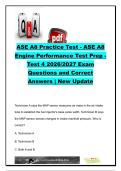
This 6-page ASE A8 Engine Performance Practice Test 4 contains 10 exam-style questions with correct answers for 2026/2027 test preparation. The material focuses on diagnostic reasoning across MAP sensor operation, coil-on-plug (COP) ignition, anti-theft no-start conditions, OBD-II enhanced EVAP faults, fuel-trim interpretation, oxygen-sensor diagnosis, catalytic-converter restrictions, DTC identification, automotive wiring circuits, and crankshaft position sensor faults.
The test begins with MAP sensor and ignition-system diagnosis. Students distinguish manifold absolute pressure sensing from direct air-mass measurement and then diagnose a cylinder #3 misfire in a COP ignition system where the coil has no voltage at its Bat+ terminal. The correct diagnostic reasoning identifies an open between the ignition coil and its power source rather than a secondary ignition problem. These questions reinforce the distinction between sensor functions and primary-versus-secondary ignition faults.
A separate no-start scenario covers factory anti-theft and transponder systems, requiring students to interpret a vehicle that cranks without starting while its security indicator continues flashing. OBD-II emissions diagnosis is then addressed through code P0457, where students identify a loose fuel filler cap as the cause associated with a gross enhanced-EVAP leak in the document. This provides targeted practice connecting vehicle symptoms and DTCs to their relevant systems.
The document gives particular attention to fuel trim and oxygen-sensor data interpretation. One scenario presents LTFT of -19% at idle with a rich air-fuel mixture and tests understanding of how the PCM responds to excessive fuel. Another presents fuel trim of -5% at idle and -25% at cruise alongside a steady 800 mV oxygen-sensor signal. When introducing a vacuum leak produces no change in the sensor output, the question identifies the oxygen sensor as faulty. These data-driven scenarios are valuable preparation for interpreting scan-tool information rather than relying solely on memorized component definitions.
Catalytic-converter and exhaust-restriction diagnosis is also tested. After a leaking injector responsible for a rich condition has been replaced, the vehicle remains sluggish and lacks power. The material connects this symptom to possible catalytic-converter restriction and reviews both exhaust back-pressure testing and vacuum-gauge diagnosis. It therefore reinforces the relationship between prolonged rich operation, catalyst concerns, and subsequent performance complaints.
The final questions strengthen OBD-II code interpretation and electrical diagnosis. Students interpret P0301, including the meaning of the “P” powertrain designation, identify a connection in a MAP sensor signal circuit from a wiring diagram, and evaluate an intermittent EFI stall/hard-start condition involving a loose crankshaft position sensor connection. Together, the questions combine multiple-choice, Technician A/Technician B, scan-data, DTC, and wiring-diagram formats relevant to ASE-style engine-performance preparation.
Relevant Students: This document is relevant to ASE A8 Engine Performance candidates, automotive technology students, automotive service and repair students, vocational and technical college learners, automotive technician apprentices, automotive engineering technology students, and working automotive technicians preparing for certification or refreshing diagnostic skills. It is particularly useful for students studying OBD-II diagnostics, electronic engine controls, MAP and oxygen sensors, COP ignition, fuel trim, EVAP systems, catalytic converters, crankshaft position sensors, wiring diagrams, scan-tool data, and systematic drivability troubleshooting.
Keywords: ASE A8 practice test, ASE A8 Test 4, ASE A8 Engine Performance, ASE A8 2026, ASE A8 2027, A8 exam questions and answers, ASE Engine Performance test prep, ASE certification preparation, MAP sensor diagnosis, manifold absolute pressure sensor, COP ignition system, coil on plug diagnosis, ignition coil power circuit, engine misfire diagnosis, anti theft no start, ignition key transponder, P0457 code, EVAP gross leak, enhanced EVAP system, fuel filler cap, LTFT diagnosis, long term fuel trim, rich air fuel ratio, oxygen sensor diagnosis, O2 sensor 800mV, catalytic converter restriction, exhaust back pressure test, vacuum gauge diagnosis, P0301 code, powertrain DTC, MAP sensor signal circuit, automotive wiring diagram, crankshaft position sensor, CKP sensor diagnosis, EFI engine stalling, scan tool diagnostics, automotive drivability diagnosis, automotive technician exam
Content preview
ASE A8 Practice Test - ASE A8
Engine Performance Test Prep -
Test 4 2026/2027 Exam
Questions and Correct
Answers | New Update
Technician A says the MAP sensor measures air mass in the air intake
tube to establish the fuel injector's base pulse width. Technician B says
the MAP sensor senses changes in intake manifold pressure. Who is
correct?
A. Technician A
B. Technician B
C. Both A and B
, D. Neither A nor B - ANSWER ✔✔Technician B
There is a misfire at the #3 cylinder of a COP ignition system. There is
no power at the Bat+ terminal of the coil's plug. Which of the following is
MOST likely causing this condition?
A. Resistance in the primary circuit.
B. Resistance in the secondary circuit.
C. A leak in the secondary insulation.
D. An open between the coil and its power source. - ANSWER ✔✔An
open between the coil and its power source.
A vehicle with a factory alarm system cranks but will not start. As the
technician turns the ignition key, the security light continues to flash
slowly. Which of the following is MOST likely causing this no-start
condition?
A. The ignition key transponder.
B. A faulty PCM.
C. No power to the injectors.
D. A dead battery. - ANSWER ✔✔The ignition key transponder.