
ICC 93 TALL MASS TIMBER BUILDINGS SPECIAL INSPECTOR
EXAM COMPREHENSIVE 200-QUESTION PRACTICE BANK –
2026/2027 EDITION
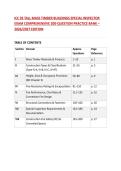
TABLE OF CONTENTS
Section Domain Approx. Page
Questions Reference
I Mass Timber Materials & Products 1–20 p. 1
II Construction Types & Classifications 21–55 p. 5
(Type IV-A, IV-B, IV-C, IV-HT)
III Height, Area & Occupancy Provisions 56–80 p. 9
(IBC Chapter 5)
IV Fire-Resistance Ratings & Encapsulation 81–110 p. 12
V Fire Performance, Char Rates & 111–135 p. 16
Connection Fire Design
VI Structural Connections & Fasteners 136–160 p. 20
VII Special Inspection Requirements & 161–180 p. 24
Documentation
VIII Construction Fire Safety (IFC) & 181–200 p. 27
Concealed Spaces
,SECTION I: MASS TIMBER MATERIALS & PRODUCTS (Questions 1–20)
1. Which material is most commonly used as the primary structural
element in tall mass timber buildings?
A. Light-frame lumber
B. Oriented strand board (OSB)
C. Cross-laminated timber (CLT)
D. Plywood
Rationale: CLT panels provide the required strength, stiffness, and fire
performance for tall mass timber construction. CLT is recognized in IBC
Section 2303.1.3 and is the most widely used mass timber product for
floor and wall panels in Type IV construction.
2. Which mass timber product is manufactured by gluing lumber
boards together with the grain running parallel to the length of the
member?
A. Cross-laminated timber (CLT)
B. Glued-laminated timber (glulam)
C. Nail-laminated timber (NLT)
D. Dowel-laminated timber (DLT)
Rationale: Glulam is a structural composite of lumber and adhesives,
recognized in IBC Section 2303.1.3. The grain of all laminations runs
parallel to the length of the member, providing high strength for beams
and columns.
,3. What is the primary advantage of mass timber compared to
structural steel or concrete?
A. Higher density
B. Reduced embodied carbon
C. Greater thermal conductivity
D. Increased weight
Rationale: Mass timber sequesters carbon and typically has lower
embodied energy than steel or concrete. This environmental benefit is a
primary driver for the increased use of mass timber in tall buildings.
4. Which mass timber product consists of layers of lumber stacked at
right angles and bonded with structural adhesive?
A. Glulam
B. Laminated veneer lumber (LVL)
C. Cross-laminated timber (CLT)
D. Parallel strand lumber (PSL)
Rationale: CLT is manufactured by stacking layers of lumber at right
angles and bonding them with structural adhesive. This cross-
lamination provides dimensional stability and two-way spanning
capability.
5. What is the maximum moisture content generally permitted for
mass timber elements at the time of fabrication?
, A. 10%
B. 15%
C. 20%
D. 35%
Rationale: The moisture content of mass timber elements should not
exceed 35% at the time of fabrication and connection. Excessive
moisture can affect dimensional stability, strength, and long-term
durability.
6. Which of the following is NOT a recognized mass timber structural
product under the IBC?
A. Cross-laminated timber (CLT)
B. Glued-laminated timber (glulam)
C. Particleboard
D. Nail-laminated timber (NLT)
Rationale: Particleboard is not a recognized structural mass timber
product. It lacks the structural capacity and fire performance required
for Type IV construction. CLT, glulam, and NLT are all recognized mass
timber products.
7. What advantage does prefabrication offer in mass timber
construction?
A. Increased on-site labor
B. Improved quality control
EXAM COMPREHENSIVE 200-QUESTION PRACTICE BANK –
2026/2027 EDITION
TABLE OF CONTENTS
Section Domain Approx. Page
Questions Reference
I Mass Timber Materials & Products 1–20 p. 1
II Construction Types & Classifications 21–55 p. 5
(Type IV-A, IV-B, IV-C, IV-HT)
III Height, Area & Occupancy Provisions 56–80 p. 9
(IBC Chapter 5)
IV Fire-Resistance Ratings & Encapsulation 81–110 p. 12
V Fire Performance, Char Rates & 111–135 p. 16
Connection Fire Design
VI Structural Connections & Fasteners 136–160 p. 20
VII Special Inspection Requirements & 161–180 p. 24
Documentation
VIII Construction Fire Safety (IFC) & 181–200 p. 27
Concealed Spaces
,SECTION I: MASS TIMBER MATERIALS & PRODUCTS (Questions 1–20)
1. Which material is most commonly used as the primary structural
element in tall mass timber buildings?
A. Light-frame lumber
B. Oriented strand board (OSB)
C. Cross-laminated timber (CLT)
D. Plywood
Rationale: CLT panels provide the required strength, stiffness, and fire
performance for tall mass timber construction. CLT is recognized in IBC
Section 2303.1.3 and is the most widely used mass timber product for
floor and wall panels in Type IV construction.
2. Which mass timber product is manufactured by gluing lumber
boards together with the grain running parallel to the length of the
member?
A. Cross-laminated timber (CLT)
B. Glued-laminated timber (glulam)
C. Nail-laminated timber (NLT)
D. Dowel-laminated timber (DLT)
Rationale: Glulam is a structural composite of lumber and adhesives,
recognized in IBC Section 2303.1.3. The grain of all laminations runs
parallel to the length of the member, providing high strength for beams
and columns.
,3. What is the primary advantage of mass timber compared to
structural steel or concrete?
A. Higher density
B. Reduced embodied carbon
C. Greater thermal conductivity
D. Increased weight
Rationale: Mass timber sequesters carbon and typically has lower
embodied energy than steel or concrete. This environmental benefit is a
primary driver for the increased use of mass timber in tall buildings.
4. Which mass timber product consists of layers of lumber stacked at
right angles and bonded with structural adhesive?
A. Glulam
B. Laminated veneer lumber (LVL)
C. Cross-laminated timber (CLT)
D. Parallel strand lumber (PSL)
Rationale: CLT is manufactured by stacking layers of lumber at right
angles and bonding them with structural adhesive. This cross-
lamination provides dimensional stability and two-way spanning
capability.
5. What is the maximum moisture content generally permitted for
mass timber elements at the time of fabrication?
, A. 10%
B. 15%
C. 20%
D. 35%
Rationale: The moisture content of mass timber elements should not
exceed 35% at the time of fabrication and connection. Excessive
moisture can affect dimensional stability, strength, and long-term
durability.
6. Which of the following is NOT a recognized mass timber structural
product under the IBC?
A. Cross-laminated timber (CLT)
B. Glued-laminated timber (glulam)
C. Particleboard
D. Nail-laminated timber (NLT)
Rationale: Particleboard is not a recognized structural mass timber
product. It lacks the structural capacity and fire performance required
for Type IV construction. CLT, glulam, and NLT are all recognized mass
timber products.
7. What advantage does prefabrication offer in mass timber
construction?
A. Increased on-site labor
B. Improved quality control


