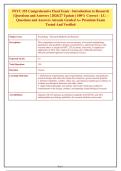
PSYC 255 Comprehensive Final Exam - Introduction to Research
| Questions and Answers | 2026/27 Update | 100% Correct - LU. -
Questions and Answers Already Graded A+ Premium Exam
Tested And Verified
Subject Area Psychology - Research Methods and Statistics
Description This comprehensive final exam assesses mastery of research methodology,
quantitative and qualitative designs, psychometrics, statistical inference, and
research ethics as taught in PSYC 255 at Liberty University. It emphasizes
application of APA-style empirical reasoning and a biblically-informed,
ethically-grounded approach to psychological science.
Expected Grade A+
Total Questions 150
Duration 3 hours
Learning Outcomes 1. Differentiate experimental, quasi-experimental, correlational, and qualitative
research designs and select the design best suited to a given research question.
2. Interpret reliability, validity, effect size, and statistical significance evidence to
evaluate psychological measures and study claims.
3. Apply ethical principles and Liberty University's Christian worldview
commitments to the design, conduct, and reporting of psychological research.
Accreditation Aligned with US regional accreditation standards (SACSCOC) and APA
undergraduate psychology guidelines for research methods coursework.
Page 1
,1. A researcher wants to test whether a new gratitude journaling intervention
causes improved life satisfaction. Which design provides the strongest causal
evidence?
A. A cross-sectional survey correlating journaling frequency with satisfaction scores.
B. A randomized controlled trial assigning participants to journaling or waitlist
conditions.
C. A longitudinal study tracking volunteers who chose to journal for six months.
D. A qualitative interview study exploring participants' journaling experiences.
Answer: B. A randomized controlled trial assigning participants to
journaling or waitlist conditions.
Random assignment in an RCT controls for confounding variables and allows
causal inference, which is the hallmark of true experiments. Correlational and
self-selected designs (A, C) cannot rule out third-variable explanations, and
qualitative designs (D) describe rather than establish causation.
2. A scale yields Cronbach's alpha = .62. What is the most appropriate
psychometric interpretation?
A. The scale has excellent internal consistency and is ready for clinical use.
B. The scale has acceptable test-retest reliability but poor internal consistency.
C. The scale's internal consistency is below the commonly accepted threshold of .70.
D. The scale demonstrates strong convergent validity with related measures.
Answer: C. The scale's internal consistency is below the commonly accepted
threshold of .70.
Cronbach's alpha estimates internal consistency; values below .70 are generally
considered inadequate for research purposes. Alpha does not directly assess
test-retest reliability (B) or validity (D), and .62 is not excellent (A).
Page 2
,3. Which sampling method most threatens external validity by relying on
volunteers who self-select into a study?
A. Stratified random sampling
B. Cluster sampling
C. Convenience sampling
D. Systematic sampling
Answer: C. Convenience sampling
Convenience sampling uses readily available, self-selected participants, which
limits generalizability to the broader population. Stratified, cluster, and
systematic sampling are probability-based methods that better support external
validity.
4. A researcher reports a p-value of .03. Which interpretation is correct under
null hypothesis significance testing?
A. There is a 3% probability that the null hypothesis is true.
B. There is a 3% probability of obtaining results at least as extreme if the null
hypothesis were true.
C. The effect size is large and practically significant.
D. The results are clinically meaningful and should change practice.
Answer: B. There is a 3% probability of obtaining results at least as extreme
if the null hypothesis were true.
A p-value indicates the probability of observing data at least as extreme as
obtained, assuming the null hypothesis is true. It does not give the probability of
the null being true (A), nor does it measure effect size or practical significance (C,
D).
Page 3
, 5. Which research design is most vulnerable to the placebo effect and demand
characteristics?
A. Double-blind randomized controlled trial
B. Single-blind randomized controlled trial
C. Open-label randomized controlled trial
D. Waitlist controlled trial with blinded assessors
Answer: C. Open-label randomized controlled trial
Open-label trials do not blind participants or researchers, maximizing placebo
effects and demand characteristics. Double-blind, single-blind, and
blinded-assessor designs reduce these biases.
6. A researcher wants to describe the lived experience of forgiveness among
cancer survivors. Which approach is most appropriate?
A. A factorial ANOVA comparing forgiveness scores across groups.
B. A phenomenological qualitative study using in-depth interviews.
C. A correlational study linking forgiveness to cortisol levels.
D. A meta-analysis of forgiveness interventions.
Answer: B. A phenomenological qualitative study using in-depth interviews.
Phenomenology is designed to capture the essence of lived experiences through
rich, subjective accounts. ANOVA, correlational, and meta-analytic designs test
relationships or aggregate effects rather than explore personal meaning.
7. Which statement best reflects the ethical principle of beneficence in
research?
A. Participants must be fully informed and voluntarily consent.
B. Researchers must maximize benefits and minimize harms.
C. Participant data must be kept confidential.
D. Vulnerable populations must be excluded from all studies.
Answer: B. Researchers must maximize benefits and minimize harms.
Beneficence requires balancing potential benefits against risks and minimizing
harm. Informed consent reflects autonomy (A), confidentiality reflects privacy
(C), and excluding vulnerable groups is not a requirement of beneficence (D).
Page 4
| Questions and Answers | 2026/27 Update | 100% Correct - LU. -
Questions and Answers Already Graded A+ Premium Exam
Tested And Verified
Subject Area Psychology - Research Methods and Statistics
Description This comprehensive final exam assesses mastery of research methodology,
quantitative and qualitative designs, psychometrics, statistical inference, and
research ethics as taught in PSYC 255 at Liberty University. It emphasizes
application of APA-style empirical reasoning and a biblically-informed,
ethically-grounded approach to psychological science.
Expected Grade A+
Total Questions 150
Duration 3 hours
Learning Outcomes 1. Differentiate experimental, quasi-experimental, correlational, and qualitative
research designs and select the design best suited to a given research question.
2. Interpret reliability, validity, effect size, and statistical significance evidence to
evaluate psychological measures and study claims.
3. Apply ethical principles and Liberty University's Christian worldview
commitments to the design, conduct, and reporting of psychological research.
Accreditation Aligned with US regional accreditation standards (SACSCOC) and APA
undergraduate psychology guidelines for research methods coursework.
Page 1
,1. A researcher wants to test whether a new gratitude journaling intervention
causes improved life satisfaction. Which design provides the strongest causal
evidence?
A. A cross-sectional survey correlating journaling frequency with satisfaction scores.
B. A randomized controlled trial assigning participants to journaling or waitlist
conditions.
C. A longitudinal study tracking volunteers who chose to journal for six months.
D. A qualitative interview study exploring participants' journaling experiences.
Answer: B. A randomized controlled trial assigning participants to
journaling or waitlist conditions.
Random assignment in an RCT controls for confounding variables and allows
causal inference, which is the hallmark of true experiments. Correlational and
self-selected designs (A, C) cannot rule out third-variable explanations, and
qualitative designs (D) describe rather than establish causation.
2. A scale yields Cronbach's alpha = .62. What is the most appropriate
psychometric interpretation?
A. The scale has excellent internal consistency and is ready for clinical use.
B. The scale has acceptable test-retest reliability but poor internal consistency.
C. The scale's internal consistency is below the commonly accepted threshold of .70.
D. The scale demonstrates strong convergent validity with related measures.
Answer: C. The scale's internal consistency is below the commonly accepted
threshold of .70.
Cronbach's alpha estimates internal consistency; values below .70 are generally
considered inadequate for research purposes. Alpha does not directly assess
test-retest reliability (B) or validity (D), and .62 is not excellent (A).
Page 2
,3. Which sampling method most threatens external validity by relying on
volunteers who self-select into a study?
A. Stratified random sampling
B. Cluster sampling
C. Convenience sampling
D. Systematic sampling
Answer: C. Convenience sampling
Convenience sampling uses readily available, self-selected participants, which
limits generalizability to the broader population. Stratified, cluster, and
systematic sampling are probability-based methods that better support external
validity.
4. A researcher reports a p-value of .03. Which interpretation is correct under
null hypothesis significance testing?
A. There is a 3% probability that the null hypothesis is true.
B. There is a 3% probability of obtaining results at least as extreme if the null
hypothesis were true.
C. The effect size is large and practically significant.
D. The results are clinically meaningful and should change practice.
Answer: B. There is a 3% probability of obtaining results at least as extreme
if the null hypothesis were true.
A p-value indicates the probability of observing data at least as extreme as
obtained, assuming the null hypothesis is true. It does not give the probability of
the null being true (A), nor does it measure effect size or practical significance (C,
D).
Page 3
, 5. Which research design is most vulnerable to the placebo effect and demand
characteristics?
A. Double-blind randomized controlled trial
B. Single-blind randomized controlled trial
C. Open-label randomized controlled trial
D. Waitlist controlled trial with blinded assessors
Answer: C. Open-label randomized controlled trial
Open-label trials do not blind participants or researchers, maximizing placebo
effects and demand characteristics. Double-blind, single-blind, and
blinded-assessor designs reduce these biases.
6. A researcher wants to describe the lived experience of forgiveness among
cancer survivors. Which approach is most appropriate?
A. A factorial ANOVA comparing forgiveness scores across groups.
B. A phenomenological qualitative study using in-depth interviews.
C. A correlational study linking forgiveness to cortisol levels.
D. A meta-analysis of forgiveness interventions.
Answer: B. A phenomenological qualitative study using in-depth interviews.
Phenomenology is designed to capture the essence of lived experiences through
rich, subjective accounts. ANOVA, correlational, and meta-analytic designs test
relationships or aggregate effects rather than explore personal meaning.
7. Which statement best reflects the ethical principle of beneficence in
research?
A. Participants must be fully informed and voluntarily consent.
B. Researchers must maximize benefits and minimize harms.
C. Participant data must be kept confidential.
D. Vulnerable populations must be excluded from all studies.
Answer: B. Researchers must maximize benefits and minimize harms.
Beneficence requires balancing potential benefits against risks and minimizing
harm. Informed consent reflects autonomy (A), confidentiality reflects privacy
(C), and excluding vulnerable groups is not a requirement of beneficence (D).
Page 4