
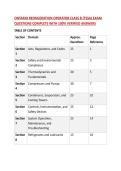
ONTARIO REFRIGERATION OPERATOR CLASS B (TSSA) EXAM
QUESTIONS COMPLETE WITH 100% VERIFIED ANSWERS
TABLE OF CONTENTS
Section Domain Approx. Page
Questions Reference
Section Acts, Regulations, and Codes 25 1
1
Section Safety and Environmental 25 3
2 Compliance
Section Thermodynamics and 30 5
3 Fundamentals
Section Compressors and Pumps 30 7
4
Section Condensers, Evaporators, and 25 10
5 Cooling Towers
Section Controls, Instrumentation, and 25 12
6 Safety Devices
Section System Operation, 25 14
7 Maintenance, and
Troubleshooting
Section Refrigerants and Lubricants 15 16
8
,SECTION 1: ACTS, REGULATIONS, AND CODES
1. Which code governs the mechanical safety requirements for the
design, construction, installation, and inspection of refrigeration
systems in Ontario?
A) CSA B51
B) CSA B52
C) ASHRAE 15
D) CSA B149.1
Rationale: CSA B52: Mechanical Refrigeration Code sets the standards
for safety in refrigeration systems in Ontario. CSA B51 covers boilers and
pressure vessels, while ASHRAE 15 provides safety standards but is not
the governing code in Ontario.
2. Under the Technical Standards and Safety Act, 2000, who has the
authority to enforce compliance with refrigeration regulations in
Ontario?
A) Ministry of Labour
B) TSSA
C) CSA Group
D) ASHRAE
Rationale: The Technical Standards and Safety Authority (TSSA) is the
regulatory body responsible for enforcing the Technical Standards &
Safety Act, 2000 and its associated regulations in Ontario.
3. Which Ontario Regulation specifically addresses the requirements
for operating engineers in refrigeration plants?
A) Ontario Regulation 213/07
,B) Ontario Regulation 219/01
C) Ontario Regulation 187/03
D) Ontario Regulation 847/00
Rationale: The Operating Engineers Regulation (Ontario Regulation
219/01) governs refrigeration operator certification under the TSSA.
4. What is the minimum passing mark for the TSSA Refrigeration
Operator Class B examination?
A) 55%
B) 60%
C) 65%
D) 70%
Rationale: The minimum passing mark for the examination comprising
multiple-choice questions is 65%.
5. What is the minimum required operating experience in a Class A or
B refrigeration plant to challenge the TSSA Refrigeration Operator
Class B exam?
A) 720 hours
B) 1,440 hours
C) 2,160 hours
D) 3,000 hours
Rationale: TSSA guidelines require 1,440 hours of practical training in a
Class A or B refrigeration plant to qualify for the Class B certification
exam.
6. Which regulation addresses the staffing, operation, maintenance,
inspection, and testing of compressor plants in Ontario?
A) Boilers and Pressure Vessels Regulation
, B) Operating Engineers Regulation
C) Environmental Protection Act
D) Occupational Health and Safety Act
Rationale: The Operating Engineers Regulation (Ontario Regulation
219/01) addresses the staffing, operation, maintenance, inspection, and
testing of compressor plants in Ontario.
7. Which standard provides requirements for the selection, care, and
use of respirators?
A) CSA B52
B) CSA Z94.4
C) CSA B51
D) ASHRAE 15
Rationale: CSA Z94.4 provides requirements for the selection, care, and
use of respirators, which is essential for safety in refrigeration plants
handling hazardous refrigerants like ammonia.
8. Which regulation addresses environmental emergency regulations
related to refrigeration systems?
A) Ontario Regulation 219/01
B) CEPA E2
C) CSA B52
D) ASHRAE 15
Rationale: CEPA E2 Environmental Emergency Regulations address
environmental emergency planning and response, which is critical for
refrigeration systems using hazardous substances.
9. A Class B refrigeration operator may act as chief operator of a
refrigeration plant up to what rating specified in Ontario legislation?
QUESTIONS COMPLETE WITH 100% VERIFIED ANSWERS
TABLE OF CONTENTS
Section Domain Approx. Page
Questions Reference
Section Acts, Regulations, and Codes 25 1
1
Section Safety and Environmental 25 3
2 Compliance
Section Thermodynamics and 30 5
3 Fundamentals
Section Compressors and Pumps 30 7
4
Section Condensers, Evaporators, and 25 10
5 Cooling Towers
Section Controls, Instrumentation, and 25 12
6 Safety Devices
Section System Operation, 25 14
7 Maintenance, and
Troubleshooting
Section Refrigerants and Lubricants 15 16
8
,SECTION 1: ACTS, REGULATIONS, AND CODES
1. Which code governs the mechanical safety requirements for the
design, construction, installation, and inspection of refrigeration
systems in Ontario?
A) CSA B51
B) CSA B52
C) ASHRAE 15
D) CSA B149.1
Rationale: CSA B52: Mechanical Refrigeration Code sets the standards
for safety in refrigeration systems in Ontario. CSA B51 covers boilers and
pressure vessels, while ASHRAE 15 provides safety standards but is not
the governing code in Ontario.
2. Under the Technical Standards and Safety Act, 2000, who has the
authority to enforce compliance with refrigeration regulations in
Ontario?
A) Ministry of Labour
B) TSSA
C) CSA Group
D) ASHRAE
Rationale: The Technical Standards and Safety Authority (TSSA) is the
regulatory body responsible for enforcing the Technical Standards &
Safety Act, 2000 and its associated regulations in Ontario.
3. Which Ontario Regulation specifically addresses the requirements
for operating engineers in refrigeration plants?
A) Ontario Regulation 213/07
,B) Ontario Regulation 219/01
C) Ontario Regulation 187/03
D) Ontario Regulation 847/00
Rationale: The Operating Engineers Regulation (Ontario Regulation
219/01) governs refrigeration operator certification under the TSSA.
4. What is the minimum passing mark for the TSSA Refrigeration
Operator Class B examination?
A) 55%
B) 60%
C) 65%
D) 70%
Rationale: The minimum passing mark for the examination comprising
multiple-choice questions is 65%.
5. What is the minimum required operating experience in a Class A or
B refrigeration plant to challenge the TSSA Refrigeration Operator
Class B exam?
A) 720 hours
B) 1,440 hours
C) 2,160 hours
D) 3,000 hours
Rationale: TSSA guidelines require 1,440 hours of practical training in a
Class A or B refrigeration plant to qualify for the Class B certification
exam.
6. Which regulation addresses the staffing, operation, maintenance,
inspection, and testing of compressor plants in Ontario?
A) Boilers and Pressure Vessels Regulation
, B) Operating Engineers Regulation
C) Environmental Protection Act
D) Occupational Health and Safety Act
Rationale: The Operating Engineers Regulation (Ontario Regulation
219/01) addresses the staffing, operation, maintenance, inspection, and
testing of compressor plants in Ontario.
7. Which standard provides requirements for the selection, care, and
use of respirators?
A) CSA B52
B) CSA Z94.4
C) CSA B51
D) ASHRAE 15
Rationale: CSA Z94.4 provides requirements for the selection, care, and
use of respirators, which is essential for safety in refrigeration plants
handling hazardous refrigerants like ammonia.
8. Which regulation addresses environmental emergency regulations
related to refrigeration systems?
A) Ontario Regulation 219/01
B) CEPA E2
C) CSA B52
D) ASHRAE 15
Rationale: CEPA E2 Environmental Emergency Regulations address
environmental emergency planning and response, which is critical for
refrigeration systems using hazardous substances.
9. A Class B refrigeration operator may act as chief operator of a
refrigeration plant up to what rating specified in Ontario legislation?


