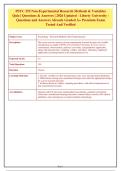
PSYC 255 Non-Experimental Research Methods & Variables
Quiz | Questions & Answers | 2026 Updated - Liberty University -
Questions and Answers Already Graded A+ Premium Exam
Tested And Verified
Subject Area Psychology - Research Methods (Non-Experimental)
Description This exam assesses mastery of non-experimental research designs and variable
classification as taught in PSYC 255 at Liberty University. It covers survey,
correlational, observational, archival, case-study, and qualitative approaches,
along with measurement, sampling, validity, and ethics. Questions emphasize
application and interpretation at the undergraduate level.
Expected Grade A+
Total Questions 150
Duration 2 hours
Learning Outcomes 1. Classify variables by their measurement scale, role, and operational definition.
2. Differentiate among non-experimental designs and select the appropriate design
for a given research question.
3. Evaluate threats to validity, sampling procedures, and ethical requirements in
non-experimental research.
Accreditation Aligned with US university undergraduate psychology standards and Liberty
University's institutional learning outcomes; content reflects current APA ethical
guidelines and contemporary research-methods terminology.
Page 1
,1. A researcher wants to study the relationship between hours of social media
use and self-reported loneliness, but cannot randomly assign participants.
Which design is most appropriate?
A. Correlational study
B. Randomized controlled trial
C. Solomon four-group design
D. Single-blind experiment
Answer: A. Correlational study
Because random assignment is impossible, a correlational design is appropriate
to examine the association between two measured variables. The other options all
require manipulation and random assignment, which are features of
experimental designs.
2. Which of the following best describes an operational definition?
A. A theoretical statement of what a concept means
B. A specific procedure for measuring or manipulating a variable
C. A statistical estimate of effect size
D. A summary of the research hypothesis
Answer: B. A specific procedure for measuring or manipulating a variable
An operational definition specifies the concrete operations used to measure or
manipulate a variable. Theoretical statements describe constructs, not
operations; effect size and hypotheses are separate concepts.
3. A researcher measures participants' religious commitment using a 7-point
Likert scale from 'not at all committed' to 'extremely committed.' This
variable is measured at which level?
A. Nominal
B. Ordinal
C. Interval
D. Ratio
Answer: C. Interval
A Likert scale with equal-appearing intervals is typically treated as interval-level
data in psychology. It is not nominal or ordinal because the distances between
points are assumed equal, and it lacks a true zero, ruling out ratio.
Page 2
,4. In a study examining the link between childhood trauma and adult anxiety, a
researcher finds r = .42, p < .01. Which conclusion is most appropriate?
A. Childhood trauma causes adult anxiety.
B. There is a statistically significant positive association between the variables.
C. The relationship is clinically meaningless because r is low.
D. The result proves the null hypothesis is false.
Answer: B. There is a statistically significant positive association between the
variables.
A significant positive correlation indicates a reliable positive association, not
causation. Correlation does not establish causation, and r = .42 is a moderate
association that may still have practical importance; no single study proves a
hypothesis.
5. A researcher wants to ensure that a sample reflects the ethnic diversity of a
university. Which sampling method is most appropriate?
A. Convenience sampling
B. Snowball sampling
C. Stratified random sampling
D. Purposive sampling
Answer: C. Stratified random sampling
Stratified random sampling divides the population into relevant strata (e.g.,
ethnicity) and randomly samples within each, ensuring proportional
representation. Convenience, snowball, and purposive sampling are non-random
and do not guarantee representativeness.
6. A researcher observes children's playground behavior without interacting
with them, recording aggressive acts. This is an example of:
A. Participant observation
B. Naturalistic observation
C. Structured interview
D. Archival research
Answer: B. Naturalistic observation
Naturalistic observation involves observing behavior in a natural setting without
intervention. Participant observation involves the researcher joining the group;
interviews and archival research rely on self-report or existing records.
Page 3
, 7. Which threat to internal validity is most relevant when a researcher uses a
pretest that may sensitize participants to the treatment?
A. Maturation
B. History
C. Testing effect
D. Instrumentation
Answer: C. Testing effect
A testing effect occurs when taking a pretest influences responses on a posttest,
often due to sensitization. Maturation and history refer to external changes over
time, and instrumentation refers to changes in measurement procedures.
8. In a case study of a rare neurological disorder, the primary limitation is:
A. Low generalizability
B. High internal validity
C. Excessive control
D. Inability to use qualitative data
Answer: A. Low generalizability
Case studies provide rich detail but limited generalizability because they focus on
a single individual or small group. They do not typically have high internal
validity or excessive control, and they often use qualitative data.
9. A researcher uses an existing dataset from the U.S. Census to examine trends
in educational attainment. This is:
A. Survey research
B. Archival research
C. Experimental research
D. Ethnographic research
Answer: B. Archival research
Archival research analyzes pre-existing records or datasets. Survey research
collects new self-report data; experimental research manipulates variables;
ethnography involves immersive observation.
Page 4
Quiz | Questions & Answers | 2026 Updated - Liberty University -
Questions and Answers Already Graded A+ Premium Exam
Tested And Verified
Subject Area Psychology - Research Methods (Non-Experimental)
Description This exam assesses mastery of non-experimental research designs and variable
classification as taught in PSYC 255 at Liberty University. It covers survey,
correlational, observational, archival, case-study, and qualitative approaches,
along with measurement, sampling, validity, and ethics. Questions emphasize
application and interpretation at the undergraduate level.
Expected Grade A+
Total Questions 150
Duration 2 hours
Learning Outcomes 1. Classify variables by their measurement scale, role, and operational definition.
2. Differentiate among non-experimental designs and select the appropriate design
for a given research question.
3. Evaluate threats to validity, sampling procedures, and ethical requirements in
non-experimental research.
Accreditation Aligned with US university undergraduate psychology standards and Liberty
University's institutional learning outcomes; content reflects current APA ethical
guidelines and contemporary research-methods terminology.
Page 1
,1. A researcher wants to study the relationship between hours of social media
use and self-reported loneliness, but cannot randomly assign participants.
Which design is most appropriate?
A. Correlational study
B. Randomized controlled trial
C. Solomon four-group design
D. Single-blind experiment
Answer: A. Correlational study
Because random assignment is impossible, a correlational design is appropriate
to examine the association between two measured variables. The other options all
require manipulation and random assignment, which are features of
experimental designs.
2. Which of the following best describes an operational definition?
A. A theoretical statement of what a concept means
B. A specific procedure for measuring or manipulating a variable
C. A statistical estimate of effect size
D. A summary of the research hypothesis
Answer: B. A specific procedure for measuring or manipulating a variable
An operational definition specifies the concrete operations used to measure or
manipulate a variable. Theoretical statements describe constructs, not
operations; effect size and hypotheses are separate concepts.
3. A researcher measures participants' religious commitment using a 7-point
Likert scale from 'not at all committed' to 'extremely committed.' This
variable is measured at which level?
A. Nominal
B. Ordinal
C. Interval
D. Ratio
Answer: C. Interval
A Likert scale with equal-appearing intervals is typically treated as interval-level
data in psychology. It is not nominal or ordinal because the distances between
points are assumed equal, and it lacks a true zero, ruling out ratio.
Page 2
,4. In a study examining the link between childhood trauma and adult anxiety, a
researcher finds r = .42, p < .01. Which conclusion is most appropriate?
A. Childhood trauma causes adult anxiety.
B. There is a statistically significant positive association between the variables.
C. The relationship is clinically meaningless because r is low.
D. The result proves the null hypothesis is false.
Answer: B. There is a statistically significant positive association between the
variables.
A significant positive correlation indicates a reliable positive association, not
causation. Correlation does not establish causation, and r = .42 is a moderate
association that may still have practical importance; no single study proves a
hypothesis.
5. A researcher wants to ensure that a sample reflects the ethnic diversity of a
university. Which sampling method is most appropriate?
A. Convenience sampling
B. Snowball sampling
C. Stratified random sampling
D. Purposive sampling
Answer: C. Stratified random sampling
Stratified random sampling divides the population into relevant strata (e.g.,
ethnicity) and randomly samples within each, ensuring proportional
representation. Convenience, snowball, and purposive sampling are non-random
and do not guarantee representativeness.
6. A researcher observes children's playground behavior without interacting
with them, recording aggressive acts. This is an example of:
A. Participant observation
B. Naturalistic observation
C. Structured interview
D. Archival research
Answer: B. Naturalistic observation
Naturalistic observation involves observing behavior in a natural setting without
intervention. Participant observation involves the researcher joining the group;
interviews and archival research rely on self-report or existing records.
Page 3
, 7. Which threat to internal validity is most relevant when a researcher uses a
pretest that may sensitize participants to the treatment?
A. Maturation
B. History
C. Testing effect
D. Instrumentation
Answer: C. Testing effect
A testing effect occurs when taking a pretest influences responses on a posttest,
often due to sensitization. Maturation and history refer to external changes over
time, and instrumentation refers to changes in measurement procedures.
8. In a case study of a rare neurological disorder, the primary limitation is:
A. Low generalizability
B. High internal validity
C. Excessive control
D. Inability to use qualitative data
Answer: A. Low generalizability
Case studies provide rich detail but limited generalizability because they focus on
a single individual or small group. They do not typically have high internal
validity or excessive control, and they often use qualitative data.
9. A researcher uses an existing dataset from the U.S. Census to examine trends
in educational attainment. This is:
A. Survey research
B. Archival research
C. Experimental research
D. Ethnographic research
Answer: B. Archival research
Archival research analyzes pre-existing records or datasets. Survey research
collects new self-report data; experimental research manipulates variables;
ethnography involves immersive observation.
Page 4