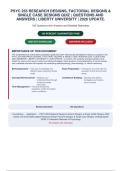
PSYC 255 RESEARCH DESIGNS, FACTORIAL DESIGNS &
SINGLE CASE DESIGNS QUIZ | QUESTIONS AND
ANSWERS | LIBERTY UNIVERSITY | 2026 UPDATE.
150 Questions with Answers and Detailed Rationales
100 PERCENT GUARANTEED PASS
INSTANT DOWNLOAD ANSWERS INCLUDED
IMPORTANCE OF THIS DOCUMENT
This comprehensive examination preparation guide has been meticulously developed to help you succeed in the
PSYC 255 RESEARCH DESIGNS, FACTORIAL DESIGNS & SINGLE CASE DESIGNS QUIZ | QUESTIONS
AND ANSWERS | LIBERTY UNIVERSITY | 2026 UPDATE.. It contains 150 carefully selected questions that
reflect the most current exam content and testing strategies. Each question is accompanied by a correct answer
and a detailed rationale that explains the underlying pathophysiology, pharmacology, or clinical reasoning.
Self-Assessment – Test your knowledge and Exam Preparation – Familiarize yourself with the
identify areas requiring further question format and content
study areas
Concept Reinforcement – Deepen your Confidence Building – Develop test-taking
understanding through strategies and reduce
evidence-based exam anxiety
rationales
Time Management – Practice answering
questions under simulated
exam conditions
Review Summary 150 Questions
Foundations - Application - PSYC 255 Research Designs Factorial Designs & Single CASE Designs AND
Liberty University 2026 Update Research Design Factorial Designs & Single-case Designs Undergraduate
YEAR 2-3 Research Methods IN Psychology
All answers with rationales
,Table of Contents
Content Area Questions Key Topics
Research Design 1-25 Design, Researcher, Treatment, Factorial, Single-case
Fundamentals AND Validity
Between-subjects 26-50 Design, Researcher, Factorial, Interaction, Study
Experimental Designs
Within-subjects Experimental 51-75 Design, Researcher, Factorial, Effect, Treatment
Designs
Factorial Designs MAIN 76-100 Design, Researcher, Single-case, Primary, Significant
Effects AND Interactions
Factorial Designs 101-125 Design, Researcher, Effect, Factorial, Measures
Interpretation AND Graphing
Single-case Experimental 126-150 Design, Researcher, Effect, Study, Factorial
Designs Reversal AND
Multiple-baseline
TOTAL 150 All questions include answers and detailed rationales
,Section A - Research Design Fundamentals AND Validity
Q1.
A researcher assigns participants to a treatment or control group based on their
pre-existing anxiety scores, then measures post-test anxiety. Which design flaw most
threatens causal inference?
A. Lack of random assignment creates B. The independent variable has only two
selection bias. levels.
C. Post-test measurement introduces testing D. The dependent variable is measured only
effects. once.
Correct: A - Lack of random assignment creates selection bias.
Rationale:Because participants were not randomly assigned, pre-existing differences
(selection bias) confound the treatment effect. Two levels of an IV and single post-test
measurement are not inherently flaws. Testing effects require a pretest, which is absent here.
Why the other answers are wrong:
B. A two-level IV is a standard, valid design choice; it does not by itself threaten internal
validity.
C. Testing effects arise from repeated measurement, but no pretest is described.
D. A single post-test is sufficient for comparing groups; repeated measurement is not required
for causality.
Reference: Leedy & Ormrod (2021). Practical Research: Planning and Design, 12th Ed., Ch. 9
Q2.
In a 2 × 3 factorial design, one factor is type of therapy (cognitive vs. behavioral) and the
other is session length (30, 60, 90 min). How many conditions does this design contain?
A. 5 B. 6
C. 9 D. 12
Correct: B - 6
Rationale:The number of conditions in a factorial design is the product of the levels: 2 × 3 =
6. Adding (2 + 3 = 5) or squaring (3² = 9) misapplies the rule, and 12 would require a third
factor.
Why the other answers are wrong:
A. 5 results from adding the levels rather than multiplying them.
C. 9 would be correct only for a 3 × 3 design, not 2 × 3.
D. 12 would require an additional factor (e.g., 2 × 3 × 2).
Reference: Gravetter & Forzano (2021). Research Methods for the Behavioral Sciences, 6th Ed., Ch. 11
Page 3
, Section A - Research Design Fundamentals AND Validity
Q3.
A multiple-baseline design across behaviors is used to evaluate a social-skills
intervention. Which pattern provides the strongest evidence for treatment effectiveness?
A. All behaviors improve simultaneously at B. Each behavior improves only after the
the start of treatment. intervention is introduced to it.
C. Only the first behavior improves, while D. All behaviors improve during baseline
others remain unchanged. before treatment begins.
Correct: B - Each behavior improves only after the intervention is introduced to it.
Rationale:Staggered improvement tied to the sequential introduction of the intervention
demonstrates that change is caused by treatment rather than maturation or history.
Simultaneous change suggests a confound, and baseline improvement contradicts the logic
of the design.
Why the other answers are wrong:
A. Simultaneous change across behaviors suggests a confounding variable rather than
treatment effect.
C. Improvement in only one behavior indicates weak or limited generalization, not strong
evidence.
D. Baseline improvement undermines the assumption of stability and confounds treatment
effects.
Reference: Kazdin, A. E. (2021). Single-Case Research Designs, 3rd Ed., Ch. 6
Q4.
A study reports a significant interaction between gender and teaching method on exam
scores. What does this interaction indicate?
A. Gender alone causes differences in exam B. Teaching method alone causes
scores. differences in exam scores.
C. The effect of teaching method on exam D. Both variables independently influence
scores depends on gender. exam scores.
Correct: C - The effect of teaching method on exam scores depends on gender.
Rationale:An interaction means the effect of one independent variable changes across levels
of the other. Main effects (A and B) describe independent effects; an interaction specifically
qualifies that a combined influence exists.
Why the other answers are wrong:
A. That describes a main effect of gender, not an interaction.
B. That describes a main effect of teaching method, not an interaction.
D. Independent influences describe main effects; interaction implies conditional effects.
Reference: Gravetter & Wallnau (2021). Statistics for the Behavioral Sciences, 10th Ed., Ch. 13
Page 4
SINGLE CASE DESIGNS QUIZ | QUESTIONS AND
ANSWERS | LIBERTY UNIVERSITY | 2026 UPDATE.
150 Questions with Answers and Detailed Rationales
100 PERCENT GUARANTEED PASS
INSTANT DOWNLOAD ANSWERS INCLUDED
IMPORTANCE OF THIS DOCUMENT
This comprehensive examination preparation guide has been meticulously developed to help you succeed in the
PSYC 255 RESEARCH DESIGNS, FACTORIAL DESIGNS & SINGLE CASE DESIGNS QUIZ | QUESTIONS
AND ANSWERS | LIBERTY UNIVERSITY | 2026 UPDATE.. It contains 150 carefully selected questions that
reflect the most current exam content and testing strategies. Each question is accompanied by a correct answer
and a detailed rationale that explains the underlying pathophysiology, pharmacology, or clinical reasoning.
Self-Assessment – Test your knowledge and Exam Preparation – Familiarize yourself with the
identify areas requiring further question format and content
study areas
Concept Reinforcement – Deepen your Confidence Building – Develop test-taking
understanding through strategies and reduce
evidence-based exam anxiety
rationales
Time Management – Practice answering
questions under simulated
exam conditions
Review Summary 150 Questions
Foundations - Application - PSYC 255 Research Designs Factorial Designs & Single CASE Designs AND
Liberty University 2026 Update Research Design Factorial Designs & Single-case Designs Undergraduate
YEAR 2-3 Research Methods IN Psychology
All answers with rationales
,Table of Contents
Content Area Questions Key Topics
Research Design 1-25 Design, Researcher, Treatment, Factorial, Single-case
Fundamentals AND Validity
Between-subjects 26-50 Design, Researcher, Factorial, Interaction, Study
Experimental Designs
Within-subjects Experimental 51-75 Design, Researcher, Factorial, Effect, Treatment
Designs
Factorial Designs MAIN 76-100 Design, Researcher, Single-case, Primary, Significant
Effects AND Interactions
Factorial Designs 101-125 Design, Researcher, Effect, Factorial, Measures
Interpretation AND Graphing
Single-case Experimental 126-150 Design, Researcher, Effect, Study, Factorial
Designs Reversal AND
Multiple-baseline
TOTAL 150 All questions include answers and detailed rationales
,Section A - Research Design Fundamentals AND Validity
Q1.
A researcher assigns participants to a treatment or control group based on their
pre-existing anxiety scores, then measures post-test anxiety. Which design flaw most
threatens causal inference?
A. Lack of random assignment creates B. The independent variable has only two
selection bias. levels.
C. Post-test measurement introduces testing D. The dependent variable is measured only
effects. once.
Correct: A - Lack of random assignment creates selection bias.
Rationale:Because participants were not randomly assigned, pre-existing differences
(selection bias) confound the treatment effect. Two levels of an IV and single post-test
measurement are not inherently flaws. Testing effects require a pretest, which is absent here.
Why the other answers are wrong:
B. A two-level IV is a standard, valid design choice; it does not by itself threaten internal
validity.
C. Testing effects arise from repeated measurement, but no pretest is described.
D. A single post-test is sufficient for comparing groups; repeated measurement is not required
for causality.
Reference: Leedy & Ormrod (2021). Practical Research: Planning and Design, 12th Ed., Ch. 9
Q2.
In a 2 × 3 factorial design, one factor is type of therapy (cognitive vs. behavioral) and the
other is session length (30, 60, 90 min). How many conditions does this design contain?
A. 5 B. 6
C. 9 D. 12
Correct: B - 6
Rationale:The number of conditions in a factorial design is the product of the levels: 2 × 3 =
6. Adding (2 + 3 = 5) or squaring (3² = 9) misapplies the rule, and 12 would require a third
factor.
Why the other answers are wrong:
A. 5 results from adding the levels rather than multiplying them.
C. 9 would be correct only for a 3 × 3 design, not 2 × 3.
D. 12 would require an additional factor (e.g., 2 × 3 × 2).
Reference: Gravetter & Forzano (2021). Research Methods for the Behavioral Sciences, 6th Ed., Ch. 11
Page 3
, Section A - Research Design Fundamentals AND Validity
Q3.
A multiple-baseline design across behaviors is used to evaluate a social-skills
intervention. Which pattern provides the strongest evidence for treatment effectiveness?
A. All behaviors improve simultaneously at B. Each behavior improves only after the
the start of treatment. intervention is introduced to it.
C. Only the first behavior improves, while D. All behaviors improve during baseline
others remain unchanged. before treatment begins.
Correct: B - Each behavior improves only after the intervention is introduced to it.
Rationale:Staggered improvement tied to the sequential introduction of the intervention
demonstrates that change is caused by treatment rather than maturation or history.
Simultaneous change suggests a confound, and baseline improvement contradicts the logic
of the design.
Why the other answers are wrong:
A. Simultaneous change across behaviors suggests a confounding variable rather than
treatment effect.
C. Improvement in only one behavior indicates weak or limited generalization, not strong
evidence.
D. Baseline improvement undermines the assumption of stability and confounds treatment
effects.
Reference: Kazdin, A. E. (2021). Single-Case Research Designs, 3rd Ed., Ch. 6
Q4.
A study reports a significant interaction between gender and teaching method on exam
scores. What does this interaction indicate?
A. Gender alone causes differences in exam B. Teaching method alone causes
scores. differences in exam scores.
C. The effect of teaching method on exam D. Both variables independently influence
scores depends on gender. exam scores.
Correct: C - The effect of teaching method on exam scores depends on gender.
Rationale:An interaction means the effect of one independent variable changes across levels
of the other. Main effects (A and B) describe independent effects; an interaction specifically
qualifies that a combined influence exists.
Why the other answers are wrong:
A. That describes a main effect of gender, not an interaction.
B. That describes a main effect of teaching method, not an interaction.
D. Independent influences describe main effects; interaction implies conditional effects.
Reference: Gravetter & Wallnau (2021). Statistics for the Behavioral Sciences, 10th Ed., Ch. 13
Page 4