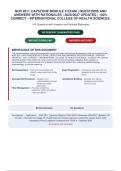
NUR 2811 CAPSTONE MODULE 9 EXAM | QUESTIONS AND
ANSWERS WITH RATIONALES | 2026/2027 UPDATED | 100%
CORRECT - INTERNATIONAL COLLEGE OF HEALTH SCIENCES.
145 Questions with Answers and Detailed Rationales
100 PERCENT GUARANTEED PASS
INSTANT DOWNLOAD ANSWERS INCLUDED
IMPORTANCE OF THIS DOCUMENT
This comprehensive examination preparation guide has been meticulously developed to help you succeed in the
NUR 2811 CAPSTONE MODULE 9 EXAM | QUESTIONS AND ANSWERS WITH RATIONALES | 2026/2027
UPDATED | 100% CORRECT - INTERNATIONAL COLLEGE OF HEALTH SCIENCES.. It contains 145 carefully
selected questions that reflect the most current exam content and testing strategies. Each question is
accompanied by a correct answer and a detailed rationale that explains the underlying pathophysiology,
pharmacology, or clinical reasoning.
Self-Assessment – Test your knowledge and Exam Preparation – Familiarize yourself with the
identify areas requiring further question format and content
study areas
Concept Reinforcement – Deepen your Confidence Building – Develop test-taking
understanding through strategies and reduce
evidence-based exam anxiety
rationales
Time Management – Practice answering
questions under simulated
exam conditions
Review Summary 145 Questions
Foundations - Application - NUR 2811 Capstone Module 9 AND WITH Rationales 2026/2027 Updated 100
Correct - International College OF Health Sciences Nursing Capstone Leadership Quality Safety AND
Integrated Clinical Judgment Undergraduate YEAR 4 / Capstone BSN
All answers with rationales
,Table of Contents
Content Area Questions Key Topics
Management OF CARE 1-25 Reflects, Indicates, Medication, Reviewing, Preparing
Safety AND Infection Control 26-50 Medication, Preparing, Administer, Reviewing, Reflects
Health Promotion AND 51-75 Finding, Intervention, Preparing, Nursing, Receiving
Maintenance
Psychosocial Integrity 76-100 Medication, Reviewing, Indicates, Finding, Understanding
Basic CARE AND Comfort 101-125 Reviewing, Indicates, Receiving, Reflects, Preparing
Pharmacological Therapies 126-145 Preparing, First, Finding, Indicates, Administer
TOTAL 145 All questions include answers and detailed rationales
,Section A - Management OF CARE
Q1.
A nurse manager is reviewing staffing for the next shift and must assign four patients to
available staff. Which assignment best reflects appropriate delegation and scope of
practice?
A. Assign a newly admitted unstable patient B. Assign the RN to the unstable patient
to the LPN and have the RN supervise requiring complex assessment and the LPN
remotely. to stable patients with routine care.
C. Assign all patients to the UAP to improve D. Assign the RN to documentation and the
efficiency and have the RN available for UAP to medication administration.
consultation.
Correct: B - Assign the RN to the unstable patient requiring complex assessment and the
LPN to stable patients with routine care.
Rationale:The RN is responsible for complex assessments and unstable patients; LPNs can
care for stable patients with predictable outcomes. Delegating unstable patients or medication
administration to unlicensed personnel violates scope of practice.
Why the other answers are wrong:
A. An unstable patient requires RN assessment and cannot be safely managed by an LPN with
remote supervision.
C. UAPs cannot perform skilled nursing assessment or assume total care for all patients.
D. Medication administration is not within UAP scope and RN documentation alone does not
meet patient needs.
Reference: American Nurses Association. (2026). Delegation and Scope of Practice, NCSBN Guidelines.
Q2.
A nurse is evaluating a quality improvement project aimed at reducing catheter-associated
urinary tract infections (CAUTIs). Which metric best indicates the project's effectiveness?
A. Number of catheters inserted per month B. CAUTI rate per 1,000 catheter-days
C. Total patient satisfaction scores D. Number of nurses trained on insertion
technique
Correct: B - CAUTI rate per 1,000 catheter-days
Rationale:The CAUTI rate per 1,000 catheter-days is the standard benchmark for measuring
infection reduction over time. Other metrics reflect process or volume, not outcome
effectiveness.
Why the other answers are wrong:
A. Insertion volume does not measure infection prevention success.
Page 3
, Section A - Management OF CARE
C. Satisfaction scores are not specific to CAUTI outcomes.
D. Training numbers reflect process, not the outcome of reduced infections.
Reference: Agency for Healthcare Research and Quality (AHRQ). (2025). CAUTI Prevention Toolkit.
Q3.
A nurse is preparing to administer a high-alert medication. Which action best reflects the
Joint Commission's National Patient Safety Goal for medication safety?
A. Verify the patient's room number before B. Use two patient identifiers and
administration independent double-check for high-alert
drugs
C. Administer the medication quickly to D. Document the medication before
avoid delay administration
Correct: B - Use two patient identifiers and independent double-check for high-alert drugs
Rationale:Using two patient identifiers and an independent double-check for high-alert
medications aligns with National Patient Safety Goals. Room numbers are not acceptable
identifiers, and documentation should occur after administration.
Why the other answers are wrong:
A. Room numbers are not approved patient identifiers.
C. Speed should never compromise safety checks.
D. Documenting before administration violates safe medication practices.
Reference: The Joint Commission. (2026). National Patient Safety Goals: Hospital Program.
Q4.
A nurse is reviewing a meta-analysis on early ambulation after surgery. Which factor most
strongly determines whether the evidence should be adopted into practice?
A. The study was published in a nursing B. The evidence is consistent, clinically
journal significant, and applicable to the patient
population
C. The intervention is inexpensive D. The study had a large sample size alone
Correct: B - The evidence is consistent, clinically significant, and applicable to the patient
population
Rationale:Evidence-based practice requires evaluating consistency, clinical significance, and
applicability to the population. Cost, sample size alone, or publication venue do not solely
determine adoption.
Why the other answers are wrong:
A. Publication in a nursing journal does not guarantee quality or applicability.
C. Cost is a consideration but not the primary determinant of evidence adoption.
D. Large sample size alone does not ensure validity or clinical relevance.
Page 4