
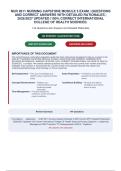
NUR 2811 NURSING CAPSTONE MODULE 5 EXAM | QUESTIONS
AND CORRECT ANSWERS WITH DETAILED RATIONALES |
2026/2027 UPDATED |100% CORRECT INTERNATIONAL
COLLEGE OF HEALTH SCIENCES.
144 Questions with Answers and Detailed Rationales
100 PERCENT GUARANTEED PASS
INSTANT DOWNLOAD ANSWERS INCLUDED
IMPORTANCE OF THIS DOCUMENT
This comprehensive examination preparation guide has been meticulously developed to help you succeed in the
NUR 2811 NURSING CAPSTONE MODULE 5 EXAM | QUESTIONS AND CORRECT ANSWERS WITH
DETAILED RATIONALES | 2026/2027 UPDATED |100% CORRECT INTERNATIONAL COLLEGE OF HEALTH
SCIENCES.. It contains 144 carefully selected questions that reflect the most current exam content and testing
strategies. Each question is accompanied by a correct answer and a detailed rationale that explains the
underlying pathophysiology, pharmacology, or clinical reasoning.
Self-Assessment – Test your knowledge and Exam Preparation – Familiarize yourself with the
identify areas requiring further question format and content
study areas
Concept Reinforcement – Deepen your Confidence Building – Develop test-taking
understanding through strategies and reduce
evidence-based exam anxiety
rationales
Time Management – Practice answering
questions under simulated
exam conditions
Review Summary 144 Questions
Foundations - Application - NUR 2811 Nursing Capstone Module 5 AND Correct WITH Detailed Rationales
2026/2027 Updated 100 Correct International College OF Health Sciences Nursing Capstone - Leadership
Management AND Transition TO Undergraduate YEAR 4 / Capstone
All answers with rationales
,Table of Contents
Content Area Questions Key Topics
Management OF CARE 1-24 First, Preparing, Evaluating, Appropriate, Administer
Safety AND Infection Control 25-48 Medication, Finding, Preparing, Reviewing, Assessing
Health Promotion AND 49-72 Medication, Blood, Reviewing, Preparing, Finding
Maintenance
Psychosocial Integrity 73-96 Preparing, Heart Failure, Reviewing, Blood, Medication
Basic CARE AND Comfort 97-120 Indicates, Teaching, Reviewing, Reflects, Finding
Pharmacological Therapies 121-144 Finding, Requires, Preparing, Acute, Understanding
TOTAL 144 All questions include answers and detailed rationales
,Section A - Management OF CARE
Q1.
A nurse manager is evaluating a new fall-prevention protocol using the PDSA cycle.
Which action best represents the 'Study' phase?
A. Implementing the protocol on a pilot unit B. Comparing pre- and post-implementation
for four weeks fall rates and staff compliance data
C. Revising the protocol based on staff D. Educating all nursing staff on the new
feedback and chart audits protocol before launch
Correct: B - Comparing pre- and post-implementation fall rates and staff compliance data
Rationale:The Study phase of PDSA involves analyzing data collected during the Do phase
to determine whether the change produced improvement. Comparing fall rates and
compliance data is the analytic step. Implementation is Do, revision is Act, and education is
Plan.
Why the other answers are wrong:
A. This describes the Do phase, where the change is tested on a small scale.
C. This describes the Act phase, where the team decides to adopt, adapt, or abandon the
change.
D. This describes the Plan phase, where preparation and training occur before implementation.
Reference: Kelly, P. (2025). Nursing Leadership & Management, 5th Ed., Ch. 12
Q2.
Which action by a newly licensed nurse best demonstrates appropriate delegation to
unlicensed assistive personnel (UAP)?
A. Asking UAP to assess a postoperative B. Directing UAP to ambulate a stable
patient's pain level patient while the nurse monitors another
C. Instructing UAP to administer a PRN oral D. Requesting UAP to evaluate a patient's
analgesic response to a blood transfusion
Correct: B - Directing UAP to ambulate a stable patient while the nurse monitors another
Rationale:Delegation to UAP must involve tasks that are routine, stable, and within UAP
scope, such as ambulating a stable patient. Assessment, medication administration, and
evaluation of interventions require a licensed nurse.
Why the other answers are wrong:
A. Pain assessment is a nursing assessment requiring a licensed nurse's clinical judgment.
C. Medication administration is a licensed nursing responsibility and cannot be delegated to
UAP.
Page 3
, Section A - Management OF CARE
D. Evaluation of a transfusion reaction requires licensed nursing assessment and intervention.
Reference: NCSBN (2024). National Guidelines for Nursing Delegation, 2nd Ed.
Q3.
A nurse is preparing to discharge a patient with a new colostomy. Which action best
reflects the case management core function of 'transitional care coordination'?
A. Providing a written list of colostomy B. Scheduling a home health nurse visit and
supply vendors confirming outpatient ostomy clinic follow-up
C. Documenting the patient's understanding D. Teaching the patient to change the
of colostomy care in the chart ostomy pouch before discharge
Correct: B - Scheduling a home health nurse visit and confirming outpatient ostomy clinic
follow-up
Rationale:Transitional care coordination involves arranging follow-up services and ensuring
continuity across settings, such as home health and outpatient clinic appointments. Teaching
and documentation are important but do not constitute coordination of care across settings.
Why the other answers are wrong:
A. Supplying a vendor list is resource information, not active care coordination.
C. Documentation is a nursing action but not the core coordination function.
D. Patient teaching is essential but is not the same as coordinating post-discharge services.
Reference: Powell, S.K. (2025). Case Management: A Practical Guide for Education and Practice, 5th
Ed., Ch. 8
Q4.
Which finding during a chart audit most strongly suggests a breach in the quality
indicator for 'timely administration of prescribed antibiotics'?
A. Antibiotic ordered at 08:00 and B. Antibiotic ordered at 08:00 and
administered at 09:10 administered at 08:45
C. Antibiotic ordered at 08:00 and D. Antibiotic ordered at 08:00 and
administered at 10:30 administered at 11:00
Correct: D - Antibiotic ordered at 08:00 and administered at 11:00
Rationale:Timely antibiotic administration for conditions such as sepsis or pneumonia is
typically measured within 1 hour (or 3 hours in some outpatient pneumonia metrics). An 11:00
administration is a 3-hour delay, the most significant breach. The other times represent
shorter delays.
Why the other answers are wrong:
A. A 70-minute delay may exceed a 1-hour metric but is less severe than a 3-hour delay.
B. A 45-minute administration meets most 1-hour timely administration thresholds.
Page 4


