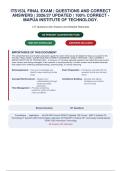
ITS153L FINAL EXAM | QUESTIONS AND CORRECT
ANSWERS | 2026/27 UPDATED | 100% CORRECT -
MAPÚA INSTITUTE OF TECHNOLOGY.
147 Questions with Answers and Detailed Rationales
100 PERCENT GUARANTEED PASS
INSTANT DOWNLOAD ANSWERS INCLUDED
IMPORTANCE OF THIS DOCUMENT
This comprehensive examination preparation guide has been meticulously developed to help you succeed in the
ITS153L FINAL EXAM | QUESTIONS AND CORRECT ANSWERS | 2026/27 UPDATED | 100% CORRECT -
MAPÚA INSTITUTE OF TECHNOLOGY.. It contains 147 carefully selected questions that reflect the most current
exam content and testing strategies. Each question is accompanied by a correct answer and a detailed rationale
that explains the underlying pathophysiology, pharmacology, or clinical reasoning.
Self-Assessment – Test your knowledge and Exam Preparation – Familiarize yourself with the
identify areas requiring further question format and content
study areas
Concept Reinforcement – Deepen your Confidence Building – Develop test-taking
understanding through strategies and reduce
evidence-based exam anxiety
rationales
Time Management – Practice answering
questions under simulated
exam conditions
Review Summary 147 Questions
Foundations - Application - Its153l AND Correct 2026/27 Updated 100 Correct - MAP A Institute OF
Technology IT Systems AND Technologies Laboratory Its153l MAP A Institute OF Technology Undergraduate
YEAR 3 BS Information Technology
All answers with rationales
,Table of Contents
Content Area Questions Key Topics
Introduction TO Computing 1-25 Student, Its153l, Laboratory, Exercise, Windows
AND Programming Concepts
DATA Types Variables AND 26-50 Its153l, Student, MAP A S, Address, Command
Operators
Control Structures 51-75 Its153l, Student, Laboratory, Subnet, Command
Conditionals AND Loops
Functions AND Modular 76-100 Its153l, Student, Exercise, Behavior, Address
Programming
Arrays AND Strings 101-125 Its153l, Student, Exercise, Correctly, Order
Pointers AND Memory 126-147 Its153l, Student, Interface, Address, Subnet
Management
TOTAL 147 All questions include answers and detailed rationales
,Section A - Introduction TO Computing AND Programming
Concepts
Q1.
During a PC assembly laboratory, after installing the CPU into an LGA socket, which step
must be performed before mounting the heatsink and fan?
A. Apply a pea-sized amount of thermal B. Spread a thick layer of thermal paste
paste to the center of the CPU integrated across the entire motherboard socket area.
heat spreader.
C. Install the RAM modules first to stabilize D. Power on the system briefly to verify the
the board before mounting the cooler. CPU is seated before attaching the cooler.
Correct: A - Apply a pea-sized amount of thermal paste to the center of the CPU integrated
heat spreader.
Rationale:Thermal paste is applied as a small pea-sized dot at the center of the CPU IHS;
the heatsink pressure spreads it evenly. A thick layer or spreading across the socket risks
overflow and poor contact, and powering on without a cooler can overheat the CPU instantly.
RAM installation order is independent and does not substitute for thermal interface
application.
Why the other answers are wrong:
B. Excess paste across the socket can bridge contacts and cause electrical or thermal
problems.
C. RAM installation is unrelated to the thermal interface requirement and does not protect the
CPU.
D. Powering on without a heatsink can cause immediate thermal damage to the CPU.
Reference: Mapúa ITS153L Laboratory Manual, Module 2: PC Assembly and Thermal Management
Q2.
A technician needs to install Windows 11 on a new NVMe SSD. Which UEFI/BIOS setting
must be enabled to allow the operating system to boot from a GPT-partitioned drive?
A. Legacy BIOS/CSM compatibility mode B. Secure Boot with UEFI mode
C. Intel Rapid Storage Technology RAID D. Fast Boot with network stack disabled
mode
Correct: B - Secure Boot with UEFI mode
Page 3
, Section A - Introduction TO Computing AND Programming Concepts
Rationale: Windows 11 requires UEFI firmware with Secure Boot enabled to boot from
GPT-partitioned drives and meet security requirements. Legacy/CSM mode uses MBR
partitioning and is incompatible with Windows 11's requirements. RAID mode and Fast Boot
settings do not address the GPT/UEFI boot requirement.
Why the other answers are wrong:
A. Legacy/CSM mode uses MBR partitioning and prevents Windows 11 GPT boot.
C. RAID mode affects storage configuration, not the UEFI/GPT boot requirement.
D. Fast Boot and network stack settings do not enable GPT/UEFI booting.
Reference: Mapúa ITS153L Laboratory Manual, Module 3: Operating System Installation and Firmware
Configuration
Q3.
In a structured cabling laboratory, a student must terminate a Cat 6 UTP cable using the
T568B standard. Which wire color sequence is correct for pins 1 through 8?
A. White-orange, orange, white-green, blue, B. White-green, green, white-orange, blue,
white-blue, green, white-brown, brown white-blue, orange, white-brown, brown
C. White-orange, orange, white-green, D. White-brown, brown, white-green, blue,
green, white-blue, blue, white-brown, brown white-blue, orange, white-orange, green
Correct: A - White-orange, orange, white-green, blue, white-blue, green, white-brown,
brown
Rationale:T568B pinout is: 1 white-orange, 2 orange, 3 white-green, 4 blue, 5 white-blue, 6
green, 7 white-brown, 8 brown. Option B is the T568A sequence, option C swaps green and
blue pairs incorrectly, and option D is a reversed non-standard order.
Why the other answers are wrong:
B. This is the T568A standard, not T568B.
C. This swaps the green and blue pair positions, which is not T568B.
D. This is a reversed, non-standard sequence that would not function correctly.
Reference: Mapúa ITS153L Laboratory Manual, Module 5: Structured Cabling and T568B Termination
Q4.
A workstation with IP address 192.168.10.25/26 cannot reach a server at 192.168.10.70.
What is the most likely cause?
A. The subnet mask is incorrect for the B. The two devices are in different subnets
network. and require a router.
C. The default gateway is set to D. DNS resolution is failing for the server
192.168.10.1. name.
Correct: B - The two devices are in different subnets and require a router.
Page 4
ANSWERS | 2026/27 UPDATED | 100% CORRECT -
MAPÚA INSTITUTE OF TECHNOLOGY.
147 Questions with Answers and Detailed Rationales
100 PERCENT GUARANTEED PASS
INSTANT DOWNLOAD ANSWERS INCLUDED
IMPORTANCE OF THIS DOCUMENT
This comprehensive examination preparation guide has been meticulously developed to help you succeed in the
ITS153L FINAL EXAM | QUESTIONS AND CORRECT ANSWERS | 2026/27 UPDATED | 100% CORRECT -
MAPÚA INSTITUTE OF TECHNOLOGY.. It contains 147 carefully selected questions that reflect the most current
exam content and testing strategies. Each question is accompanied by a correct answer and a detailed rationale
that explains the underlying pathophysiology, pharmacology, or clinical reasoning.
Self-Assessment – Test your knowledge and Exam Preparation – Familiarize yourself with the
identify areas requiring further question format and content
study areas
Concept Reinforcement – Deepen your Confidence Building – Develop test-taking
understanding through strategies and reduce
evidence-based exam anxiety
rationales
Time Management – Practice answering
questions under simulated
exam conditions
Review Summary 147 Questions
Foundations - Application - Its153l AND Correct 2026/27 Updated 100 Correct - MAP A Institute OF
Technology IT Systems AND Technologies Laboratory Its153l MAP A Institute OF Technology Undergraduate
YEAR 3 BS Information Technology
All answers with rationales
,Table of Contents
Content Area Questions Key Topics
Introduction TO Computing 1-25 Student, Its153l, Laboratory, Exercise, Windows
AND Programming Concepts
DATA Types Variables AND 26-50 Its153l, Student, MAP A S, Address, Command
Operators
Control Structures 51-75 Its153l, Student, Laboratory, Subnet, Command
Conditionals AND Loops
Functions AND Modular 76-100 Its153l, Student, Exercise, Behavior, Address
Programming
Arrays AND Strings 101-125 Its153l, Student, Exercise, Correctly, Order
Pointers AND Memory 126-147 Its153l, Student, Interface, Address, Subnet
Management
TOTAL 147 All questions include answers and detailed rationales
,Section A - Introduction TO Computing AND Programming
Concepts
Q1.
During a PC assembly laboratory, after installing the CPU into an LGA socket, which step
must be performed before mounting the heatsink and fan?
A. Apply a pea-sized amount of thermal B. Spread a thick layer of thermal paste
paste to the center of the CPU integrated across the entire motherboard socket area.
heat spreader.
C. Install the RAM modules first to stabilize D. Power on the system briefly to verify the
the board before mounting the cooler. CPU is seated before attaching the cooler.
Correct: A - Apply a pea-sized amount of thermal paste to the center of the CPU integrated
heat spreader.
Rationale:Thermal paste is applied as a small pea-sized dot at the center of the CPU IHS;
the heatsink pressure spreads it evenly. A thick layer or spreading across the socket risks
overflow and poor contact, and powering on without a cooler can overheat the CPU instantly.
RAM installation order is independent and does not substitute for thermal interface
application.
Why the other answers are wrong:
B. Excess paste across the socket can bridge contacts and cause electrical or thermal
problems.
C. RAM installation is unrelated to the thermal interface requirement and does not protect the
CPU.
D. Powering on without a heatsink can cause immediate thermal damage to the CPU.
Reference: Mapúa ITS153L Laboratory Manual, Module 2: PC Assembly and Thermal Management
Q2.
A technician needs to install Windows 11 on a new NVMe SSD. Which UEFI/BIOS setting
must be enabled to allow the operating system to boot from a GPT-partitioned drive?
A. Legacy BIOS/CSM compatibility mode B. Secure Boot with UEFI mode
C. Intel Rapid Storage Technology RAID D. Fast Boot with network stack disabled
mode
Correct: B - Secure Boot with UEFI mode
Page 3
, Section A - Introduction TO Computing AND Programming Concepts
Rationale: Windows 11 requires UEFI firmware with Secure Boot enabled to boot from
GPT-partitioned drives and meet security requirements. Legacy/CSM mode uses MBR
partitioning and is incompatible with Windows 11's requirements. RAID mode and Fast Boot
settings do not address the GPT/UEFI boot requirement.
Why the other answers are wrong:
A. Legacy/CSM mode uses MBR partitioning and prevents Windows 11 GPT boot.
C. RAID mode affects storage configuration, not the UEFI/GPT boot requirement.
D. Fast Boot and network stack settings do not enable GPT/UEFI booting.
Reference: Mapúa ITS153L Laboratory Manual, Module 3: Operating System Installation and Firmware
Configuration
Q3.
In a structured cabling laboratory, a student must terminate a Cat 6 UTP cable using the
T568B standard. Which wire color sequence is correct for pins 1 through 8?
A. White-orange, orange, white-green, blue, B. White-green, green, white-orange, blue,
white-blue, green, white-brown, brown white-blue, orange, white-brown, brown
C. White-orange, orange, white-green, D. White-brown, brown, white-green, blue,
green, white-blue, blue, white-brown, brown white-blue, orange, white-orange, green
Correct: A - White-orange, orange, white-green, blue, white-blue, green, white-brown,
brown
Rationale:T568B pinout is: 1 white-orange, 2 orange, 3 white-green, 4 blue, 5 white-blue, 6
green, 7 white-brown, 8 brown. Option B is the T568A sequence, option C swaps green and
blue pairs incorrectly, and option D is a reversed non-standard order.
Why the other answers are wrong:
B. This is the T568A standard, not T568B.
C. This swaps the green and blue pair positions, which is not T568B.
D. This is a reversed, non-standard sequence that would not function correctly.
Reference: Mapúa ITS153L Laboratory Manual, Module 5: Structured Cabling and T568B Termination
Q4.
A workstation with IP address 192.168.10.25/26 cannot reach a server at 192.168.10.70.
What is the most likely cause?
A. The subnet mask is incorrect for the B. The two devices are in different subnets
network. and require a router.
C. The default gateway is set to D. DNS resolution is failing for the server
192.168.10.1. name.
Correct: B - The two devices are in different subnets and require a router.
Page 4