
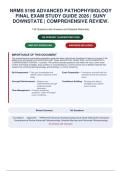
NRMS 5190 ADVANCED PATHOPHYSIOLOGY
FINAL EXAM STUDY GUIDE 2026 | SUNY
DOWNSTATE | COMPREHENSIVE REVIEW.
145 Questions with Answers and Detailed Rationales
100 PERCENT GUARANTEED PASS
INSTANT DOWNLOAD ANSWERS INCLUDED
IMPORTANCE OF THIS DOCUMENT
This comprehensive examination preparation guide has been meticulously developed to help you succeed in the
NRMS 5190 ADVANCED PATHOPHYSIOLOGY FINAL EXAM STUDY GUIDE 2026 | SUNY DOWNSTATE |
COMPREHENSIVE REVIEW.. It contains 145 carefully selected questions that reflect the most current exam
content and testing strategies. Each question is accompanied by a correct answer and a detailed rationale that
explains the underlying pathophysiology, pharmacology, or clinical reasoning.
Self-Assessment – Test your knowledge and Exam Preparation – Familiarize yourself with the
identify areas requiring further question format and content
study areas
Concept Reinforcement – Deepen your Confidence Building – Develop test-taking
understanding through strategies and reduce
evidence-based exam anxiety
rationales
Time Management – Practice answering
questions under simulated
exam conditions
Review Summary 145 Questions
Foundations - Application - NRMS 5190 Advanced Pathophysiology Study Guide 2026 SUNY Downstate
Comprehensive Review Advanced Pathophysiology Graduate Msn/dnp-level Advanced Pathophysiology
All answers with rationales
,Table of Contents
Content Area Questions Key Topics
Cellular Adaptation Injury 1-25 Mechanism, Pathophysiologic, Explains, Disease, Directly
AND Death
Inflammation AND Wound 26-50 Explains, Mechanism, Syndrome, Acute, Pathophysiologic
Healing
Genetics AND Genetic 51-75 Explains, Mechanism, Pathophysiologic, Disease, Syndrome
Disorders
Alterations IN Immune 76-100 Explains, Mechanism, Pathophysiologic, Pattern, Disease
Function
Alterations IN Fluid 101-125 Explains, Mechanism, Acute, Directly, Pathophysiologic
Electrolyte AND Acid-base
Balance
Alterations IN Cardiovascular 126-145 Explains, Mechanism, Chronic, Consistent, Syndrome
Function
TOTAL 145 All questions include answers and detailed rationales
,Section A - Cellular Adaptation Injury AND Death
Q1.
During reperfusion of ischemic myocardium, mitochondrial permeability transition pore
(mPTP) opening is most directly triggered by which cellular event?
A. Sustained cytosolic alkalosis with B. Rapid normalization of pH with calcium
hypocalcemia and ROS overload
C. Activation of AMPK and autophagy D. Increased nitric oxide synthase coupling
upregulation
Correct: B - Rapid normalization of pH with calcium and ROS overload
Rationale:Reperfusion paradoxically worsens injury when rapid pH correction (reactive
hypercontracture) coincides with calcium overload and reactive oxygen species, opening the
mPTP and triggering necrosis/apoptosis. The other options either protect mitochondria or
describe adaptive responses that do not open the pore.
Why the other answers are wrong:
A. Alkalosis with hypocalcemia does not favor mPTP opening; calcium overload is required.
C. AMPK/autophagy is largely cytoprotective and not the direct trigger of mPTP.
D. NOS coupling improves endothelial function rather than initiating mPTP opening.
Reference: Kumar, V., Abbas, A.K., Aster, J.C. (2025). Robbins & Cotran Pathologic Basis of Disease,
11th Ed., Ch. 2 (Cell Injury).
Q2.
A patient with chronic granulomatous disease (CGD) is at greatest risk for infection with
which class of organisms?
A. Encapsulated bacteria (e.g., B. Catalase-positive organisms (e.g.,
Streptococcus pneumoniae) Staphylococcus aureus, Aspergillus)
C. Intracellular pathogens requiring T-cell D. Enteric gram-negative bacilli (e.g.,
immunity (e.g., Mycobacterium tuberculosis) Escherichia coli)
Correct: B - Catalase-positive organisms (e.g., Staphylococcus aureus, Aspergillus)
Rationale:CGD results from defective NADPH oxidase, impairing the respiratory burst
needed to kill catalase-positive organisms that degrade their own hydrogen peroxide. T-cell
defects underlie mycobacterial susceptibility, complement/antibody defects underlie
encapsulated organisms, and enteric bacilli are less specific to CGD.
Why the other answers are wrong:
A. Encapsulated bacteria are classically linked to complement and B-cell defects, not CGD.
C. Intracellular pathogen susceptibility reflects T-cell/macrophage defects (e.g., HIV, IFN-
Page 3
, Section A - Cellular Adaptation Injury AND Death
pathway defects).
D. Enteric gram-negative infections are not the hallmark of CGD.
Reference: Abbas, A.K., Lichtman, A.H., Pillai, S. (2024). Cellular and Molecular Immunology, 10th Ed.,
Ch. 21.
Q3.
Which laboratory pattern best distinguishes disseminated intravascular coagulation (DIC)
from primary fibrinolysis?
A. Elevated D-dimer with normal platelet B. Prolonged PT/PTT with low fibrinogen
count and thrombocytopenia
C. Isolated prolonged bleeding time with D. Elevated von Willebrand factor antigen
normal fibrinogen with normal platelets
Correct: B - Prolonged PT/PTT with low fibrinogen and thrombocytopenia
Rationale:DIC is a consumptive coagulopathy showing prolonged PT/PTT, low fibrinogen,
thrombocytopenia, and elevated D-dimer. Primary fibrinolysis typically shows normal platelet
count and fibrinogen with elevated plasmin activity, distinguishing it from DIC.
Why the other answers are wrong:
A. Normal platelet count argues against DIC and is more typical of isolated fibrinolysis.
C. Isolated bleeding time prolongation suggests platelet function defect, not DIC.
D. Elevated vWF antigen is seen in endothelial injury states, not diagnostic of DIC.
Reference: Hoffman, R., et al. (2024). Hematology: Basic Principles and Practice, 8th Ed., Ch. 140
(DIC).
Q4.
In heart failure with preserved ejection fraction (HFpEF), the primary pathophysiologic
abnormality is best characterized as:
A. Reduced contractility with eccentric B. Impaired diastolic relaxation and
hypertrophy increased ventricular stiffness
C. Primary valvular regurgitation with D. Decreased systemic vascular resistance
volume overload with high-output state
Correct: B - Impaired diastolic relaxation and increased ventricular stiffness
Rationale:HFpEF is driven by impaired diastolic filling due to increased myocardial stiffness
(often from hypertrophy, fibrosis, or amyloid), not by reduced ejection fraction. The other
options describe HFrEF, valvular disease, or high-output states.
Why the other answers are wrong:
A. Reduced contractility with eccentric hypertrophy defines HFrEF.
C. Primary valvular regurgitation can cause volume overload but is not the core HFpEF
Page 4


