Page 1 of 56
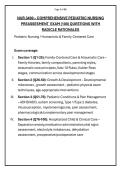
NUR 3490 – COMPREHENSIVE PEDIATRIC NURSING
PREASSESMENT EXAM (100) QUESTIONS WITH
RADICLE RATIONALES
Pediatric Nursing / Humanistic & Family-Centered Care
Exam coverage:
I. Section 1 (Q1-25): Family-Centered Care & Atraumatic Care –
Family theories, family compositions, parenting styles,
atraumatic care principles, Katz 10 Rules, Kubler-Ross
stages, communication across developmental stages
II. Section 2 (Q26-50): Growth & Development – Developmental
milestones , growth assessment , pediatric physical exam
techniques, age-appropriate interventions
III. Section 3 (Q51-75): Pediatric Conditions & Pain Management
– ADHD/ADD, autism screening, Type 1/Type 2 diabetes,
intussusception, myelomeningocele, pain assessment,
pharmacological/complementary pain management
IV. Section 4 (Q76-100): Hospitalized Child & Clinical Care –
Separation anxiety,medication administration,vital signs
assessment, electrolyte imbalances, dehydration
assessment, preoperative/postoperative care
, Page 2 of 56
Question 1
The primary goal of family-centered care in pediatric nursing is
to:
A. Reduce healthcare costs by minimizing hospital stays
B. Create mutually beneficial partnerships among providers,
patients, and families
C. Exclude families from care decisions to maintain
professional objectivity
D. Focus exclusively on the child's physical needs
CORRECT: B. Create mutually beneficial partnerships
among providers, patients, and families ✔️
RATIONALE: Family-centered care is grounded in "mutually
beneficial partnerships among health care providers, patients,
and families." This collaborative approach is essential for
successful pediatric health outcomes and recognizes the family
as the constant in the child's life.
Question 2
Which of the following is NOT one of the three principles of
atraumatic care?
A. Prevent or minimize physical distress and injury
B. Prevent or minimize parent-child separation
C. Promote a sense of control for the child and family
D. Complete all procedures without informing the child to
reduce anxiety
, Page 3 of 56
CORRECT: D. Complete all procedures without informing the
child to reduce anxiety ✔️
RATIONALE: The three principles of atraumatic care are: (1)
preventing or minimizing physical distress and injury, (2)
preventing or minimizing parent-child separation, and (3)
promoting a sense of control. Preparing the child and parents
for care reduces anxiety; performing procedures without
preparation increases distress.
Question 3
Which type of play is most typical for toddlers (1-3 years)?
A. Solitary play
B. Parallel play
C. Cooperative play
D. Fantasy play
CORRECT: B. Parallel play ✔️
RATIONALE: Toddlers typically engage in parallel play, where
"play becomes more social" and they "imitate behavior" of other
children but still play alongside rather than with them. This is a
normal developmental stage.
Question 4
Play is considered the "work" of children because it contributes
to:
A. Only physical development
B. Cognitive growth, physical development, and social
, Page 4 of 56
interaction
C. Entertainment without educational value
D. Only social skills development
CORRECT: B. Cognitive growth, physical development, and
social interaction ✔️
RATIONALE: Play is considered the "work" of children because
it contributes to cognitive growth, physical development, and
social interaction. Play is essential for healthy development
across all pediatric age groups.
Question 5
Which type of play is typical for preschoolers (3-5 years)?
A. Solitary play
B. Parallel play
C. Fantasy play and large motor activities
D. Cooperative play with complex rules
CORRECT: C. Fantasy play and large motor activities ✔️
RATIONALE: Preschoolers engage in "large motor activities,"
"fantasy play," and demonstrate increased manual dexterity.
There is a "big social aspect- interacts with other a lot" during
this developmental stage.
Question 6
School-age children typically engage in which type of play?
A. Solitary play
B. Parallel play
NUR 3490 – COMPREHENSIVE PEDIATRIC NURSING
PREASSESMENT EXAM (100) QUESTIONS WITH
RADICLE RATIONALES
Pediatric Nursing / Humanistic & Family-Centered Care
Exam coverage:
I. Section 1 (Q1-25): Family-Centered Care & Atraumatic Care –
Family theories, family compositions, parenting styles,
atraumatic care principles, Katz 10 Rules, Kubler-Ross
stages, communication across developmental stages
II. Section 2 (Q26-50): Growth & Development – Developmental
milestones , growth assessment , pediatric physical exam
techniques, age-appropriate interventions
III. Section 3 (Q51-75): Pediatric Conditions & Pain Management
– ADHD/ADD, autism screening, Type 1/Type 2 diabetes,
intussusception, myelomeningocele, pain assessment,
pharmacological/complementary pain management
IV. Section 4 (Q76-100): Hospitalized Child & Clinical Care –
Separation anxiety,medication administration,vital signs
assessment, electrolyte imbalances, dehydration
assessment, preoperative/postoperative care
, Page 2 of 56
Question 1
The primary goal of family-centered care in pediatric nursing is
to:
A. Reduce healthcare costs by minimizing hospital stays
B. Create mutually beneficial partnerships among providers,
patients, and families
C. Exclude families from care decisions to maintain
professional objectivity
D. Focus exclusively on the child's physical needs
CORRECT: B. Create mutually beneficial partnerships
among providers, patients, and families ✔️
RATIONALE: Family-centered care is grounded in "mutually
beneficial partnerships among health care providers, patients,
and families." This collaborative approach is essential for
successful pediatric health outcomes and recognizes the family
as the constant in the child's life.
Question 2
Which of the following is NOT one of the three principles of
atraumatic care?
A. Prevent or minimize physical distress and injury
B. Prevent or minimize parent-child separation
C. Promote a sense of control for the child and family
D. Complete all procedures without informing the child to
reduce anxiety
, Page 3 of 56
CORRECT: D. Complete all procedures without informing the
child to reduce anxiety ✔️
RATIONALE: The three principles of atraumatic care are: (1)
preventing or minimizing physical distress and injury, (2)
preventing or minimizing parent-child separation, and (3)
promoting a sense of control. Preparing the child and parents
for care reduces anxiety; performing procedures without
preparation increases distress.
Question 3
Which type of play is most typical for toddlers (1-3 years)?
A. Solitary play
B. Parallel play
C. Cooperative play
D. Fantasy play
CORRECT: B. Parallel play ✔️
RATIONALE: Toddlers typically engage in parallel play, where
"play becomes more social" and they "imitate behavior" of other
children but still play alongside rather than with them. This is a
normal developmental stage.
Question 4
Play is considered the "work" of children because it contributes
to:
A. Only physical development
B. Cognitive growth, physical development, and social
, Page 4 of 56
interaction
C. Entertainment without educational value
D. Only social skills development
CORRECT: B. Cognitive growth, physical development, and
social interaction ✔️
RATIONALE: Play is considered the "work" of children because
it contributes to cognitive growth, physical development, and
social interaction. Play is essential for healthy development
across all pediatric age groups.
Question 5
Which type of play is typical for preschoolers (3-5 years)?
A. Solitary play
B. Parallel play
C. Fantasy play and large motor activities
D. Cooperative play with complex rules
CORRECT: C. Fantasy play and large motor activities ✔️
RATIONALE: Preschoolers engage in "large motor activities,"
"fantasy play," and demonstrate increased manual dexterity.
There is a "big social aspect- interacts with other a lot" during
this developmental stage.
Question 6
School-age children typically engage in which type of play?
A. Solitary play
B. Parallel play