Page 1 of 62
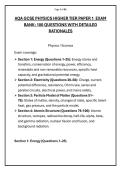
AQA GCSE PHYSICS HIGHER TIER PAPER 1 EXAM
BANK: 100 QUESTIONS WITH DETAILED
RATIONALES
Physics / Science
Exam coverage:
➢ Section 1: Energy (Questions 1–25): Energy stores and
transfers, conservation of energy, power, efficiency,
renewable and non-renewable resources, specific heat
capacity, and gravitational potential energy.
➢ Section 2: Electricity (Questions 26–50): Charge, current,
potential difference, resistance, Ohm's law, series and
parallel circuits, electrical power, and mains safety.
➢ Section 3: Particle Model of Matter (Questions 51–
75): States of matter, density, changes of state, specific latent
heat, gas pressure, and the particle model.
➢ Section 4: Atomic Structure (Questions 76–100): Atomic
structure, isotopes, radioactive decay, half-life, alpha, beta,
and gamma radiation, nuclear fission and fusion, and
background radiation.
Section 1: Energy (Questions 1–25)
, Page 2 of 62
Question 1: A student lifts a 2.0 kg textbook from the floor to a
shelf 1.5 m high. The gravitational field strength is 9.8 N/kg.
Which of the following calculations correctly determines the
energy transferred to the textbook's gravitational potential
energy store?
A. 2.0 × 1.5 = 3.0 J
B. 2.0 × 9.8 × 1.5 = 29.4 J
C. 2.0 × 9.8 = 19.6 J
D. 2.0 × 1.5 ÷ 9.8 = 0.31 J
CORRECT ANSWER: B
RATIONALE: The gravitational potential energy (GPE) is
calculated using the equation 𝐸𝑝 = 𝑚𝑔ℎ, where 𝑚 is mass, 𝑔 is
gravitational field strength, and ℎ is height. Substituting the
values: 𝐸𝑝 = 2.0 × 9.8 × 1.5 = 29.4 J. Option A omits the
gravitational field strength. Option C omits the height. Option D
incorrectly divides by 𝑔.
Question 2: Which of the following best describes the principle
of conservation of energy?
A. Energy can be created and destroyed in a closed system.
B. Energy can be transferred between stores but the total
amount in a closed system remains constant.
C. Energy always transfers from a cooler object to a warmer
, Page 3 of 62
object.
D. Energy is only conserved in mechanical systems.
CORRECT ANSWER: B
RATIONALE: The principle of conservation of energy states that
energy cannot be created or destroyed; it can only be
transferred between stores. The total energy in a closed system
remains constant. Option A is incorrect because energy cannot
be created or destroyed. Option C is incorrect because energy
transfers from hot to cold, not cold to hot. Option D is incorrect
because conservation of energy applies to all systems.
Question 3: A 1500 W electric heater is used for 30 minutes.
How much energy is transferred by the heater?
A. 45,000 J
B. 2,700,000 J
C. 750 J
D. 50 J
CORRECT ANSWER: B
RATIONALE: Energy transferred is calculated using 𝐸 = 𝑃𝑡,
where 𝑃 is power in watts and 𝑡 is time in seconds. Convert 30
minutes to seconds: 30 × 60 = 1800 s. Then 𝐸 = 1500 ×
1800 = 2,700,000 J. Option A uses 30 seconds instead of 30
, Page 4 of 62
minutes. Option C divides instead of multiplying. Option D is
incorrect.
Question 4: Which of the following is a renewable energy
resource?
A. Coal
B. Natural gas
C. Wind
D. Nuclear fuel
CORRECT ANSWER: C
RATIONALE: Wind is a renewable energy resource because it is
naturally replenished and will not run out. Coal, natural gas, and
nuclear fuel are non-renewable because they are finite and will
eventually be depleted.
Question 5: A ball is dropped from a height of 5.0 m. Assuming
no air resistance, what is the speed of the ball just before it hits
the ground? Use 𝑔 = 9.8 N/kg.
A. 9.9 m/s
B. 49 m/s
AQA GCSE PHYSICS HIGHER TIER PAPER 1 EXAM
BANK: 100 QUESTIONS WITH DETAILED
RATIONALES
Physics / Science
Exam coverage:
➢ Section 1: Energy (Questions 1–25): Energy stores and
transfers, conservation of energy, power, efficiency,
renewable and non-renewable resources, specific heat
capacity, and gravitational potential energy.
➢ Section 2: Electricity (Questions 26–50): Charge, current,
potential difference, resistance, Ohm's law, series and
parallel circuits, electrical power, and mains safety.
➢ Section 3: Particle Model of Matter (Questions 51–
75): States of matter, density, changes of state, specific latent
heat, gas pressure, and the particle model.
➢ Section 4: Atomic Structure (Questions 76–100): Atomic
structure, isotopes, radioactive decay, half-life, alpha, beta,
and gamma radiation, nuclear fission and fusion, and
background radiation.
Section 1: Energy (Questions 1–25)
, Page 2 of 62
Question 1: A student lifts a 2.0 kg textbook from the floor to a
shelf 1.5 m high. The gravitational field strength is 9.8 N/kg.
Which of the following calculations correctly determines the
energy transferred to the textbook's gravitational potential
energy store?
A. 2.0 × 1.5 = 3.0 J
B. 2.0 × 9.8 × 1.5 = 29.4 J
C. 2.0 × 9.8 = 19.6 J
D. 2.0 × 1.5 ÷ 9.8 = 0.31 J
CORRECT ANSWER: B
RATIONALE: The gravitational potential energy (GPE) is
calculated using the equation 𝐸𝑝 = 𝑚𝑔ℎ, where 𝑚 is mass, 𝑔 is
gravitational field strength, and ℎ is height. Substituting the
values: 𝐸𝑝 = 2.0 × 9.8 × 1.5 = 29.4 J. Option A omits the
gravitational field strength. Option C omits the height. Option D
incorrectly divides by 𝑔.
Question 2: Which of the following best describes the principle
of conservation of energy?
A. Energy can be created and destroyed in a closed system.
B. Energy can be transferred between stores but the total
amount in a closed system remains constant.
C. Energy always transfers from a cooler object to a warmer
, Page 3 of 62
object.
D. Energy is only conserved in mechanical systems.
CORRECT ANSWER: B
RATIONALE: The principle of conservation of energy states that
energy cannot be created or destroyed; it can only be
transferred between stores. The total energy in a closed system
remains constant. Option A is incorrect because energy cannot
be created or destroyed. Option C is incorrect because energy
transfers from hot to cold, not cold to hot. Option D is incorrect
because conservation of energy applies to all systems.
Question 3: A 1500 W electric heater is used for 30 minutes.
How much energy is transferred by the heater?
A. 45,000 J
B. 2,700,000 J
C. 750 J
D. 50 J
CORRECT ANSWER: B
RATIONALE: Energy transferred is calculated using 𝐸 = 𝑃𝑡,
where 𝑃 is power in watts and 𝑡 is time in seconds. Convert 30
minutes to seconds: 30 × 60 = 1800 s. Then 𝐸 = 1500 ×
1800 = 2,700,000 J. Option A uses 30 seconds instead of 30
, Page 4 of 62
minutes. Option C divides instead of multiplying. Option D is
incorrect.
Question 4: Which of the following is a renewable energy
resource?
A. Coal
B. Natural gas
C. Wind
D. Nuclear fuel
CORRECT ANSWER: C
RATIONALE: Wind is a renewable energy resource because it is
naturally replenished and will not run out. Coal, natural gas, and
nuclear fuel are non-renewable because they are finite and will
eventually be depleted.
Question 5: A ball is dropped from a height of 5.0 m. Assuming
no air resistance, what is the speed of the ball just before it hits
the ground? Use 𝑔 = 9.8 N/kg.
A. 9.9 m/s
B. 49 m/s