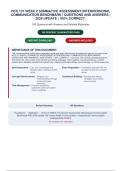
HCS 131 WEEK 2 SUMMATIVE ASSESSMENT:INTERPERSONAL
COMMUNICATION BENCHMARK | QUESTIONS AND ANSWERS |
2026 UPDATE | 100% CORRECT.
150 Questions with Answers and Detailed Rationales
100 PERCENT GUARANTEED PASS
INSTANT DOWNLOAD ANSWERS INCLUDED
IMPORTANCE OF THIS DOCUMENT
This comprehensive examination preparation guide has been meticulously developed to help you succeed in the
HCS 131 WEEK 2 SUMMATIVE ASSESSMENT:INTERPERSONAL COMMUNICATION BENCHMARK |
QUESTIONS AND ANSWERS | 2026 UPDATE | 100% CORRECT.. It contains 150 carefully selected questions
that reflect the most current exam content and testing strategies. Each question is accompanied by a correct
answer and a detailed rationale that explains the underlying pathophysiology, pharmacology, or clinical reasoning.
Self-Assessment – Test your knowledge and Exam Preparation – Familiarize yourself with the
identify areas requiring further question format and content
study areas
Concept Reinforcement – Deepen your Confidence Building – Develop test-taking
understanding through strategies and reduce
evidence-based exam anxiety
rationales
Time Management – Practice answering
questions under simulated
exam conditions
Review Summary 150 Questions
Foundations - Application - HCS 131 WEEK 2 Summative Assessment Interpersonal Communication
Benchmark AND 2026 Update 100 Correct Health Communication / Interpersonal Communication
Undergraduate YEAR 2
All answers with rationales
,Table of Contents
Content Area Questions Key Topics
Communication Models AND 1-25 Communication, Manager, Concept, Discharge, Staff
Theories
Verbal AND Nonverbal 26-50 Communication, Patient S, Demonstrates, Reflects, Technique
Communication
Listening Skills AND Active 51-75 Communication, Technique, Manager, Interview, Notices
Listening
Interpersonal 76-100 Communication, Demonstrates, Technique, Reflects, Framework
Communication IN
Healthcare Teams
Patient-provider 101-125 Communication, Demonstrates, Meeting, Reflects, Manager
Communication Wants
Cultural Competence AND 126-150 Communication, Preparing, Colleague, Patient S, Appropriate
Diversity IN Communication
TOTAL 150 All questions include answers and detailed rationales
,Section A - Communication Models AND Theories
Q1.
A community health worker repeatedly nods and says 'I understand' while a client
describes barriers to medication adherence. Later, the client reports feeling unheard.
Which communication concept best explains this disconnect?
A. Pseudo-listening B. Selective listening
C. Defensive listening D. Insulated listening
Correct: A - Pseudo-listening
Rationale:Pseudo-listening occurs when a person gives the appearance of listening through
nonverbal and verbal cues without genuine cognitive engagement. The worker's nods and
verbal acknowledgments create an illusion of attention, but the client's perception of being
unheard reveals the lack of true processing. Selective listening involves attending only to
certain parts of a message, defensive listening involves perceiving personal attacks, and
insulated listening involves avoiding certain topics.
Why the other answers are wrong:
B. Selective listening involves focusing on specific parts of a message, not feigning overall
attention.
C. Defensive listening involves interpreting remarks as personal attacks, which is not indicated
here.
D. Insulated listening involves avoiding or ignoring specific topics, not giving false signals of
engagement.
Reference: Adler, R.B., et al. (2023). Interplay: The Process of Interpersonal Communication, 15th Ed.,
Ch. 7
Q2.
In a team meeting, a supervisor says, 'We need to improve our discharge planning
process.' A staff member perceives this as a personal criticism of her recent work. This
scenario best illustrates which perceptual influence?
A. Halo effect B. Self-serving bias
C. Fundamental attribution error D. Egocentrism
Correct: D - Egocentrism
Page 3
, Section A - Communication Models AND Theories
Rationale: Egocentrism in communication refers to the tendency to interpret messages in
relation to oneself, often leading to personalization of neutral statements. The staff member's
perception that a general process improvement comment is about her work reflects this
self-focused interpretation. The halo effect involves generalizing a positive trait, self-serving
bias involves attributing success to internal factors, and fundamental attribution error involves
overemphasizing personal traits in others' behavior.
Why the other answers are wrong:
A. Halo effect involves allowing one positive characteristic to overshadow other perceptions.
B. Self-serving bias involves attributing one's own successes to internal factors and failures to
external factors.
C. Fundamental attribution error involves overemphasizing internal causes for others'
behaviors.
Reference: Wood, J.T. (2022). Interpersonal Communication: Everyday Encounters, 9th Ed., Ch. 3
Q3.
Which of the following best describes the concept of emotional contagion in a healthcare
team?
A. The tendency to suppress emotions to B. The transmission of moods and emotions
maintain professionalism. from one person to another.
C. The ability to recognize and manage D. The process of empathizing with a
one's own emotions. patient's emotional state.
Correct: B - The transmission of moods and emotions from one person to another.
Rationale:Emotional contagion refers to the automatic and often unconscious transfer of
emotional states between individuals, which can significantly affect team dynamics and
patient interactions. Suppressing emotions is emotional labor, recognizing and managing
emotions is emotional intelligence, and empathizing with a patient is empathy, not contagion.
Why the other answers are wrong:
A. Suppressing emotions is a form of emotional labor, not contagion.
C. Recognizing and managing one's own emotions is a component of emotional intelligence.
D. Empathizing with a patient's emotional state is empathy, not the transmission of emotions
between people.
Reference: Barsade, S.G. (2022). The Ripple Effect: Emotional Contagion and Its Influence on Group
Behavior, Administrative Science Quarterly, 47(4)
Q4.
A nurse manager wants to give constructive feedback to a staff member about repeated
tardiness. Which approach best reflects the principles of assertive communication?
Page 4
COMMUNICATION BENCHMARK | QUESTIONS AND ANSWERS |
2026 UPDATE | 100% CORRECT.
150 Questions with Answers and Detailed Rationales
100 PERCENT GUARANTEED PASS
INSTANT DOWNLOAD ANSWERS INCLUDED
IMPORTANCE OF THIS DOCUMENT
This comprehensive examination preparation guide has been meticulously developed to help you succeed in the
HCS 131 WEEK 2 SUMMATIVE ASSESSMENT:INTERPERSONAL COMMUNICATION BENCHMARK |
QUESTIONS AND ANSWERS | 2026 UPDATE | 100% CORRECT.. It contains 150 carefully selected questions
that reflect the most current exam content and testing strategies. Each question is accompanied by a correct
answer and a detailed rationale that explains the underlying pathophysiology, pharmacology, or clinical reasoning.
Self-Assessment – Test your knowledge and Exam Preparation – Familiarize yourself with the
identify areas requiring further question format and content
study areas
Concept Reinforcement – Deepen your Confidence Building – Develop test-taking
understanding through strategies and reduce
evidence-based exam anxiety
rationales
Time Management – Practice answering
questions under simulated
exam conditions
Review Summary 150 Questions
Foundations - Application - HCS 131 WEEK 2 Summative Assessment Interpersonal Communication
Benchmark AND 2026 Update 100 Correct Health Communication / Interpersonal Communication
Undergraduate YEAR 2
All answers with rationales
,Table of Contents
Content Area Questions Key Topics
Communication Models AND 1-25 Communication, Manager, Concept, Discharge, Staff
Theories
Verbal AND Nonverbal 26-50 Communication, Patient S, Demonstrates, Reflects, Technique
Communication
Listening Skills AND Active 51-75 Communication, Technique, Manager, Interview, Notices
Listening
Interpersonal 76-100 Communication, Demonstrates, Technique, Reflects, Framework
Communication IN
Healthcare Teams
Patient-provider 101-125 Communication, Demonstrates, Meeting, Reflects, Manager
Communication Wants
Cultural Competence AND 126-150 Communication, Preparing, Colleague, Patient S, Appropriate
Diversity IN Communication
TOTAL 150 All questions include answers and detailed rationales
,Section A - Communication Models AND Theories
Q1.
A community health worker repeatedly nods and says 'I understand' while a client
describes barriers to medication adherence. Later, the client reports feeling unheard.
Which communication concept best explains this disconnect?
A. Pseudo-listening B. Selective listening
C. Defensive listening D. Insulated listening
Correct: A - Pseudo-listening
Rationale:Pseudo-listening occurs when a person gives the appearance of listening through
nonverbal and verbal cues without genuine cognitive engagement. The worker's nods and
verbal acknowledgments create an illusion of attention, but the client's perception of being
unheard reveals the lack of true processing. Selective listening involves attending only to
certain parts of a message, defensive listening involves perceiving personal attacks, and
insulated listening involves avoiding certain topics.
Why the other answers are wrong:
B. Selective listening involves focusing on specific parts of a message, not feigning overall
attention.
C. Defensive listening involves interpreting remarks as personal attacks, which is not indicated
here.
D. Insulated listening involves avoiding or ignoring specific topics, not giving false signals of
engagement.
Reference: Adler, R.B., et al. (2023). Interplay: The Process of Interpersonal Communication, 15th Ed.,
Ch. 7
Q2.
In a team meeting, a supervisor says, 'We need to improve our discharge planning
process.' A staff member perceives this as a personal criticism of her recent work. This
scenario best illustrates which perceptual influence?
A. Halo effect B. Self-serving bias
C. Fundamental attribution error D. Egocentrism
Correct: D - Egocentrism
Page 3
, Section A - Communication Models AND Theories
Rationale: Egocentrism in communication refers to the tendency to interpret messages in
relation to oneself, often leading to personalization of neutral statements. The staff member's
perception that a general process improvement comment is about her work reflects this
self-focused interpretation. The halo effect involves generalizing a positive trait, self-serving
bias involves attributing success to internal factors, and fundamental attribution error involves
overemphasizing personal traits in others' behavior.
Why the other answers are wrong:
A. Halo effect involves allowing one positive characteristic to overshadow other perceptions.
B. Self-serving bias involves attributing one's own successes to internal factors and failures to
external factors.
C. Fundamental attribution error involves overemphasizing internal causes for others'
behaviors.
Reference: Wood, J.T. (2022). Interpersonal Communication: Everyday Encounters, 9th Ed., Ch. 3
Q3.
Which of the following best describes the concept of emotional contagion in a healthcare
team?
A. The tendency to suppress emotions to B. The transmission of moods and emotions
maintain professionalism. from one person to another.
C. The ability to recognize and manage D. The process of empathizing with a
one's own emotions. patient's emotional state.
Correct: B - The transmission of moods and emotions from one person to another.
Rationale:Emotional contagion refers to the automatic and often unconscious transfer of
emotional states between individuals, which can significantly affect team dynamics and
patient interactions. Suppressing emotions is emotional labor, recognizing and managing
emotions is emotional intelligence, and empathizing with a patient is empathy, not contagion.
Why the other answers are wrong:
A. Suppressing emotions is a form of emotional labor, not contagion.
C. Recognizing and managing one's own emotions is a component of emotional intelligence.
D. Empathizing with a patient's emotional state is empathy, not the transmission of emotions
between people.
Reference: Barsade, S.G. (2022). The Ripple Effect: Emotional Contagion and Its Influence on Group
Behavior, Administrative Science Quarterly, 47(4)
Q4.
A nurse manager wants to give constructive feedback to a staff member about repeated
tardiness. Which approach best reflects the principles of assertive communication?
Page 4