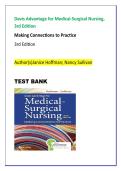
Davis Advantage for Medical-Surgical Nursing,
3rd Edition
Making Connections to Practice
3rd Edition
Author(s)Janice Hoffman; Nancy Sullivan
TEST BANK
,
,Question 1
A medical-surgical nurse receives handoff for four patients. Which
patient should the nurse assess first?
A. A patient with chronic osteoarthritis reporting pain of 6/10
B. A patient with pneumonia whose oxygen saturation has decreased
from 95% to 88%
C. A patient with diabetes requesting assistance to the bathroom
D. A patient with hypertension whose blood pressure is 146/88 mm Hg
Correct Answer:
B. A patient with pneumonia whose oxygen saturation has decreased
from 95% to 88%
Rationale:
The patient with pneumonia and a declining oxygen saturation has a
potential airway or breathing problem and requires immediate
assessment. The other patients have needs that are important but are
not associated with an immediate threat to physiologic stability. The
nurse should prioritize actual or potential life-threatening problems
using clinical judgment and the ABC framework.
Question 2
A newly admitted patient asks why the medical-surgical nurse is asking
about the patient's usual ability to perform activities of daily living.
Which response by the nurse is most appropriate?
A. "This information helps determine whether you need a long-term
care facility."
, B. "This helps us identify your baseline function and plan individualized
care."
C. "We ask every patient these questions because they are required by
the hospital."
D. "This allows the nurse to determine whether your family is providing
enough support."
Correct Answer:
B. "This helps us identify your baseline function and plan individualized
care."
Rationale:
Determining baseline functional status supports patient-centered care
and helps the nurse identify changes in condition, establish realistic
goals, and individualize interventions. The other responses are either
inaccurate or unnecessarily judgmental. Baseline assessment is a clinical
component of comprehensive nursing care, not simply an
administrative requirement.
Question 3
The nurse is beginning care for a patient who has limited English
proficiency. Which action best promotes patient-centered
communication?
A. Ask a family member to interpret all instructions.
B. Speak loudly and slowly so the patient can understand.
C. Use a qualified medical interpreter for important clinical
communication.
D. Give the patient written information and avoid complex discussions.
3rd Edition
Making Connections to Practice
3rd Edition
Author(s)Janice Hoffman; Nancy Sullivan
TEST BANK
,
,Question 1
A medical-surgical nurse receives handoff for four patients. Which
patient should the nurse assess first?
A. A patient with chronic osteoarthritis reporting pain of 6/10
B. A patient with pneumonia whose oxygen saturation has decreased
from 95% to 88%
C. A patient with diabetes requesting assistance to the bathroom
D. A patient with hypertension whose blood pressure is 146/88 mm Hg
Correct Answer:
B. A patient with pneumonia whose oxygen saturation has decreased
from 95% to 88%
Rationale:
The patient with pneumonia and a declining oxygen saturation has a
potential airway or breathing problem and requires immediate
assessment. The other patients have needs that are important but are
not associated with an immediate threat to physiologic stability. The
nurse should prioritize actual or potential life-threatening problems
using clinical judgment and the ABC framework.
Question 2
A newly admitted patient asks why the medical-surgical nurse is asking
about the patient's usual ability to perform activities of daily living.
Which response by the nurse is most appropriate?
A. "This information helps determine whether you need a long-term
care facility."
, B. "This helps us identify your baseline function and plan individualized
care."
C. "We ask every patient these questions because they are required by
the hospital."
D. "This allows the nurse to determine whether your family is providing
enough support."
Correct Answer:
B. "This helps us identify your baseline function and plan individualized
care."
Rationale:
Determining baseline functional status supports patient-centered care
and helps the nurse identify changes in condition, establish realistic
goals, and individualize interventions. The other responses are either
inaccurate or unnecessarily judgmental. Baseline assessment is a clinical
component of comprehensive nursing care, not simply an
administrative requirement.
Question 3
The nurse is beginning care for a patient who has limited English
proficiency. Which action best promotes patient-centered
communication?
A. Ask a family member to interpret all instructions.
B. Speak loudly and slowly so the patient can understand.
C. Use a qualified medical interpreter for important clinical
communication.
D. Give the patient written information and avoid complex discussions.