
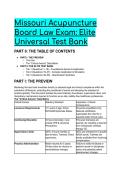
Missouri Acupuncture
Board Law Exam: Elite
Universal Test Bank
PART 0: THE TABLE OF CONTENTS
● PART I: THE PREVIEW
○ The Intro
○ The "Critical Axioms" Data Matrix
● PART II: THE ELITE TEST BANK
○ Tier 1 (Questions 1–18) - Foundational Syntax & Application
○ Tier 2 (Questions 19–37) - Complex Application & Simulation
○ Tier 3 (Questions 38–55) - Grandmaster Synthesis
PART I: THE PREVIEW
Mastering this test bank translates directly to absolute legal and clinical compliance within the
jurisdiction of Missouri, protecting the practitioner's license and elevating the standard of
practice globally. This document isolates the exact statutory boundaries, supervision ratios, and
disciplinary mechanisms required to function as an elite, liability-free healthcare professional.
The "Critical Axioms" Data Matrix
Critical Domain Statutory Standard Implication / Clinical
Consequence
Licensure Requirements 21+ years of age; Active Prevents unqualified entry;
NCCAOM Diplomate Status. National certification
supersedes the need for a
separate state clinical exam.
Continuing Education 30 hours biennially; must First-year licensees are
include CPR & Universal exempt; dry needling is banned
Precautions. from chiropractic meridian
therapy CE.
Supervision Limits ADTs: 4 hours monthly (2 ADTs are restricted to 5 specific
face-to-face). Trainees: Direct NADA points; Trainees are
supervision. strictly prohibited from receiving
compensation.
Practice Administration Retain records for 5 years; Failure to notify the Board or
30-day notice for closure or patients results in disciplinary
name/address changes. action and potential patient
abandonment charges.
,Critical Domain Statutory Standard Implication / Clinical
Consequence
Disciplinary Authority The Board recommends Unlicensed practice is a Class
discipline; the AHC determines B Misdemeanor. Appeals must
cause. be filed within 30 days.
PART II: THE ELITE TEST BANK
Tier 1 - Foundational Syntax & Application
Q1: An applicant submits their Missouri acupuncture licensure packet containing their NCCAOM
certification, background check, and fee. The applicant is 20 years old. Based on the statutory
qualifications for licensure, what is the FIRST reason this application will be denied? A) The
applicant has not completed the mandatory state jurisprudence exam. B) The applicant has not
completed a 1,905-hour ACAOM curriculum. C) The applicant is under 21 years of age. D) The
applicant has not secured a supervising physician.
● Answer: C (The applicant is under 21 years of age)
● Distractor Analysis:
○ A is incorrect: Missouri statutes do not mandate a separate jurisprudence exam for
initial licensure.
○ B is incorrect: NCCAOM diplomate status satisfies the educational requirement; the
1,905-hour rule applies specifically to non-ACAOM trainee programs.
○ D is incorrect: Licensed acupuncturists are independent practitioners and do not
require physician supervision in Missouri.
The Mentor's Analysis: Initial licensure mandates an absolute age floor. When facing eligibility
assessments, the immediate priority is verifying baseline statutory requirements. By utilizing the
age provision in Chapter 324, the practitioner bypasses the common trap of assuming
alternative state guidelines apply. Professional Intuition: Age 21 and NCCAOM Diplomate
status are the non-negotiable twin pillars of Missouri licensure.
Q2: A licensed acupuncturist opens a new clinical space. Regarding the physical license
document, which action is the MOST APPROPRIATE? A) Store the license securely in a locked
filing cabinet to prevent theft. B) Keep a digital copy on a smartphone to show patients upon
request. C) Mail the original license back to the Board and request a certified clinic copy. D)
Have the license in their possession at all times while practicing.
● Answer: D (Have the license in their possession at all times while practicing)
● Distractor Analysis:
○ A is incorrect: Storing the license out of sight violates the requirement to have it
readily available or posted.
○ B is incorrect: Digital copies do not satisfy the statutory requirement for possessing
the official document issued by the state.
○ C is incorrect: The original license must be retained by the practitioner, not
surrendered for a secondary copy.
The Mentor's Analysis: The law requires the physical presence of the credential during all
clinical activities. When facing facility setups, the immediate priority is visible compliance. By
utilizing proper posting, the practitioner bypasses the common trap of failing site inspections due
to missing documentation. Professional Intuition: The practitioner's license must breathe
the same air the practitioner does while practicing; keep it physically present.
Q3: An Auricular Detox Technician (ADT) is preparing to treat a patient for substance abuse.
, Which points are they EXCLUSIVELY permitted to needle? A) Shen Men, Lung, Liver, Kidney,
Sympathetic B) Shen Men, Heart, Liver, Kidney, Endocrine C) Shen Men, Point Zero, Liver,
Kidney, Sympathetic D) Any five points designated by the supervising L.Ac.
● Answer: A (Shen Men, Lung, Liver, Kidney, Sympathetic)
● Distractor Analysis:
○ B is incorrect: Heart and Endocrine are not the specified NADA protocol points
authorized by Missouri law.
○ C is incorrect: Point Zero is an auricular point but is excluded from the rigid
statutory list. * D is incorrect: The supervising L.Ac. cannot override state statute;
the points are explicitly fixed by law.
The Mentor's Analysis: ADT scope is surgically restricted by statute, not by the supervisor's
discretion. When facing ADT delegation, the immediate priority is adherence to the standard
5-point protocol. By utilizing these exact points, the practitioner bypasses the common trap of
accidental scope expansion. Professional Intuition: Delegation does not equal expansion;
ADTs are legally locked into the 5 specified points.
Q4: A practitioner's license is due for renewal. How many continuing education (CE) hours are
required, and what specific topics MUST be included? A) 15 hours; including Ethics and CPR.
B) 30 hours; including CPR and universal precautions. C) 60 hours; including NCCAOM core
subjects and CPR. D) 30 hours; including dry needling and ethics.
● Answer: B (30 hours; including CPR and universal precautions)
● Distractor Analysis:
○ A is incorrect: 15 hours is half the required amount for a biennial renewal.
○ C is incorrect: 60 hours exceeds the Missouri requirement, matching NCCAOM
national requirements instead.
○ D is incorrect: Dry needling is explicitly excluded from chiropractic meridian therapy
CE and is not a mandate for L.Ac. renewal.
The Mentor's Analysis: Renewal hinges on specific safety protocols alongside general
education. When facing license renewal, the immediate priority is verifying the inclusion of
mandated safety courses. By utilizing the CPR and universal precautions mandate, the
practitioner bypasses the common trap of short-changing mandatory topics. Professional
Intuition: Thirty hours over two years is meaningless without documented CPR and
infection control.
Q5: A newly licensed acupuncturist is approaching their first license expiration date (within the
first year of licensure). How many CE hours are required for this FIRST renewal? A) 30 hours B)
15 hours C) 0 hours D) Only the CPR requirement
● Answer: C (0 hours)
● Distractor Analysis:
○ A is incorrect: The 30-hour rule applies to subsequent two-year cycles, not the initial
period.
○ B is incorrect: Missouri does not prorate CE hours for the first year.
○ D is incorrect: The entire CE requirement is waived for the first year of licensure.
The Mentor's Analysis: The state grants a grace period for new licensees integrating into
practice. When facing an initial renewal, the immediate priority is simply submitting the renewal
form and fee. By utilizing the first-year exemption, the practitioner bypasses the common trap of
rushing unnecessary CE credits. Professional Intuition: The first year is a CE free-pass;
focus entirely on clinical integration.
Q6: An acupuncturist legally changes their last name following a marriage. What is the
MAXIMUM timeframe allowed to notify the Committee of this change? A) 14 days B) 30 days C)
Board Law Exam: Elite
Universal Test Bank
PART 0: THE TABLE OF CONTENTS
● PART I: THE PREVIEW
○ The Intro
○ The "Critical Axioms" Data Matrix
● PART II: THE ELITE TEST BANK
○ Tier 1 (Questions 1–18) - Foundational Syntax & Application
○ Tier 2 (Questions 19–37) - Complex Application & Simulation
○ Tier 3 (Questions 38–55) - Grandmaster Synthesis
PART I: THE PREVIEW
Mastering this test bank translates directly to absolute legal and clinical compliance within the
jurisdiction of Missouri, protecting the practitioner's license and elevating the standard of
practice globally. This document isolates the exact statutory boundaries, supervision ratios, and
disciplinary mechanisms required to function as an elite, liability-free healthcare professional.
The "Critical Axioms" Data Matrix
Critical Domain Statutory Standard Implication / Clinical
Consequence
Licensure Requirements 21+ years of age; Active Prevents unqualified entry;
NCCAOM Diplomate Status. National certification
supersedes the need for a
separate state clinical exam.
Continuing Education 30 hours biennially; must First-year licensees are
include CPR & Universal exempt; dry needling is banned
Precautions. from chiropractic meridian
therapy CE.
Supervision Limits ADTs: 4 hours monthly (2 ADTs are restricted to 5 specific
face-to-face). Trainees: Direct NADA points; Trainees are
supervision. strictly prohibited from receiving
compensation.
Practice Administration Retain records for 5 years; Failure to notify the Board or
30-day notice for closure or patients results in disciplinary
name/address changes. action and potential patient
abandonment charges.
,Critical Domain Statutory Standard Implication / Clinical
Consequence
Disciplinary Authority The Board recommends Unlicensed practice is a Class
discipline; the AHC determines B Misdemeanor. Appeals must
cause. be filed within 30 days.
PART II: THE ELITE TEST BANK
Tier 1 - Foundational Syntax & Application
Q1: An applicant submits their Missouri acupuncture licensure packet containing their NCCAOM
certification, background check, and fee. The applicant is 20 years old. Based on the statutory
qualifications for licensure, what is the FIRST reason this application will be denied? A) The
applicant has not completed the mandatory state jurisprudence exam. B) The applicant has not
completed a 1,905-hour ACAOM curriculum. C) The applicant is under 21 years of age. D) The
applicant has not secured a supervising physician.
● Answer: C (The applicant is under 21 years of age)
● Distractor Analysis:
○ A is incorrect: Missouri statutes do not mandate a separate jurisprudence exam for
initial licensure.
○ B is incorrect: NCCAOM diplomate status satisfies the educational requirement; the
1,905-hour rule applies specifically to non-ACAOM trainee programs.
○ D is incorrect: Licensed acupuncturists are independent practitioners and do not
require physician supervision in Missouri.
The Mentor's Analysis: Initial licensure mandates an absolute age floor. When facing eligibility
assessments, the immediate priority is verifying baseline statutory requirements. By utilizing the
age provision in Chapter 324, the practitioner bypasses the common trap of assuming
alternative state guidelines apply. Professional Intuition: Age 21 and NCCAOM Diplomate
status are the non-negotiable twin pillars of Missouri licensure.
Q2: A licensed acupuncturist opens a new clinical space. Regarding the physical license
document, which action is the MOST APPROPRIATE? A) Store the license securely in a locked
filing cabinet to prevent theft. B) Keep a digital copy on a smartphone to show patients upon
request. C) Mail the original license back to the Board and request a certified clinic copy. D)
Have the license in their possession at all times while practicing.
● Answer: D (Have the license in their possession at all times while practicing)
● Distractor Analysis:
○ A is incorrect: Storing the license out of sight violates the requirement to have it
readily available or posted.
○ B is incorrect: Digital copies do not satisfy the statutory requirement for possessing
the official document issued by the state.
○ C is incorrect: The original license must be retained by the practitioner, not
surrendered for a secondary copy.
The Mentor's Analysis: The law requires the physical presence of the credential during all
clinical activities. When facing facility setups, the immediate priority is visible compliance. By
utilizing proper posting, the practitioner bypasses the common trap of failing site inspections due
to missing documentation. Professional Intuition: The practitioner's license must breathe
the same air the practitioner does while practicing; keep it physically present.
Q3: An Auricular Detox Technician (ADT) is preparing to treat a patient for substance abuse.
, Which points are they EXCLUSIVELY permitted to needle? A) Shen Men, Lung, Liver, Kidney,
Sympathetic B) Shen Men, Heart, Liver, Kidney, Endocrine C) Shen Men, Point Zero, Liver,
Kidney, Sympathetic D) Any five points designated by the supervising L.Ac.
● Answer: A (Shen Men, Lung, Liver, Kidney, Sympathetic)
● Distractor Analysis:
○ B is incorrect: Heart and Endocrine are not the specified NADA protocol points
authorized by Missouri law.
○ C is incorrect: Point Zero is an auricular point but is excluded from the rigid
statutory list. * D is incorrect: The supervising L.Ac. cannot override state statute;
the points are explicitly fixed by law.
The Mentor's Analysis: ADT scope is surgically restricted by statute, not by the supervisor's
discretion. When facing ADT delegation, the immediate priority is adherence to the standard
5-point protocol. By utilizing these exact points, the practitioner bypasses the common trap of
accidental scope expansion. Professional Intuition: Delegation does not equal expansion;
ADTs are legally locked into the 5 specified points.
Q4: A practitioner's license is due for renewal. How many continuing education (CE) hours are
required, and what specific topics MUST be included? A) 15 hours; including Ethics and CPR.
B) 30 hours; including CPR and universal precautions. C) 60 hours; including NCCAOM core
subjects and CPR. D) 30 hours; including dry needling and ethics.
● Answer: B (30 hours; including CPR and universal precautions)
● Distractor Analysis:
○ A is incorrect: 15 hours is half the required amount for a biennial renewal.
○ C is incorrect: 60 hours exceeds the Missouri requirement, matching NCCAOM
national requirements instead.
○ D is incorrect: Dry needling is explicitly excluded from chiropractic meridian therapy
CE and is not a mandate for L.Ac. renewal.
The Mentor's Analysis: Renewal hinges on specific safety protocols alongside general
education. When facing license renewal, the immediate priority is verifying the inclusion of
mandated safety courses. By utilizing the CPR and universal precautions mandate, the
practitioner bypasses the common trap of short-changing mandatory topics. Professional
Intuition: Thirty hours over two years is meaningless without documented CPR and
infection control.
Q5: A newly licensed acupuncturist is approaching their first license expiration date (within the
first year of licensure). How many CE hours are required for this FIRST renewal? A) 30 hours B)
15 hours C) 0 hours D) Only the CPR requirement
● Answer: C (0 hours)
● Distractor Analysis:
○ A is incorrect: The 30-hour rule applies to subsequent two-year cycles, not the initial
period.
○ B is incorrect: Missouri does not prorate CE hours for the first year.
○ D is incorrect: The entire CE requirement is waived for the first year of licensure.
The Mentor's Analysis: The state grants a grace period for new licensees integrating into
practice. When facing an initial renewal, the immediate priority is simply submitting the renewal
form and fee. By utilizing the first-year exemption, the practitioner bypasses the common trap of
rushing unnecessary CE credits. Professional Intuition: The first year is a CE free-pass;
focus entirely on clinical integration.
Q6: An acupuncturist legally changes their last name following a marriage. What is the
MAXIMUM timeframe allowed to notify the Committee of this change? A) 14 days B) 30 days C)


