Page 1 of 54
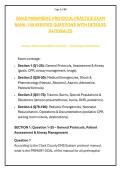
SNHD PARAMEDIC PROTOCOL PRACTICE EXAM
BANK: 100 VERIFIED QUESTIONS WITH DETAILED
RATIONALES
Emergency Medical Services (EMS) / Paramedicine / Pharmacology / Clinical Medicine
Exam coverage:
• Section 1 (Q1-25): General Protocols, Assessment & Airway
(goals, CPR, airway management, triage).
• Section 2 (Q26-50): Medical Emergencies, Shock &
Pharmacology (Narcan, Albuterol, Aspirin, Adenosine,
Parkland formula).
• Section 3 (Q51-75): Trauma, Burns, Special Populations &
Obstetrics (tension pneumothorax, burns, DNR, pediatrics).
• Section 4 (Q76-100): Pediatric Emergencies, Neonatal
Resuscitation, Operations & Documentation (pediatric CPR,
waiting room criteria, destinations).
SECTION 1: Question 1–25 – General Protocols, Patient
Assessment & Airway Management
Question 1
According to the Clark County EMS System protocol manual,
what is the PRIMARY GOAL of the manual for all prehospital
, Page 2 of 54
care providers and emergency department physicians?
A. To increase ambulance transport volumes to regional
hospitals.
B. To standardize prehospital patient care within the Clark
County EMS System.
C. To reduce the number of emergency department visits.
D. To prioritize paramedic safety over patient outcomes.
CORRECT ANSWER: B ✓
RATIONALE: The primary goal of the Clark County EMS protocol
manual is to standardize prehospital care for all providers
within the system, ensuring consistent, evidence-based
treatment across the county.
Question 2
A 45-year-old male is unresponsive with no palpable pulse.
Bystander CPR is in progress. According to the SNHD adult
cardiac arrest protocol for a witnessed arrest, what is the
paramedic's immediate priority upon arrival?
A. Attach the AED and analyze the rhythm.
B. Immediately begin high-quality CPR.
C. Establish intravenous access.
D. Administer epinephrine 1 mg IV push.
CORRECT ANSWER: B ✓
RATIONALE: For a witnessed cardiac arrest, the priority is to
, Page 3 of 54
immediately begin high-quality CPR with minimal interruptions.
The "pit crew" model emphasizes continuous, effective
compressions.
Question 3
A 6-year-old child is in cardiac arrest. According to SNHD
pediatric protocols, what is the correct compression-to-
ventilation ratio for a two-rescuer pediatric cardiac arrest?
A. 30:2
B. 15:2
C. 5:1
D. Continuous compressions with asynchronous ventilations
CORRECT ANSWER: B ✓
RATIONALE: The SNHD protocol specifies a 15:2 compression-
to-ventilation ratio for two-rescuer pediatric CPR. For single
rescuer, it is 30:2.
Question 4
Which of the following is an acceptable method of ventilating
and managing an airway if the patient's pulse oximetry can be
maintained above 90%?
A. Endotracheal intubation
, Page 4 of 54
B. Bag-valve-mask (BVM) ventilation
C. Supraglottic airway device
D. Continuous positive airway pressure (CPAP)
CORRECT ANSWER: B ✓
RATIONALE: According to SNHD protocols, BVM ventilation is
an acceptable method of ventilation and airway management if
SpO₂ can be maintained above 90%.
Question 5
According to SNHD protocols, which of the following patients is
considered a "pediatric patient"?
A. Any patient under 12 years of age.
B. Patients under 18 years of age AND patients who do not show
signs of puberty (including chest hair or underarm hair on males
and any breast development on females).
C. Any patient weighing less than 40 kg.
D. Patients under 15 years of age only.
CORRECT ANSWER: B ✓
RATIONALE: The SNHD protocol defines a pediatric patient as
those under 18 years AND those who have not yet developed
secondary sexual characteristics (pubertal signs).
SNHD PARAMEDIC PROTOCOL PRACTICE EXAM
BANK: 100 VERIFIED QUESTIONS WITH DETAILED
RATIONALES
Emergency Medical Services (EMS) / Paramedicine / Pharmacology / Clinical Medicine
Exam coverage:
• Section 1 (Q1-25): General Protocols, Assessment & Airway
(goals, CPR, airway management, triage).
• Section 2 (Q26-50): Medical Emergencies, Shock &
Pharmacology (Narcan, Albuterol, Aspirin, Adenosine,
Parkland formula).
• Section 3 (Q51-75): Trauma, Burns, Special Populations &
Obstetrics (tension pneumothorax, burns, DNR, pediatrics).
• Section 4 (Q76-100): Pediatric Emergencies, Neonatal
Resuscitation, Operations & Documentation (pediatric CPR,
waiting room criteria, destinations).
SECTION 1: Question 1–25 – General Protocols, Patient
Assessment & Airway Management
Question 1
According to the Clark County EMS System protocol manual,
what is the PRIMARY GOAL of the manual for all prehospital
, Page 2 of 54
care providers and emergency department physicians?
A. To increase ambulance transport volumes to regional
hospitals.
B. To standardize prehospital patient care within the Clark
County EMS System.
C. To reduce the number of emergency department visits.
D. To prioritize paramedic safety over patient outcomes.
CORRECT ANSWER: B ✓
RATIONALE: The primary goal of the Clark County EMS protocol
manual is to standardize prehospital care for all providers
within the system, ensuring consistent, evidence-based
treatment across the county.
Question 2
A 45-year-old male is unresponsive with no palpable pulse.
Bystander CPR is in progress. According to the SNHD adult
cardiac arrest protocol for a witnessed arrest, what is the
paramedic's immediate priority upon arrival?
A. Attach the AED and analyze the rhythm.
B. Immediately begin high-quality CPR.
C. Establish intravenous access.
D. Administer epinephrine 1 mg IV push.
CORRECT ANSWER: B ✓
RATIONALE: For a witnessed cardiac arrest, the priority is to
, Page 3 of 54
immediately begin high-quality CPR with minimal interruptions.
The "pit crew" model emphasizes continuous, effective
compressions.
Question 3
A 6-year-old child is in cardiac arrest. According to SNHD
pediatric protocols, what is the correct compression-to-
ventilation ratio for a two-rescuer pediatric cardiac arrest?
A. 30:2
B. 15:2
C. 5:1
D. Continuous compressions with asynchronous ventilations
CORRECT ANSWER: B ✓
RATIONALE: The SNHD protocol specifies a 15:2 compression-
to-ventilation ratio for two-rescuer pediatric CPR. For single
rescuer, it is 30:2.
Question 4
Which of the following is an acceptable method of ventilating
and managing an airway if the patient's pulse oximetry can be
maintained above 90%?
A. Endotracheal intubation
, Page 4 of 54
B. Bag-valve-mask (BVM) ventilation
C. Supraglottic airway device
D. Continuous positive airway pressure (CPAP)
CORRECT ANSWER: B ✓
RATIONALE: According to SNHD protocols, BVM ventilation is
an acceptable method of ventilation and airway management if
SpO₂ can be maintained above 90%.
Question 5
According to SNHD protocols, which of the following patients is
considered a "pediatric patient"?
A. Any patient under 12 years of age.
B. Patients under 18 years of age AND patients who do not show
signs of puberty (including chest hair or underarm hair on males
and any breast development on females).
C. Any patient weighing less than 40 kg.
D. Patients under 15 years of age only.
CORRECT ANSWER: B ✓
RATIONALE: The SNHD protocol defines a pediatric patient as
those under 18 years AND those who have not yet developed
secondary sexual characteristics (pubertal signs).