

PHYSICS
(Electric circuits and Electrostatics)
Electric circuits
Potential difference (V) ~ Work done per unit charge
V= Work ÷ Charge unit=Volts
Current (I)~ rate of flow of charge
I=Charge ÷ Time unit=Amps
Resistance (R)~ materials opposition to flow of electric current
Unit=Ohms
Ohms law
Current flowing through a conductor is directly proportional to the voltage across the
conductor if temperature is constant
V=IR
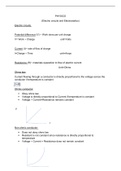
Ohmic conductor
Obey ohms law
Voltage is directly proportional to Current if temperature is constant
Voltage ÷ Current=Resistance remains constant
V
I
Non ohmic conductor
Does not obey ohms law
Resistant is not constant since resistance is directly proportional to
temperature
Voltage ÷ Current = Resistance does not remain constant
(Electric circuits and Electrostatics)
Electric circuits
Potential difference (V) ~ Work done per unit charge
V= Work ÷ Charge unit=Volts
Current (I)~ rate of flow of charge
I=Charge ÷ Time unit=Amps
Resistance (R)~ materials opposition to flow of electric current
Unit=Ohms
Ohms law
Current flowing through a conductor is directly proportional to the voltage across the
conductor if temperature is constant
V=IR
Ohmic conductor
Obey ohms law
Voltage is directly proportional to Current if temperature is constant
Voltage ÷ Current=Resistance remains constant
V
I
Non ohmic conductor
Does not obey ohms law
Resistant is not constant since resistance is directly proportional to
temperature
Voltage ÷ Current = Resistance does not remain constant


