
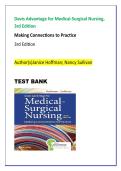
Davis Advantage for Medical-Surgical Nursing,
3rd Edition
Making Connections to Practice
3rd Edition
Author(s)Janice Hoffman; Nancy Sullivan
TEST BANK
,
,Question 1
A nurse begins caring for a newly admitted adult patient on a medical-
surgical unit. Which action best demonstrates patient-centered nursing
care?
A. Completing the admission assessment as quickly as possible to
remain on schedule
B. Using the patient's stated goals and preferences when developing the
plan of care
C. Following the unit's routine plan of care for all patients with the same
diagnosis
D. Asking the patient's family to make decisions because they know the
patient best
Correct Answer:
B. Using the patient's stated goals and preferences when developing the
plan of care
Rationale:
Patient-centered care incorporates the patient's values, preferences,
needs, and goals into clinical decisions. A relies on efficiency rather than
individualized care. C treats patients as though identical plans are
appropriate for everyone. D removes decision-making from a capable
patient rather than supporting autonomy.
Question 2
Which nursing action best reflects competent use of the nursing process
when caring for a patient with a new change in condition?
A. Administering the prescribed treatment immediately without
additional assessment
, B. Collecting relevant data before identifying the patient's nursing
problems
C. Waiting for the health care provider to determine the nursing
diagnosis
D. Selecting interventions before determining whether the patient has
unmet needs
Correct Answer:
B. Collecting relevant data before identifying the patient's nursing
problems
Rationale:
Assessment is the first step of the nursing process and provides the data
needed to identify patient problems accurately. A and D involve
intervention before adequate assessment. C is incorrect because
identifying nursing diagnoses is within the nurse's scope of practice.
Question 3
A medical-surgical nurse reviews a patient's blood pressure, pulse,
respiratory rate, oxygen saturation, pain level, and mental status. Which
action demonstrates clinical judgment?
A. Recording the findings without interpretation
B. Comparing the findings with expected patterns and determining their
significance
C. Reporting every finding to the provider regardless of significance
D. Documenting the findings at the end of the shift from memory
Correct Answer:
B. Comparing the findings with expected patterns and determining their
significance
3rd Edition
Making Connections to Practice
3rd Edition
Author(s)Janice Hoffman; Nancy Sullivan
TEST BANK
,
,Question 1
A nurse begins caring for a newly admitted adult patient on a medical-
surgical unit. Which action best demonstrates patient-centered nursing
care?
A. Completing the admission assessment as quickly as possible to
remain on schedule
B. Using the patient's stated goals and preferences when developing the
plan of care
C. Following the unit's routine plan of care for all patients with the same
diagnosis
D. Asking the patient's family to make decisions because they know the
patient best
Correct Answer:
B. Using the patient's stated goals and preferences when developing the
plan of care
Rationale:
Patient-centered care incorporates the patient's values, preferences,
needs, and goals into clinical decisions. A relies on efficiency rather than
individualized care. C treats patients as though identical plans are
appropriate for everyone. D removes decision-making from a capable
patient rather than supporting autonomy.
Question 2
Which nursing action best reflects competent use of the nursing process
when caring for a patient with a new change in condition?
A. Administering the prescribed treatment immediately without
additional assessment
, B. Collecting relevant data before identifying the patient's nursing
problems
C. Waiting for the health care provider to determine the nursing
diagnosis
D. Selecting interventions before determining whether the patient has
unmet needs
Correct Answer:
B. Collecting relevant data before identifying the patient's nursing
problems
Rationale:
Assessment is the first step of the nursing process and provides the data
needed to identify patient problems accurately. A and D involve
intervention before adequate assessment. C is incorrect because
identifying nursing diagnoses is within the nurse's scope of practice.
Question 3
A medical-surgical nurse reviews a patient's blood pressure, pulse,
respiratory rate, oxygen saturation, pain level, and mental status. Which
action demonstrates clinical judgment?
A. Recording the findings without interpretation
B. Comparing the findings with expected patterns and determining their
significance
C. Reporting every finding to the provider regardless of significance
D. Documenting the findings at the end of the shift from memory
Correct Answer:
B. Comparing the findings with expected patterns and determining their
significance



